Transmission dynamics of dengue–Zika co-infection with antibody-dependent enhancement, cross-immunity, and vaccination: backward bifurcation analysis and data calibration
Keywords:
Dengue–Zika co-infection, Antibody-dependent enhancement, Backward bifurcation, Dengue vaccination, Vector controlAbstract
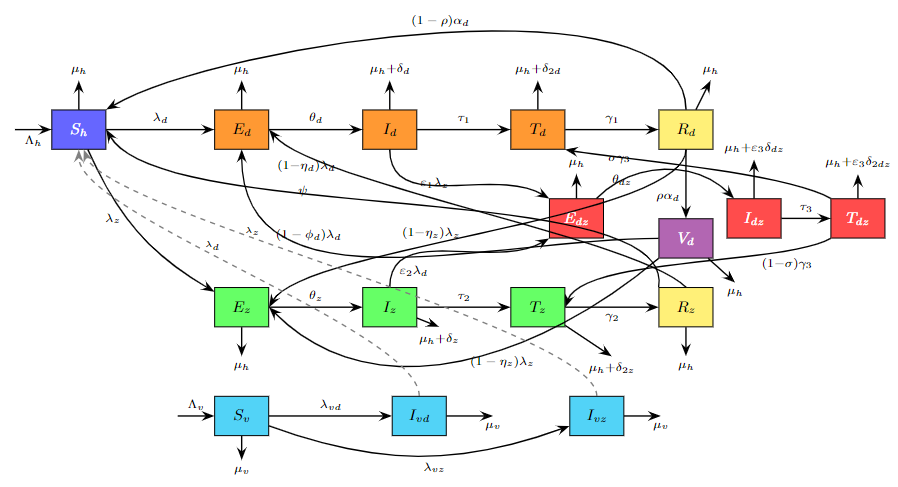
The co-circulation of dengue virus (DENV) and Zika virus (ZIKV) in Aedes aegypti-endemic regions creates a significantly more dangerous epidemiological landscape than either pathogen alone. Yet no existing model simultaneously incorporates antibody-dependent enhancement (ADE), dual Zika transmission routes, synergistic co-infection mortality, dengue vaccination, and calibration against confirmed co-endemic surveillance data. We address this gap by developing a sixteen-compartment deterministic model that captures ADE through susceptibility multipliers epsilon_1 and epsilon_2, partial cross-immunity, imperfect dengue vaccination, and both vector-borne and sexual Zika transmission. We derived the disease-free equilibrium and obtained closed-form expressions for the component reproduction numbers mathcal{R}_{0d} and mathcal{R}_{0z}. The overall reproduction number mathcal{R}_0 = rho(FV^{-1}), computed as the spectral radius of the 8 X 8 next-generation matrix, satisfies mathcal{R}_0 geq max{mathcal{R}_{0d}, mathcal{R}_{0z}}, with equality only when the linear cross-infection parameters beta_{z3}, beta_{vd2}, beta_{vz2} are zero. All co-infection effects, including ADE, are confined to the nonlinear regime. This confirms that single-disease models can systematically underestimate epidemic risk during co-circulation. Local asymptotic stability of the disease-free equilibrium when mathcal{R}_0 < 1, uniform persistence when mathcal{R}_0 > 1, and the existence of at least one endemic equilibrium are established. Centre manifold analysis reveals backward bifurcation in both submodels, implying that reducing \mathcal{R}_0 below unity is necessary but not sufficient for disease elimination. The model was calibrated using 36 weeks of SINAN surveillance data from Esp\'{i}rito Santo state, Brazil (January--September 2021), yielding key fitted parameters: b^* = 1.278~wk^{-1}, beta_d^* = 0.749, beta_{z2}^* = 0.161, beta_{vd1}^* = 0.118, and beta_{vz1}^* = 0.252, with Pearson correlations of r = 0.594 (dengue) and r = 0.739 (Zika). Sensitivity analysis identifies the mosquito biting rate b and vector mortality \mu_v as the dominant intervention targets. Simulations reveal super-linear amplification of co-infections with rising biting rates and a 120-fold suppression of peak dengue incidence when vector mortality doubles. These findings support an integrated control strategy in which sustained vector management is the most cost-effective lever, complemented by improved healthcare access and high-coverage dengue vaccination to mitigate ADE-driven amplification.
References
[1] W. Dejnirattisai, P. Supasa, W. Wongwiwat, A. Rouvinski, G. Barba-Spaeth, T. Duangchinda, A. Sakuntabhai, V.-M. Cao-Lormeau, P. Malasit, F. A. Rey, J. Mongkolsapaya & G. R. Screaton, ``Dengue virus sero-cross-reactivity drives antibody-dependent enhancement of infection with Zika virus,'' Nat. Immunol. 17 (2016) 1102. https://doi.org/10.1038/ni.3515.
[2] A. Lim, F. M. Shearer, K. Sewalk, D. M. Pigott, J. Clarke, A. Ghouse, C. Judge, H. Kang, J. P. Messina, M. U. G. Kraemer, K. A. M. Gaythorpe, W. M. de Souza, E. O. Nsoesie, M. Celone, N. Faria, S. J. Ryan, I. B. Rabe, D. P. Rojas, S. I. Hay, J. S. Brownstein, N. Golding & O. J. Brady, ``The overlapping global distribution of dengue, chikungunya, Zika and yellow fever,'' Nat. Commun. 16 (2025) 3418. https://doi.org/10.1038/s41467-025-58609-5.
[3] World Health Organization, ``Dengue and severe dengue,'' WHO Fact Sheet, 2025. Available online: https://www.who.int/news-room/fact-sheets/detail/dengue-and-severe-dengue.
[4] N. Haider, M. N. Hasan, J. Onyango & M. Asaduzzaman, ``Global landmark: 2023 marks the worst year for dengue cases with millions infected and thousands of deaths reported,'' IJID Reg. 13 (2024) 100459. https://doi.org/10.1016/j.ijregi.2024.100459.
[5] N. Haider, M. N. Hasan, J. Onyango, M. Billah, S. Khan, D. Papakonstantinou, P. Paudyal & M. Asaduzzaman, ``Global dengue epidemic worsens with record 14 million cases and 9000 deaths reported in 2024,'' Int. J. Infect. Dis. 158 (2025) 107940. https://doi.org/10.1016/j.ijid.2025.107940.
[6] eClinicalMedicine, ``Dengue as a growing global health concern,'' EClinicalMedicine 77 (2024) 102975. https://doi.org/10.1016/j.eclinm.2024.102975.
[7] W. X. Zhang, T. Y. Zhao, C. C. Wang, Y. He, H. Z. Lu, H. T. Zhang, L. M. Wang, M. Zhang, C. X. Li & S. Q. Deng, ``Assessing the global dengue burden: incidence, mortality & disability trends over three decades,'' PLoS Negl. Trop. Dis. 19 (2025) e0012932. https://doi.org/10.1371/journal.pntd.0012932.
[8] Pan American Health Organization / World Health Organization, ``Zika: a silent virus requiring enhanced surveillance and control,'' PAHO/WHO, Washington, DC, Sep. 2023. Available online: https://www.paho.org/en/news/1-9-2023-Zika-silent-virus-requiring-enhanced-surveillance-and-control.
[9] N. R. Faria, R. D. S. S. Azevedo, M. U. G. Kraemer, R. Souza, M. S. Cunha, S. C. Hill, J. Thézé, M. B. Bonsall, T. A. Bowden, I. Rissanen, I. M. Rocco, J. S. Nogueira, A. Y. Maeda, F. G. D. S. Vasami, F. L. L. Macedo, A. Suzuki, S. G. Rodrigues, A. C. R. Cruz, B. T. Nunes, D. B. A. Medeiros, D. S. G. Rodrigues, A. L. N. Queiroz, E. V. P. da Silva, D. F. Henriques, E. S. T. da Rosa, C. S. de Oliveira, L. C. Martins, H. B. Vasconcelos, L. M. N. Casseb, D. B. Simith, J. P. Messina, L. Abade, J. Lourenço, L. C. J. Alcantara, M. M. de Lima, M. Giovanetti, S. I. Hay, R. S. de Oliveira, P. D. S. Lemos, L. F. de Oliveira, C. P. S. de Lima, S. P. da Silva, J. M. de Vasconcelos, L. Franco, J. F. Cardoso, J. L. D. S. G. Vianez-Júnior, D. Mir, G. Bello, E. Delatorre, K. Khan, M. Creatore, G. E. Coelho, W. K. de Oliveira, R. Tesh, O. G. Pybus, M. R. T. Nunes & P. F. C. Vasconcelos, ``Zika virus in the Americas: early epidemiological and genetic findings,'' Science 352 (2016) 345. https://doi.org/10.1126/science.aaf5036.
[10] L. R. Petersen, D. J. Jamieson, A. M. Powers & M. A. Honein, ``Zika virus,'' N. Engl. J. Med. 374 (2016) 1552. https://doi.org/10.1056/NEJMra1602113.
[11] I. B. Rabe, S. L. Hills, J. M. Haussig, A. T. Walker, T. Dos Santos, J. L. San Martin, G. Gutierrez, J. Mendez-Rico, J. C. Rodriguez, D. Elizondo-Lopez, G. Gonzalez-Escobar, E. Chanda, S. M. Al Eryani, C. Kodama, A. Yajima, M. Kakkar, M. Kato, P. R. Wijesinghe, S. Samaraweera, H. Brindle, H. Tissera, J. Kelley, E. Lackritz & D. P. Rojas, ``A review of the recent epidemiology of Zika virus infection,'' Am. J. Trop. Med. Hyg. 112 (2025) 1026. https://doi.org/10.4269/ajtmh.24-0420.
[12] World Health Organization, ``Zika epidemiology update -- May 2024,'' WHO Publications, Geneva, Switzerland, 2024. Available online: https://www.who.int/publications/m/item/Zika-epidemiology-update-may-2024.
[13] P. M. Saba Villarroel, R. Hamel, N. Gumpangseth, S. Yainoy, P. Koomhin, D. Missé & S. Wichit, ``Global seroprevalence of Zika virus in asymptomatic individuals: a systematic review,'' PLoS Negl. Trop. Dis. 18 (2024) e0011842. https://doi.org/10.1371/journal.pntd.0011842.
[14] J. M. Pescarini, M. Rodrigues, E. S. Paixão, L. Cardim, C. A. A. de Brito, M. da C. N. Costa, A. C. Santos, L. Smeeth, M. da G. Teixeira, A. P. F. de Souza, M. L. Barreto & E. B. Brickley, ``Dengue, Zika & chikungunya viral circulation and hospitalization rates in Brazil from 2014 to 2019: an ecological study,'' PLoS Negl. Trop. Dis. 16 (2022) e0010602. https://doi.org/10.1371/journal.pntd.0010602.
[15] F. Pinotti, M. Giovanetti, M. M. de Lima, E. M. de Cerqueira, L. C. J. Alcantara, S. Gupta, M. Recker & J. Lourenco, ``Shifting patterns of dengue three years after Zika virus emergence in Brazil,'' Nat. Commun. 15 (2024) 632. https://doi.org/10.1038/s41467-024-44799-x.
[16] J. V. Zambrana, C. M. Hasund, R. A. Aogo, S. Bos, S. Arguello, K. Gonzalez, D. Collado, T. Miranda, G. Kuan, A. Gordon, A. Balmaseda, L. Katzelnick & E. Harris, ``Primary exposure to Zika virus is linked with increased risk of symptomatic dengue virus infection with serotypes 2, 3 & 4, but not 1,'' Sci. Transl. Med. 16 (2024) eadn2199. https://doi.org/10.1126/scitranslmed.adn2199.
[17] L. C. Katzelnick, L. Gresh, M. E. Halloran, J. C. Mercado, G. Kuan, A. Gordon, A. Balmaseda & E. Harris, ``Antibody-dependent enhancement of severe dengue disease in humans,'' Science 358 (2017) 929. https://doi.org/10.1126/science.aan6836.
[18] R. Khandia, A. Munjal, K. Dhama, K. Karthik, R. Tiwari, Y. S. Malik, R. K. Singh & W. Chaicumpa, ``Modulation of dengue/Zika virus pathogenicity by antibody-dependent enhancement and strategies to protect against enhancement in Zika virus infection,'' Front. Immunol. 9 (2018) 597. https://doi.org/10.3389/fimmu.2018.00597.
[19] A. Sarker, N. Dhama & R. D. Gupta, ``Dengue virus neutralizing antibody: a review of targets, cross-reactivity & antibody-dependent enhancement,'' Front. Immunol. 14 (2023) 1200195. https://doi.org/10.3389/fimmu.2023.1200195.
[20] P. M. S. Castanha, G. Erdos, S. C. Watkins, L. D. Falo Jr., E. T. A. Marques & S. M. Barratt-Boyes, ``Reciprocal immune enhancement of dengue and Zika virus infection in human skin,'' JCI Insight 5 (2020) e133653. https://doi.org/10.1172/jci.insight.133653.
[21] B. Tang, Y. Xiao, B. Sander, M. A. Kulkarni, RADAM-LAC Research Team & J. Wu, ``Modelling the impact of antibody-dependent enhancement on disease severity of Zika virus and dengue virus sequential and co-infection,'' R. Soc. Open Sci. 7 (2020) 191749. https://doi.org/10.1098/rsos.191749.
[22] J. P. Romero-Leiton, E. K. E. Laison, R. Alfaro, E. J. Parmley, J. Arino, K. R. Acharya & B. Nasri, ``Exploring Zika's dynamics: a scoping review journey from epidemic to equations through mathematical modelling,'' Infect. Dis. Model. 10 (2025) 536. https://doi.org/10.1016/j.idm.2024.12.016.
[23] S. T. Ogunlade, M. T. Meehan, A. I. Adekunle & E. S. McBryde, ``A systematic review of mathematical models of dengue transmission and vector control: 2010--2020,'' Viruses 15 (2023) 254. https://doi.org/10.3390/v15010254.
[24] M. Aguiar, V. Anam, K. B. Blyuss, C. D. S. Estadilla, B. V. Guerrero, D. Knopoff, B. W. Kooi, A. K. Srivastav, V. Steindorf & N. Stollenwerk, ``Mathematical models for dengue fever epidemiology: a 10-year systematic review,'' Phys. Life Rev. 40 (2022) 65. https://doi.org/10.1016/j.plrev.2022.02.001.
[25] S. M. Garba, A. B. Gumel & M. R. Abu Bakar, ``Backward bifurcations in dengue transmission dynamics,'' Math. Biosci. 215 (2008) 11. https://doi.org/10.1016/j.mbs.2008.05.002.
[26] A. Abidemi & N. A. B. Aziz, ``Analysis of deterministic models for dengue disease transmission dynamics with vaccination perspective in Johor, Malaysia,'' Int. J. Appl. Comput. Math. 8 (2022) 45. https://doi.org/10.1007/s40819-022-01250-3.
[27] J. Ren & R. Xu, ``Dynamic analysis and application of a dengue transmission model with vaccination and incubation delays,'' J. Appl. Math. Comput. 69 (2023) 895. https://doi.org/10.1007/s12190-022-01776-1.
[28] A. B. Gumel, ``Causes of backward bifurcations in some epidemiological models,'' J. Math. Anal. Appl. 395 (2012) 355. https://doi.org/10.1016/j.jmaa.2012.04.077.
[29] D. Gao, Y. Lou, D. He, T. C. Porco, Y. Kuang, G. Chowell & S. Ruan, ``Prevention and control of Zika as a mosquito-borne and sexually transmitted disease: a mathematical modelling analysis,'' Sci. Rep. 6 (2016) 28070. https://doi.org/10.1038/srep28070.
[30] O. Maxian, A. Neufeld, E. J. Talis, L. M. Childs & J. C. Blackwood, ``Zika virus dynamics: when does sexual transmission matter?'' Epidemics 21 (2017) 48. https://doi.org/10.1016/j.epidem.2017.06.003.
[31] S. Towers, F. Brauer, C. Castillo-Chavez, A. K. I. Falconar, A. Mubayi & C. M. E. Romero-Vivas, ``Estimate of the reproduction number of the 2015 Zika virus outbreak in Barranquilla, Colombia & estimation of the relative role of sexual transmission,'' Epidemics 17 (2016) 50. https://doi.org/10.1016/j.epidem.2016.10.003.
[32] L. Wang & H. Zhao, ``Dynamics analysis of a Zika--dengue co-infection model with dengue vaccine and antibody-dependent enhancement,'' Physica A 522 (2019) 248. https://doi.org/10.1016/j.physa.2019.01.099.
[33] S. A. Jose, R. Raja, B. I. Omede, R. P. Agarwal, J. Alzabut, J. Cao & V. E. Balas, ``Mathematical modelling on co-infection: transmission dynamics of Zika virus and dengue fever,'' Nonlinear Dyn. 111 (2023) 4879. https://doi.org/10.1007/s11071-022-08063-5.
[34] A. Omame, M. E. Isah & M. Abbas, ``An optimal control model for COVID-19, Zika, dengue & chikungunya co-dynamics with reinfection,'' Optim. Control Appl. Methods 44 (2023) 170. https://doi.org/10.1002/oca.2936.
[35] S. A. Ayuba, I. Akeyede & A. S. Olagunju, ``Stability and sensitivity analysis of dengue-malaria co-infection model in endemic stage,'' J. Nig. Soc. Phys. Sci. 3 (2021) 96. https://doi.org/10.46481/jnsps.2021.196.
[36] F. A. Oguntolu, O. J. Peter, O. Babasola, B. I. Omede, G. B. Balogun, A. A. Victor & A. I. Abioye, ``Mathematical modelling on the dynamics of dengue fever with vaccination and transovarial transmission with real statistical data,'' Qual. Quant. 60 (2026) 6327. https://doi.org/10.1007/s11135-025-02527-7.
[37] A. Abidemi & O. J. Peter, ``Host-vector dynamics of dengue with asymptomatic, isolation and vigilant compartments: insights from modelling,'' Eur. Phys. J. Plus 138 (2023) 199. https://doi.org/10.1140/epjp/s13360-023-03823-7.
[38] A. Abidemi, Fatmawati & O. J. Peter, ``An optimal control model for dengue dynamics with asymptomatic, isolation & vigilant compartments,'' Decis. Anal. J. 10 (2024) 100413. https://doi.org/10.1016/j.dajour.2024.100413.
[39] F. F. Herdicho, Fatmawati, C. Alfiniyah, F. P. Fajrin, E. Bonyah, M. A. Rois & O. J. Peter, ``Modelling the dynamics of dengue transmission with awareness and optimal control analysis,'' PLoS ONE 20 (2025) e0322702. https://doi.org/10.1371/journal.pone.0322702.
[40] P. van den Driessche & J. Watmough, ``Reproduction numbers and subthreshold endemic equilibria for compartmental models of disease transmission,'' Math. Biosci. 180 (2002) 29. https://doi.org/10.1016/S0025-5564(02)00108-6.
[41] C. Castillo-Chavez & B. Song, ``Dynamical models of tuberculosis and their applications,'' Math. Biosci. Eng. 1 (2004) 361. https://doi.org/10.3934/mbe.2004.1.361.
[42] Governo ES, ``Sesa divulga 36$^{circ}$ boletim da dengue, Zika e chikungunya,'' Governo do Estado do Espírito Santo, Sep. 16, 2021. Available online: https://www.es.gov.br/Noticia/sesa-divulga-36-boletim-da-dengue--Zika-e-chikungunya.
[43] Brazilian Institute of Geography & Statistics (IBGE), ``Estimativas da população residente nos municípios do Brasil,'' Technical report, IBGE, Brasília, Brazil, 2021. Available online: https://www.ibge.gov.br/estatisticas/sociais/populacao/9103-estimativas-de-populacao.html?edicao=31451&t=custom-data-edicao.
[44] World Health Organization, ``World health statistics 2021: monitoring health for the SDGs, sustainable development goals,'' World Health Organization, Geneva, Switzerland, 2021. Available online: https://www.who.int/publications/i/item/9789240027053.
[45] R. Taghikhani & A. B. Gumel, ``Mathematics of dengue transmission dynamics: roles of vector vertical transmission and temperature fluctuations,'' Infect. Dis. Model. 3 (2018) 266. https://doi.org/10.1016/j.idm.2018.09.003.
[46] P. Reiter, ``Climate change and mosquito-borne disease,'' Environ. Health Perspect. 109 (2001) 141. https://pubmed.ncbi.nlm.nih.gov/11250812/.
[47] O. J. Brady, M. A. Johansson, C. A. Guerra, S. Bhatt, N. Golding, D. J. Pigott, H. Delatte, M. G. Grech, P. T. Leisnham, R. Maciel-de-Freitas, L. M. Styer, D. L. Smith, T. W. Scott, P. W. Gething & S. I. Hay, ``Modelling adult Aedes aegypti and Aedes albopictus survival at different temperatures in laboratory and field settings,'' Parasit. Vectors 6 (2013) 351. https://doi.org/10.1186/1756-3305-6-351.
[48] D. J. Gubler, ``Dengue and dengue hemorrhagic fever,'' Clin. Microbiol. Rev. 11 (1998) 480. https://doi.org/10.1128/CMR.11.3.480.
[49] World Health Organization, ``Dengue: guidelines for diagnosis, treatment, prevention and control,'' World Health Organization, Geneva, Switzerland, 2009. Available online: https://www.who.int/publications/i/item/9789241547871.
[50] D. S. Shepard, J. A. Suaya, S. B. Halstead, M. B. Nathan, D. J. Gubler, R. T. Mahoney, D. N. C. Wang & M. I. Meltzer, ``Cost-effectiveness of a pediatric dengue vaccine,'' Vaccine 22 (2004) 1275. https://doi.org/10.1016/j.vaccine.2003.09.019.
[51] S. B. Halstead, ``Dengue fever/dengue hemorrhagic fever,'' in Tropical Infectious Diseases: Principles, Pathogens and Practice, R. L. Guerrant, D. H. Walker & P. F. Weller, Eds., Elsevier, Philadelphia, PA, USA, 2007, pp. 800-810.
[52] S. B. Halstead, ``Dengue,'' Lancet 370 (2007) 1644. https://doi.org/10.1016/S0140-6736(07)61687-0.
[53] H. J. Wearing & P. Rohani, ``Ecological and immunological determinants of dengue epidemics,'' Proc. Natl. Acad. Sci. U.S.A. 103 (2006) 11802. https://doi.org/10.1073/pnas.0602960103.
[54] T. M. Aliota, D. M. Dudley, C. M. Newman, E. L. Mohr, D. D. Gellerup, M. E. Breitbach, C. R. Buechler, M. N. Rasheed, M. S. Mohns, A. M. Weiler, G. L. Barry, K. L. Weisgrau, J. A. Eudailey, E. G. Rakasz, L. J. Vosler, J. Post, S. Capuano, T. G. Golos, S. R. Permar, J. E. Osorio, T. C. Friedrich, S. L. O'Connor & D. H. O'Connor, ``Heterologous protection against Asian Zika virus challenge in rhesus macaques,'' PLoS Negl. Trop. Dis. 10 (2016) e0005168. https://doi.org/10.1371/journal.pntd.0005168.
[55] S. Sridhar, A. Luedtke, E. Langevin, M. Cot, L. Guy, B. Descamps, S. Dayan, L. Crevat & M. T. Thomas, ``Effect of dengue serostatus on dengue vaccine safety and efficacy,'' N. Engl. J. Med. 379 (2018) 327. https://doi.org/10.1056/NEJMoa1800820.
[56] S. R. Hadinegoro, J. L. Arredondo-Garcia, M. R. Capeding, C. Deseda, T. Chotpitayasunondh, R. Dietze, H. I. H. Ismail, H. Reynales, K. Limkittikul, D. M. Rivera-Medina, H. N. Tran, A. Bouckenooghe, D. Chansinharaj, G. Horvath, C. Kelly, A. Langevin, M. Laot, Y. Lombart, F. Méréau, J. Noriega, T. P. Nga, S. B. Tornieporth & M. C. Wartel, ``Efficacy and long-term safety of a dengue vaccine in regions of endemic disease,'' N. Engl. J. Med. 373 (2015) 1195. https://doi.org/10.1056/NEJMoa1506223.
[57] N. Chitnis, J. M. Hyman & J. M. Cushing, ``Determining important parameters in the spread of malaria through the sensitivity analysis of a mathematical model,'' Bull. Math. Biol. 70 (2008) 1272. https://doi.org/10.1007/s11538-008-9299-0.
[58] O. Olawoyin & C. Kribs, ``Effects of multiple transmission pathways on Zika dynamics,'' Infect. Dis. Model. 3 (2018) 331. https://doi.org/10.1016/j.idm.2018.11.003.
[59] H. McCallum, N. Barlow & J. Hone, ``How should pathogen transmission be modelled?'' Trends Ecol. Evol. 16 (2001) 295. https://doi.org/10.1016/S0169-5347(01)02144-9.
[60] O. Diekmann, J. A. Heesterbeek & M. G. Roberts, ``The construction of next-generation matrices for compartmental epidemic models,'' J. R. Soc. Interface 7 (2010) 873. https://doi.org/10.1098/rsif.2009.0386.
[61] H. R. Thieme, Mathematics in Population Biology, Princeton University Press, Princeton, NJ, USA, 2003. https://doi.org/10.1515/9780691187655.
[62] C. Castillo-Chavez, Z. Feng & W. Huang, ``On the computation of $mathcal{R}_0$ and its role in global stability,'' in Mathematical Approaches for Emerging and Reemerging Infectious Diseases: An Introduction, C. Castillo-Chavez, S. Blower, P. van den Driessche, D. Kirschner & A.-A. Yakubu (Eds.), Springer, New York, NY, USA, 2002, pp. 229--250. https://doi.org/10.1007/978-1-4757-3667-0_13.
[63] E. A. Undurraga, Y. A. Halasa & D. S. Shepard, ``Use of expansion factors to estimate the burden of dengue in Southeast Asia: a systematic analysis,'' PLoS Negl. Trop. Dis. 7 (2013) e2056. https://doi.org/10.1371/journal.pntd.0002056.
[64] M. M. O. Silva, M. S. Rodrigues, I. A. D. Paploski, M. Kikuti, A. M. S. Kasper, C. S. Cruz, J. J. A. G. Donanzan, R. Rego Fereira, G. S. Campos, S. I. Sardi, U. Kitron, G. A. Reis & M. G. Ribeiro, ``Accuracy of dengue reporting by national surveillance system, Brazil,'' Emerg. Infect. Dis. 22 (2016) 336. https://doi.org/10.3201/eid2202.150495.
[65] E. M. Netto, A. R. Almeida, A. T. Carvalho, M. S. Rodrigues, I. A. D. Paploski, M. Kikuti, M. G. Ribeiro, D. M. Kitron, G. A. Reis & M. G. Queiroz, ``High Zika virus seroprevalence in Salvador, northeastern Brazil limits the potential for further outbreaks,'' mBio 8 (2017) e01390-17. https://doi.org/10.1128/mBio.01390-17.
[66] E. C. Duru, M. C. Anyanwu, T. N. Nnamani, C. N. Nwosu & G. C. E. Mbah, ``Semi-analytical solution and numerical simulations of a co-infection model of malaria and Zika virus disease,'' J. Nig. Soc. Phys. Sci. 7 (2025) 2436. https://doi.org/10.46481/jnsps.2025.2436.
Published
How to Cite
Issue
Section
Copyright (c) 2026 Thomas U. Onoja, Benson A. E. Afere, Ayodele Gabriel Fasanya, Sunday Yomi, Bolarinwa Bolaji (Author)

This work is licensed under a Creative Commons Attribution 4.0 International License.