Heavy metal contamination assessment of the Taloka and Wurno aquifers, Sokoto Basin, northwestern Nigeria
Keywords:
Sokoto Basin, Aquifers, Hydrogeochemistry, Heavy metals, Contamination degreeAbstract
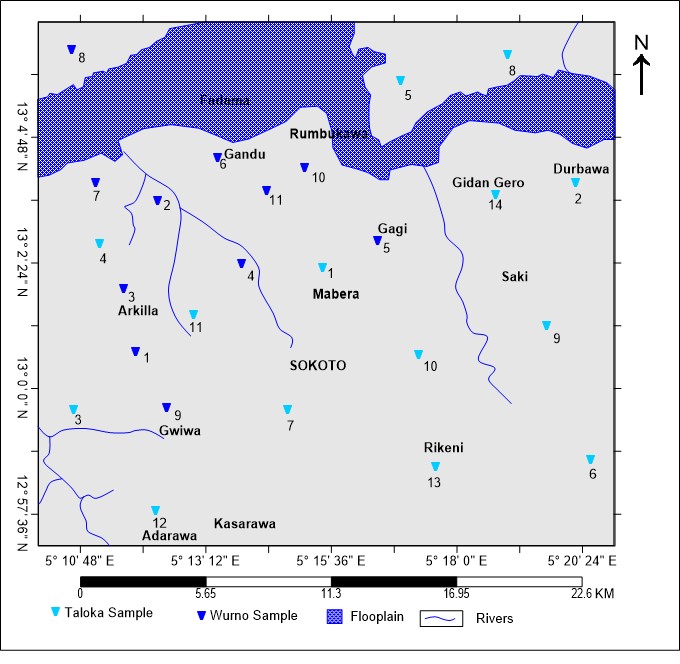
A comprehensive heavy metal pollution assessment of the Taloka and Wurno aquifers within the Sokoto Basin, northwestern Nigeria, was carried out. Field mapping, borehole logging and water quality analysis were integrated to describe the distribution of heavy metals in groundwater. Heavy metal evaluation points to variations between the Taloka and Wurno aquifers. A plausible hypothesis is that the dissolution of iron-rich lithologies in the Taloka aquifer contributes to the elevated iron (Fe) concentrations observed in the Taloka Formation. In contrast, redox reactions involving organic-rich shales and limestones of the overlying Dange Formation may contribute to the relatively higher concentrations of potentially toxic metals, particularly lead (Pb) and arsenic (As), observed in the Wurno Formation. The Wurno aquifer is also more vulnerable to surface contamination due to its shallower stratigraphic position. The concentrations of As and Pb in a substantial number of groundwater samples from both aquifers exceed the World Health Organization (WHO) safe limits for heavy metals in drinking water. The findings indicate a possible combined geogenic and anthropogenic influence on groundwater quality in both aquifers and highlight the need for continuous groundwater monitoring, targeted water treatment interventions and sustainable aquifer management strategies.
References
[1] H. Ibrahim, U. Z. Faruq, I. H. Adamu, H. Hamza & H. G. Mohammed, ``High-resolution sequence stratigraphy of the Maastrichtian-Paleocene succession in the Sokoto Basin'', Arabian Journal of Geosciences 17 (2024) 54. https://doi.org/10.1007/s12517-023-11829-9.
[2] C. S. Nwajide, Geology of Nigeria's Sedimentary Basins, CSS Bookshop Limited, Lagos, Nigeria, 2013. https://books.google.com/books/about/Geology_of_Nigeria_s_Sedimentary_Basins.html?id=NTmzzQEACAAJ.
[3] H. R. Anderson & W. Ogilbee, Aquifers in the Sokoto Basin, northwestern Nigeria, with a description of the general hydrogeology of the region, U.S. Geological Survey Water-Supply Paper 1757-L, 1973. https://doi.org/10.3133/wsp1757L.
[4] B. Aliyu, ``Geology occurrence and uses of limestone deposit in Kalambaina Formation Sokoto Basin, northwestern Nigeria'', Advanced Research Journal 3 (2025) 35. https://doi.org/10.71350/3062192525.
[5] C. A. Kogbe, ``Cretaceous and Tertiary of the Iullemmeden Basin in Nigeria (West Africa)'', Cretaceous Research 2 (1981) 129. https://doi.org/10.1016/0195-6671(81)90007-0.
[6] T. A. Adagunodo & A. I. Ojoawo, ``A short review on fluoride and arsenic constituents in Nigerian groundwater networks: causes, effects and suggested removal methods'', Journal of Advanced Zoology 44 (2023) 230. https://doi.org/10.17762/jaz.v44i4.1762.
[7] V. F. Sanga, C. Fabian & F. Kimbokota, ``Heavy metal pollution in leachates and its impacts on the quality of groundwater resources around Iringa municipal solid waste dumpsite'', Environmental Science and Pollution Research 30 (2023) 8110. https://doi.org/10.1007/s11356-022-22760-z.
[8] J. Nyirenda & P. M. Mwansa, ``Impact of leachate on quality of ground water around Chunga Landfill, Lusaka, Zambia and possible health risks'', Heliyon 8 (2022) e12321. https://doi.org/10.1016/j.heliyon.2022.e12321.
[9] S. U. Wali, N. B. Alias, S. B. Harun, K. J. Umar, M. A. Gada, I. M. Dankani, I. U. Kaoje, & A. A. Usman, ``Water quality indices and multivariate statistical analysis of urban groundwater in semi-arid Sokoto Basin, northwestern Nigeria'', Groundwater for Sustainable Development 18 (2022) 100779. https://doi.org/10.1016/j.gsd.2022.100779.
[10] S. U. Wali, N. Alias & S. B. Harun, ``Hydrogeochemical evaluation and mechanisms controlling groundwater in different geologic environments, western Sokoto Basin, northwestern Nigeria'', SN Applied Sciences 2 (2020) 1808. https://doi.org/10.1007/s42452-020-03589-y.
[11] H. A. Ibrahim, M. Abdulkarim, H. M. Grema, I. M. Abdullahi & H. Hamidu, ``Physico-chemical assessment of water quality in the Gidan Gulbi shallow floodplain aquifer, northwestern Nigeria'', American Journal of Water Resources 8 (2020) 155. https://www.researchgate.net/publication/343189481_PhysicoChemical_Assessment_of_Water_Quality_in_the_Gidan_Gulbi_Shallow_Floodplain_Aquifer_Northwestern_Nigeria.
[12] T. Yahaya, E. Oladele, T. Salisu, E. Orji, Z. Zakari, U. U. Liman, C. B. Gomo & M. Abdullahi, ``Toxic metals in cement induced hematological and DNA damage as well as carcinogenesis in occupationally-exposed block-factory workers in Lagos, Nigeria'', Egyptian Journal of Basic and Applied Sciences 9 (2022) 499. https://doi.org/10.1080/2314808X.2022.2106097.
[13] T. A. Adagunodo, A. A. Aremu, O. G. Bayowa, A. I. Ojoawo, A. O. Adewoye & T. E. Olonade, ``Assessment and health effects of radon and its relation with some parameters in groundwater sources from shallow aquifers in granitic terrains, southeastern axis of Ibadan, Nigeria'', Groundwater for Sustainable Development 21 (2023) 100930. https://doi.org/10.1016/j.gsd.2023.100930.
[14] A. O. Adewoye, T. T. Ajibade, S. O. Adewoye, T. E. Olagunju & T. A. Adagunodo, ``Pollution indices and health risk assessment of heavy metals in floodplain of urban catchment of Asa drainage systems, southwestern Nigeria'', IOP Conference Series: Earth and Environmental Science 655 (2021) 012091. https://doi.org/10.1088/1755-1315/655/1/012091.
[15] T. A. Adagunodo, A. I. Ojoawo, J. O. Omidiora, P. O. Isibor, W. O. Raji & R. A. Ogundiya, ``Heavy metal contamination and risk assessments from varying agricultural sites'', in Recent Research on Environmental Earth Sciences, Geomorphology, Soil Science, Paleoclimate, and Karst, A. Çiner et al. (Eds.), Springer Nature, Cham, Switzerland, 2026, pp. 449--453. https://doi.org/10.1007/978-3-032-20990-0_86.
[16] S. O. Adewoye, V. O. Adenigba, A. O. Adewoye & T. A. Adagunodo, ``Bioremediation of heavy metals from pharmaceutical industry sewages using bimetallic nanoparticles of Eichorniacrassipes'', IOP Conference Series: Earth and Environmental Science 655 (2021) 012021. https://doi.org/10.1088/1755-1315/655/1/012021.
[17] A. A. Abubakar & I. M. Arzika, ``Heavy metal levels in tomatoes from Fadama area near BUA Cement PLC Sokoto, northwest Nigeria'', Asian Journal of Biological Sciences 17 (2024) 121. https://doi.org/10.3923/ajbs.2024.121.127.
[18] E. E. Effiong, S. A. Ngah, T. K. S. Abam & I. U. Ubong, ``Physicochemical analysis of samples of water for drinking and sanitary purposes in selected schools in parts of Rivers State, Nigeria'', Environmental Contaminants Reviews 5 (2022) 72. https://doi.org/10.26480/ecr.02.2022.72.77.
[19] O. O. Falowo & M. P. Otuaga, ``A geo-environmental impact assessment of abattoir effluent discharge on groundwater quality in Igoba area of Ondo State, Nigeria'', Indonesian Journal of Earth Sciences 2 (2022) 110. https://doi.org/10.52562/injoes.v2i2.393.
[20] N. M. Waziri & J. E. Andrews, ``In vitro bioaccessibility of lead in artisanal mining contaminated soils and sediments from the Anka area, NW Nigeria'', Earth Science Research 3 (2014) 1. https://doi.org/10.5539/esr.v3n1p1.
[21] American Public Health Association, American Water Works Association & Water Environment Federation, Standard Methods for the Examination of Water and Wastewater, 20th ed., American Public Health Association, Washington, DC, USA, 1998. https://books.google.com/books?id=pv5PAQAAIAAJ.
[22] L. Haa kanson, ``An ecological risk index for aquatic pollution control: a sedimentological approach'', Water Research 14 (1980) 975. https://doi.org/10.1016/0043-1354(80)90143-8.
[23] G. M. S. Abrahim & R. J. Parker, ``Assessment of heavy metal enrichment factors and degree of contamination in marine sediments from Tamaki Estuary, Auckland, New Zealand'', Environmental Monitoring and Assessment 136 (2008) 227. https://doi.org/10.1007/s10661-007-9678-2.
[24] World Health Organization, Guidelines for Drinking-water Quality, 4th ed., World Health Organization, Geneva, Switzerland, 2011. https://iris.who.int/handle/10665/44584.
[25] S. U. Wali, N. B. Alias, A. A. Usman, A. Umar, N. Muhammad, I. U. Kaoje, B. Samaila, B. Aliyu, H. M. Ladan, M. Atiku & S. Ibrahim, ``Hydrochemical characterization and seasonal variability of shallow groundwater in the Sokoto Basin, northern Nigeria: rock weathering as a dominant control factor'', Discover Geoscience 3 (2025) 122. https://doi.org/10.1007/s44288-025-00228-0.
[26] A. N. Amadi, T. Aminu, I. A. Okunlola, P. I. Olasehinde & M. O. Jimoh, ``Lithologic influence on the hydrogeochemical characteristics of groundwater in Zango, northwest Nigeria'', Natural Resources and Conservation 3 (2015) 11. https://doi.org/10.13189/nrc.2015.030103.
[27] I. Saidu, N. Muhammed, A. Y. Zubairu & E. C. Effiong, ``Microbiological and physicochemical quality of groundwater sources in Wamakko, Nigeria'', Global Academic Journal of Agriculture and Biosciences 6 (2024) 65. https://doi.org/10.36348/gajab.2024.v06i03.003.
[28] S. Salihu & N. B. Muhammad, ``Heavy metal and physicochemical analysis of well water from selected areas in Wamakko community, Sokoto State, Nigeria'', Asian Journal of Geological Research 3 (2020) 125. https://journalajoger.com/index.php/AJOGER/article/view/99.
[29] M. M. Islam, M. R. Karim, X. Zheng & X. Li, ``Heavy metal and metalloid pollution of soil, water and foods in Bangladesh: a critical review'', International Journal of Environmental Research and Public Health 15 (2018) 2825. https://doi.org/10.3390/ijerph15122825.
[30] T. O. Ale & T. H. T. Ogunribido, ``Pollution status of drinking water sources proximal to dumpsites: insights from diverse geo-environmental settings in Nigeria'', Arabian Journal of Geosciences 17 (2024) 312. https://doi.org/10.1007/s12517-024-12116-x.
Published
How to Cite
Issue
Section
Copyright (c) 2027 H. A. Ibrahim, A. N. Amadi, N. M. Waziri, O. P. Abioye (Author)

This work is licensed under a Creative Commons Attribution 4.0 International License.