A mathematical model of cybercrime contagion: impact ofemployment on youth offending
Keywords:
Cybercrime, Unemployment, Mathematical model, Sensitivity analysis, Numerical simulationsAbstract
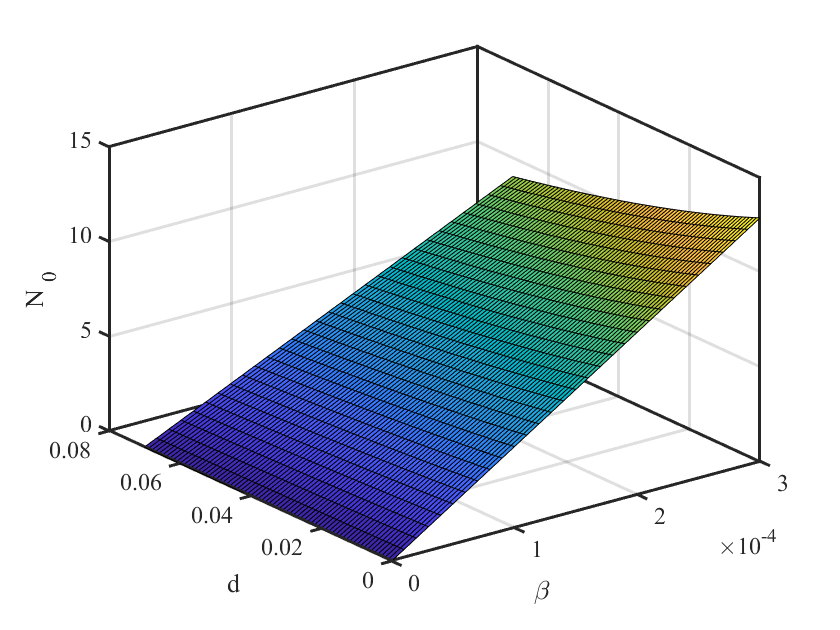
The growing incidence of youth cybercrime, driven by unemployment and the precarity of temporary employment, constitutes a major social crisis that has received limited mathematical analysis. This study develops a deterministic four-compartment UCTR model comprising unemployed (U), cybercriminal (C), temporarily employed (T), and regularly employed (R) youth populations to examine interactions among unemployment, temporary employment, stable employment, and illicit digital activity. Using the next-generation matrix, we derive the cybercrime generation number, N0, and establish that the cybercrime-free equilibrium is globally stable when N0 < 1. Global sensitivity analysis based on Latin hypercube sampling (LHS) and partial rank correlation coefficients (PRCCs) identifies peer influence and recruitment into cybercrime from temporary employment as the strongest drivers of cybercrime. Conversely, transition to stable employment and legal prosecution are the principal deterrents. Numerical simulations show that high job-loss rates and continued entry into temporary employment sustain the cybercriminal population, whereas consistent transition to permanent employment substantially reduces cybercrime over time. These findings indicate that cybercrime control requires structural policies that strengthen long-term employment security rather than short-term interventions that do not provide sustained socioeconomic stability.
Published
How to Cite
Issue
Section
Copyright (c) 2026 Chinwendu Emilian Madubueze, Kazeem A. Tijani, Elijah Iji Ajogi, Madumelu H. C. Madubueze (Author)

This work is licensed under a Creative Commons Attribution 4.0 International License.
How to Cite
Similar Articles
- Shah Zeb, Awais Ahmad, Rizwana Kausar, Siti Ainor Mohd Yatim, Nurulhuda Ramli, Muhammad Rafiq, Evaluating lung cancer control through a time-delay mathematical model with detailed sensitivity analysis , Journal of the Nigerian Society of Physical Sciences: Volume 8, Issue 3, August 2026 (In Progress)
- Kazeem A. Tijani, Chinwendu. E. Madubueze, Isaac O. Onwubuya, Nkiruka Maria-Assumpta Akabuike, John Olajide Akanni, Mathematical modelling of the dynamical system of military population, focusing on the impact of welfare , Journal of the Nigerian Society of Physical Sciences: Volume 7, Issue 4, November 2025
- Kabiru Lere Najib, Adamu Shitu Hassan, Food and environmental degradation as causative agents of honey bee colonies decline: Mathematical model approach , Journal of the Nigerian Society of Physical Sciences: Volume 3, Issue 4, November 2021
- Kazeem A. Tijani, Chinwendu E. Madubueze, Reuben I. Gweryina, Terhemen Aboiyar, Mathematical modelling and optimal-control strategies of schistosomiasis–typhoid fever co-infection: using the demographic setting of Makurdi, Benue State, Nigeria , Journal of the Nigerian Society of Physical Sciences: Volume 8, Issue 3, August 2026 (In Progress)
- A. O. Sangotola, S. B. Adeyemo, O. A. Nuga, A. E. Adeniji, A. J. Adigun, A tuberculosis model with three infected classes , Journal of the Nigerian Society of Physical Sciences: Volume 6, Issue 1, February 2024
- Ogechi Regina Amanso, Jeconia Okelo Abonyo, Phineas Roy Kiogora, Obiora Cornelius Collins, A novel mathematical model for transmission dynamics of HPV and cervical cancer progression with cancer-reliant awareness , Journal of the Nigerian Society of Physical Sciences: Volume 8, Issue 2, May 2026
- Fatmawati, Faishal F. Herdicho, Nurina Fitriani, Norma Alias, Mazlan Hashim, Olumuyiwa J. Peter, Optimal control strategies for dynamical model of climate change under real data , Journal of the Nigerian Society of Physical Sciences: Volume 7, Issue 3, August 2025
- S. A. Abdullahi, A. G. Habib, N. Hussaini, Mathematical Model of In-host Dynamics of Snakebite Envenoming , Journal of the Nigerian Society of Physical Sciences: Volume 4, Issue 2, May 2022
- Muhammad Farman, Kottakkaran Sooppy Nisar, Modeling and stability analysis of a fractional-order tuberculosisvmodel with different exposed populations progressing to infection , Journal of the Nigerian Society of Physical Sciences: Volume 8, Issue 3, August 2026 (In Progress)
- Bolarinwa Bolaji, Abdullahi Ibrahim, Favour Ani, Benjamin Omede, Godwin Acheneje, A model for the control of transmission dynamics of human monkeypox disease in Sub-Saharan Africa , Journal of the Nigerian Society of Physical Sciences: Volume 6, Issue 2, May 2024
You may also start an advanced similarity search for this article.
Most read articles by the same author(s)
- Kazeem A. Tijani, Chinwendu. E. Madubueze, Isaac O. Onwubuya, Nkiruka Maria-Assumpta Akabuike, John Olajide Akanni, Mathematical modelling of the dynamical system of military population, focusing on the impact of welfare , Journal of the Nigerian Society of Physical Sciences: Volume 7, Issue 4, November 2025
- Kazeem A. Tijani, Chinwendu E. Madubueze, Reuben I. Gweryina, Typhoid fever dynamical model with cost-effective optimalcontrol , Journal of the Nigerian Society of Physical Sciences: Volume 5, Issue 4, November 2023
- Kazeem A. Tijani, Chinwendu E. Madubueze, Reuben I. Gweryina, Terhemen Aboiyar, Mathematical modelling and optimal-control strategies of schistosomiasis–typhoid fever co-infection: using the demographic setting of Makurdi, Benue State, Nigeria , Journal of the Nigerian Society of Physical Sciences: Volume 8, Issue 3, August 2026 (In Progress)