Advancing remote ultrasound diagnosis through a federated deep transfer learning framework
Keywords:
Federated learning, Deep transfer learning, Ultrasound classification, Grad-CAM, TeleroboticsAbstract
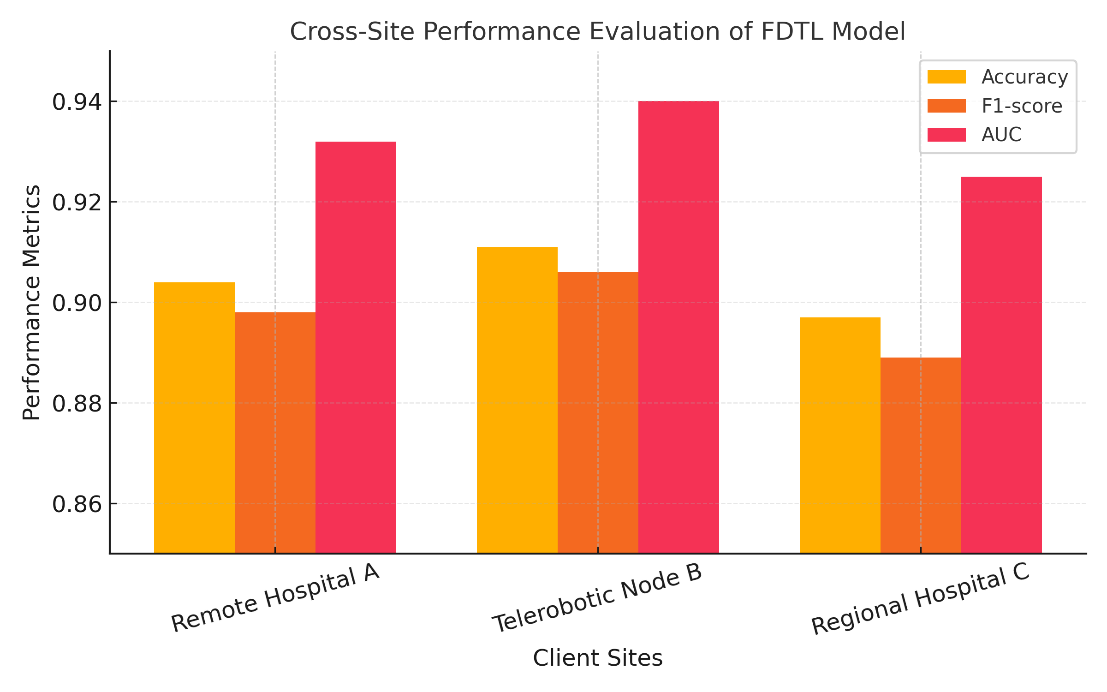
Telerobotic ultrasound systems enable clinicians to remotely control robotic arms equipped with ultrasound probes, improving diagnostic access. However, their effectiveness is constrained by limited annotated datasets, privacy concerns associated with centralized storage, and a lack of transparent and generalizable artificial intelligence (AI) models. This study presents a Federated Deep Transfer Learning (FDTL) framework supporting collaborative ultrasound image classification while keeping images on local client nodes. Four pretrained convolutional neural networks (CNNs) were fine-tuned on the breast ultrasound images (BUSI) dataset to extract diagnostic features. Federated averaging (FedAvg) enabled model aggregation without sharing raw client data. Centralized and federated approaches were compared, and convergence was analyzed. A gradient-weighted class activation mapping (Grad-CAM) module supported interpretability. The framework achieved a peak federated classification accuracy of 91.1% using DenseNet-121 and a macro-averaged accuracy of 90.5% across the evaluated architectures, outperforming individual client models while maintaining stable convergence over 80 communication rounds. Convergence stabilized within 50--60 rounds. Grad-CAM highlighted attention regions corresponding to diagnostically relevant lesion boundaries and textures. The framework shows a promising balance of diagnostic performance, data localization, interpretability, and scalability under simulated federated conditions. These findings provide preliminary evidence of robustness across heterogeneous simulated clients and suggest potential for decentralized ultrasound diagnosis.
References
[1] A. E. Anasthesia, U. Ibrahim, S. D. Yusuf, D. Z. Joseph, N. Flavious, M. Sidi, S. Sheme, A. Mundi, A. Dare, D. S. Joseph & Y. A. Ningii, ``Diagnostic reference levels (DRLs) and image quality evaluation for digital mammography in a Nigerian facility'', Journal of the Nigerian Society of Physical Sciences 4 (2022) 281. https://doi.org/10.46481/jnsps.2022.734.
[2] A. A. Oglat, K. A. Rabaeh, M. D. Salman, M. M. Eyadeh & K. Zyoid, ``Temperature- and frequency-dependent ultrasound response of a Poly(N-vinylcaprolactam) polymer gel dosimeter'', Journal of the Nigerian Society of Physical Sciences 8 (2026) 3305. https://doi.org/10.46481/jnsps.2026.3305.
[3] S. I. Ele, U. R. Alo, H. F. Nweke, A. H. Okemiri & E. O. Uche-Nwachi, ``Deep convolutional neural network (DCNN)-based model for pneumonia detection using chest X-ray images'', Journal of the Nigerian Society of Physical Sciences 7 (2025) 2443. https://doi.org/10.46481/jnsps.2025.2443.
[4] S. Abuowaida, H. A. Owida, D. M. Alsekait, N. Alshdaifat, D. S. AbdElminaam & M. Alshinwan, ``UltraSegNet: A hybrid deep learning framework for enhanced breast cancer segmentation and classification on ultrasound images'', Computers, Materials & Continua 83 (2025) 3303. https://doi.org/10.32604/cmc.2025.063470.
[5] S. J. Adams, B. Burbridge, L. Chatterson, P. Babyn & I. Mendez, ``A telerobotic ultrasound clinic model of ultrasound service delivery to improve access to imaging in rural and remote communities'', Journal of the American College of Radiology 19 (2022) 162. https://doi.org/10.1016/j.jacr.2021.07.023.
[6] D. Black, M. Nogami & S. Salcudean, ``Mixed reality human teleoperation with device-agnostic remote ultrasound: Communication and user interaction'', Computers & Graphics 118 (2024) 184. https://doi.org/10.1016/j.cag.2024.01.003.
[8] S. R. Sugguna & E. P. Sumesh, ``HybridNet: Advancing MRI image quality using dense attention and deep learning'', Engineering Science and Technology, an International Journal 71 (2025) 102186. https://doi.org/10.1016/j.jestch.2025.102186.
[9] M. K. Singh, A. K. Singh, P. Choudhary, A. K. Singh & L. K. Tyagi, ``A practical deep learning framework for multi-class skin cancer detection using U-Net segmentation and ResNet50 transfer learning'', Journal of the Nigerian Society of Physical Sciences 8 (2026) 3530. https://doi.org/10.46481/jnsps.2026.3530.
[10] M. Bhargavi & S. Balakrishna, ``Transfer learning-based hybrid feature learning framework for enhanced skin cancer diagnosis using deep feature integration'', Engineering Science and Technology, an International Journal 69 (2025) 102135. https://doi.org/10.1016/j.jestch.2025.102135.
[11] D. Guo, Z. Xue, D. Chen, C. Lu, J. Fu, J. Yuan & Y. Huang, ``Radiomics knowledge-driven deep learning framework for breast cancer ultrasound video diagnosis'', Expert Systems with Applications 298 (2026) 129800. https://doi.org/10.1016/j.eswa.2025.129800.
[12] M. D. Liman, S. I. Osanga, E. S. Alu & S. Zakariya, ``Regularization effects in deep learning architecture'', Journal of the Nigerian Society of Physical Sciences 6 (2024) 1911. https://doi.org/10.46481/jnsps.2024.1911.
[13] E. Patnala, R. Bingu, H. R. Sangaraju, S. Adinarayana, J. S. Dhatterwal & S. Kavitha, ``Automated breast cancer classification using a hybrid deep learning framework with attention-integrated EfficientNet'', Biomedical Signal Processing and Control 112 (2026) 108552. https://doi.org/10.1016/j.bspc.2025.108552.
[14] H. Jasrotia, C. Singh & S. Kaur, ``EfficientNet-based attention residual U-Net with guided loss for breast tumor segmentation in ultrasound images'', Ultrasound in Medicine & Biology 51 (2025) 1112. https://doi.org/10.1016/j.ultrasmedbio.2025.03.009.
[15] N. Sirjani, M. G. Oghli, M. K. Tarzamni, M. Gity, A. Shabanzadeh, P. Ghaderi, I. Shiri, A. Akhavan, M. Faraji & M. Taghipour, ``A novel deep learning model for breast lesion classification using ultrasound images: A multicenter data evaluation'', Physica Medica 107 (2023) 102560. https://doi.org/10.1016/j.ejmp.2023.102560.
[16] V. T.-T. Vo, T. Shin, H.-J. Yang, S.-R. Kang & S.-H. Kim, ``A comparison between centralized and asynchronous federated learning approaches for survival outcome prediction using clinical and PET data from non-small cell lung cancer patients'', Computer Methods and Programs in Biomedicine 248 (2024) 108104. https://doi.org/10.1016/j.cmpb.2024.108104.
[17] R. Karthik, R. Menaka, G. S. Kathiresan, M. Anirudh & M. Nagharjun, ``Gaussian dropout based stacked ensemble CNN for classification of breast tumor in ultrasound images'', IRBM 43 (2022) 715. https://doi.org/10.1016/j.irbm.2021.10.002.
[18] W. Wang, J. Li, Z. Wang, Y. Liu, F. Yang & S. Cui, ``Study on the classification of benign and malignant breast lesions using a multi-sequence breast MRI fusion radiomics and deep learning model'', European Journal of Radiology Open 13 (2024) 100607. https://doi.org/10.1016/j.ejro.2024.100607.
[19] A. Nour & B. Boufama, ``Hybrid deep learning and active contour approach for enhanced breast lesion segmentation and classification in mammograms'', Intelligence-Based Medicine 11 (2025) 100224. https://doi.org/10.1016/j.ibmed.2025.100224.
[20] Z. Wang, M. M. Ali, K. I. Sahibzada, F. Maqsood, N. U. Rehman, M. Aftab, Q. Zia, W. Hou & D.-Q. Wei, ``Hybrid feature extraction for breast cancer classification using the ensemble residual VGG16 deep learning model'', Current Bioinformatics 20 (2025) 149. https://doi.org/10.2174/0115748936333380240816053223.
[21] R. Tenajas & D. Miraut, ``Challenges in standardizing image quality across diverse ultrasound devices'', Intelligent Medicine 4 (2024) 275. https://doi.org/10.1016/j.imed.2024.01.002.
[23] I. Nissar, S. Alam & S. Masood, ``SwinEff-AttentionNet: A dual hybrid model for breast image segmentation and classification using multiple ultrasound modality'', Biomedical Signal Processing and Control 112 (2026) 108795. https://doi.org/10.1016/j.bspc.2025.108795.
[24] S. Kumbhare, A. B. Kathole & S. Shinde, ``Federated learning aided breast cancer detection with intelligent heuristic-based deep learning framework'', Biomedical Signal Processing and Control 86 (2023) 105080. https://doi.org/10.1016/j.bspc.2023.105080.
[25] J. Du, W. Li, P. Liu, C.-M. Vong, Y. You, B. Lei & T. Wang, ``Federated learning using model projection for multi-center disease diagnosis with non-IID data'', Neural Networks 178 (2024) 106409. https://doi.org/10.1016/j.neunet.2024.106409.
[26] S. Din, M. Imran, S. Irfan, A. Tariq, Z. Elgamal & H. Dawood, ``Federated learning for melanoma detection: A decentralized and privacy-preserving approach using deep learning'', Biomedical Signal Processing and Control 112 (2026) 108576. https://doi.org/10.1016/j.bspc.2025.108576.
[27] B. Karthiga, K. R. Praneeth, V. Saravanan & T. K. R. K. Rao, ``Enhancing cancer detection in medical imaging through federated learning and explainable artificial intelligence: A hybrid approach for optimized diagnostics'', Egyptian Informatics Journal 31 (2025) 100751. https://doi.org/10.1016/j.eij.2025.100751.
[28] A. Raza, A. Guzzo, M. Ianni, R. Lappano, A. Zanolini, M. Maggiolini & G. Fortino, ``Federated learning in radiomics: A comprehensive meta-survey on medical image analysis'', Computer Methods and Programs in Biomedicine 267 (2025) 108768. https://doi.org/10.1016/j.cmpb.2025.108768.
[29] R. Joshi, S. Kumari, K. Pandey & R. Badola, ``A collaborated federated learning for healthcare informatics: Solution and challenges'', in Federated Learning in Metaverse Healthcare, S. Mahajan & J. M. Chatterjee (Eds.), Academic Press, 2026, pp. 171--188. https://doi.org/10.1016/B978-0-443-33789-5.00024-8.
[30] D. Wang, Y. Cui, M. Li, H. Xi & J. Zhu, ``FedFAT: Frequency adpative interpolation for federated domain generalization on heterogeneous medical images'', Pattern Recognition 172 (2026) 112459. https://doi.org/10.1016/j.patcog.2025.112459.
[31] O. O. Oladimeji, H. Ayaz, I. McLoughlin & S. Unnikrishnan, ``Mutual information-based radiomic feature selection with SHAP explainability for breast cancer diagnosis'', Results in Engineering 24 (2024) 103071. https://doi.org/10.1016/j.rineng.2024.103071.
[32] M. Naas, H. Mzoughi, I. Njeh & M. BenSlima, ``An explainable AI for breast cancer classification using vision transformer (ViT)'', Biomedical Signal Processing and Control 108 (2025) 108011. https://doi.org/10.1016/j.bspc.2025.108011.
[33] J. S. Christobel & K. S. S. Rani, ``A novel vision-efficient Grad-CAM network for early breast cancer detection using multi-scale histopathological image analysis'', Biomedical Signal Processing and Control 112 (2026) 108939. https://doi.org/10.1016/j.bspc.2025.108939.
[34] S. Singh, R. Kumar, N. P. Singh & M. K. Maurya, ``Unsupervised attention-based framework for cancerous region segmentation with explainable post-hoc thresholding in histopathological images'', Biomedical Signal Processing and Control 113 (2026) 108815. https://doi.org/10.1016/j.bspc.2025.108815.
[35] C. Chen, H. Pan, K. Zhang, Z. Li & F. Yu, ``A federated fairness-aware incentive mechanism for medical image classification'', Engineering Applications of Artificial Intelligence 160 (2025) 111855. https://doi.org/10.1016/j.engappai.2025.111855.
[36] F. Hu, S. Qiu, X. Yang, C. Wu, M. B. Nunes & H. Chen, ``Privacy-preserving healthcare and medical data collaboration service system based on blockchain and federated learning'', Computers, Materials & Continua 80 (2024) 2897. https://doi.org/10.32604/cmc.2024.052570.
[37] X. Deng, S. Ding, H. Lin, L. Jiang, H. Sun & J. Jin, ``Privacy-preserving online medical image exchange via hyperchaotic memristive neural networks and DNA encoding'', Neurocomputing 653 (2025) 131132. https://doi.org/10.1016/j.neucom.2025.131132.
[38] W. Al-Dhabyani, M. Gomaa, H. Khaled & A. Fahmy, ``Dataset of breast ultrasound images'', Data in Brief 28 (2020) 104863. https://doi.org/10.1016/j.dib.2019.104863.
[39] S. Haluzani, A. Lungu, M. Mudenda, A. Hamapa, C. Mkandawire, A. Kaluba, O. Khondowe, M. Mutale, K. Imasiku, M. Nyirenda, O. Nkolola, L. Kasonka, F. Simute, A. Mwiche, E. Njelesani, P. Mwaba, C. V. Alexandra, D. Lissauer, M. Mulaya, D. Kabamba, J. M. Zulu & L. Hangulu, ``Quality of ultrasound images by midwives implementing ultrasound scanning services during antenatal clinics within selected healthcare facilities of Zambia'', WFUMB Ultrasound Open 2 (2024) 100057. https://doi.org/10.1016/j.wfumbo.2024.100057.
[40] H. B. McMahan, E. Moore, D. Ramage, S. Hampson & B. Ag{"u}era y Arcas, Communication-efficient learning of deep networks from decentralized data, Proceedings of the 20th International Conference on Artificial Intelligence and Statistics, Fort Lauderdale, USA, 2017, pp. 1273--1282. https://proceedings.mlr.press/v54/mcmahan17a.html.
[41] J. Ru, Z. Zhu & J. Shi, ``Spatial and geometric learning for classification of breast tumors from multi-center ultrasound images: A hybrid learning approach'', BMC Medical Imaging 24 (2024) 133. https://doi.org/10.1186/s12880-024-01307-3.
[42] A. Raheem, Z. Yang, A. S. Alluhaidan, M. A. Manan, S. Ahmed, F. Sabah & S. Ahmad, ``FAME: A privacy-preserving dual-stage deep learning framework for breast ultrasound imaging using federated transfer and synthetic learning'', Digital Health 11 (2025) 20552076251390564. https://doi.org/10.1177/20552076251390564.
[43] Y. Jiang, C.-M. Feng, J. Ren, J. Wei, Z. Zhang, Y. Hu, Y. Liu, R. Sun, X. Tang, J. Du, X. Wan, Y. Xu, B. Du, X. Gao, G. Wang, S. Zhou, S. Cui & Z. Li, ``From pretraining to privacy: Federated ultrasound foundation model with self-supervised learning'', npj Digital Medicine 8 (2025) 714. https://doi.org/10.1038/s41746-025-02085-0.
[44] M. A. Elshenawy, N. S. Tawfik, N. Hamada, R. Kadry, S. Fayed & N. Ghatwary, ``A comparative analysis of federated learning for multi-class breast cancer classification in ultrasound imaging'', AI 6 (2025) 316. https://doi.org/10.3390/ai6120316.
Published
How to Cite
Issue
Section
Copyright (c) 2027 Oluwatobi Noah Akande, Funmilola Alaba Ajala, Gift Adene, Julius Makinde, Roseline Oluwaseun Ogundokun, Rotimi-Williams Bello (Author)

This work is licensed under a Creative Commons Attribution 4.0 International License.