Efficiency Benchmarking of Nigerian Electricity Distribution Companies Using an Integrated DEA–Shannon Entropy
Keywords:
Data envelopment analysis, Shannon entropy, Nigerian electricity distribution companies (DisCos), Efficiency benchmarking, Technical efficiencyAbstract
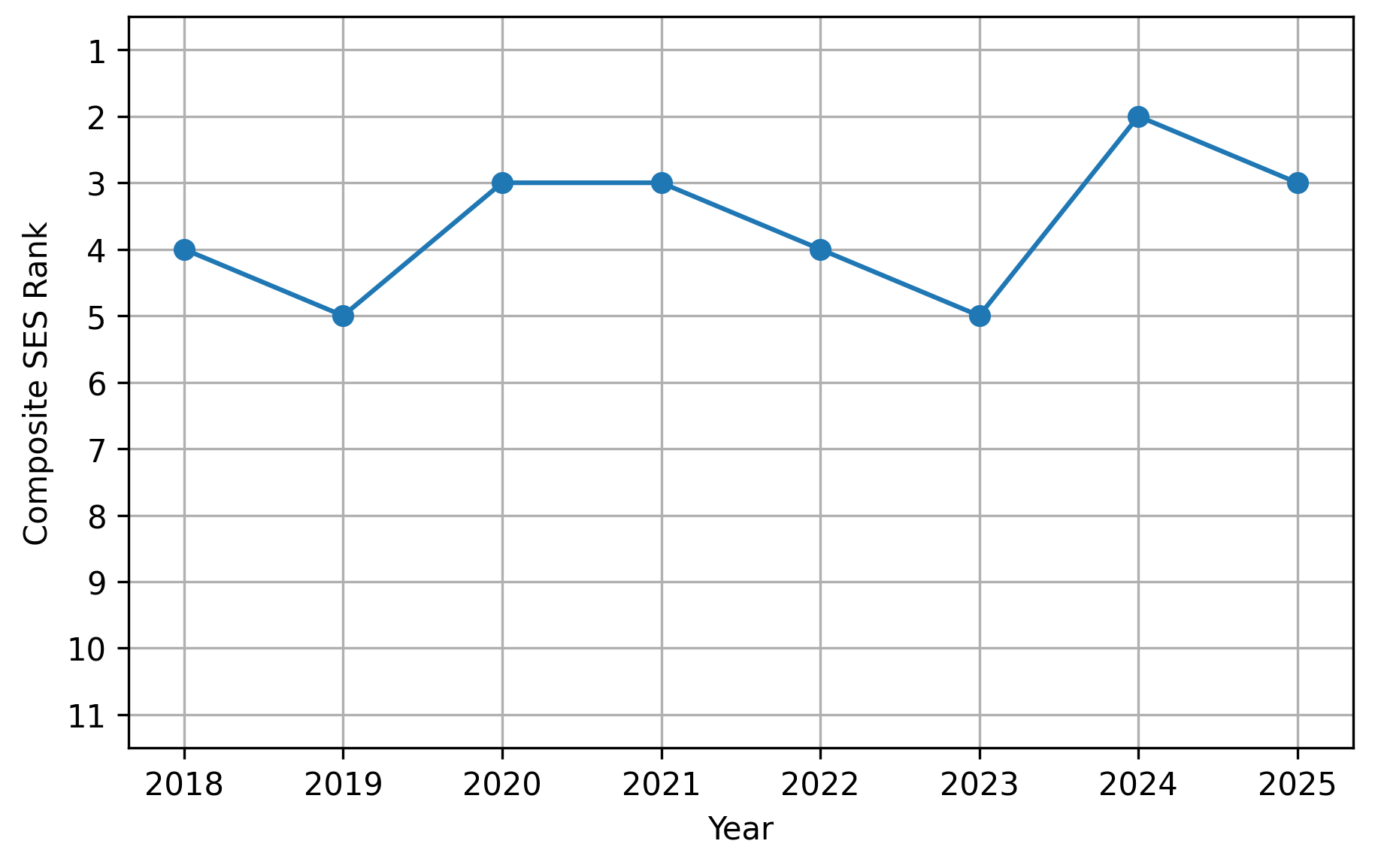
This study evaluates the relative operational efficiency of the eleven legacy Nigerian electricity distribution companies (DisCos) over 2018--2025 using an integrated Data Envelopment Analysis (DEA)--Shannon entropy framework. The DEA production specification treats customers under estimated billing as the input-side operating burden, with metered customers, revenue collected, and energy billed in gigawatt-hours (GWh) as desirable outputs. Three DEA specifications are estimated annually: constant returns to scale (CRS), input-oriented variable returns to scale (IVRS), and output-oriented variable returns to scale (OVRS). Their efficiency scores are combined using year-specific Shannon entropy weights to obtain a composite Shannon Efficiency Score (SES) for each DisCo. Results reveal substantial heterogeneity in technical, scale, and output-oriented efficiency across DisCos and over time, with IKEDC and EKEDC generally among the stronger performers. Shannon entropy does not modify the underlying DEA frontiers or individual efficiency scores; it derives information-based weights from the annual score distributions and combines them at the aggregation and ranking stage. Because metered customers and customers under estimated billing enter the DEA production specification directly, the resulting scores inherently reflect metering status and should not be interpreted as an independent statistical test of the relationship between metering performance and operational efficiency. The integrated DEA--Shannon entropy framework provides a reproducible approach for combining complementary DEA efficiency perspectives and benchmarking the relative performance of Nigerian electricity distribution companies.
References
[1] Bureau of Public Enterprises, ``Power sector reform in Nigeria'', Available online: https://www.bpe.gov.ng/power-sector-reform-nigeria/ (accessed 26 July 2026).
[2] Nigerian Electricity Regulatory Commission, NERC annual report 2024, NERC, Abuja, Nigeria, 2025. https://nerc.gov.ng/resources/nerc-annual-report-2024/.
[3] Bureau of Public Enterprises, ``Distribution companies (DISCOs)'', Available online: https://www.bpe.gov.ng/pixpopup-item/distribution-companies-discos/ (accessed 23 July 2026).
[4] Nigerian Electricity Regulatory Commission, 2023 annual report and accounts, NERC, Abuja, Nigeria, 2023. https://nerc.gov.ng/wp-content/uploads/2024/09/2023_Annual_Report.pdf.
[5] Nigerian Electricity Regulatory Commission, Metering factsheet: November--December 2025, NERC, Abuja, Nigeria, 2025. https://nerc.gov.ng/resources/metering-factsheet-nov-dec-2025/.
[6] Nigerian Electricity Regulatory Commission, NERC fourth quarter 2025 report, NERC, Abuja, Nigeria, 2026. https://nerc.gov.ng/resources/nerc-fourth-quarter-2025-report/.
[7] A. Charnes, W. W. Cooper & E. Rhodes, ``Measuring the efficiency of decision making units'', European Journal of Operational Research 2 (1978) 429. https://doi.org/10.1016/0377-2217(78)90138-8.
[8] R. D. Banker, A. Charnes & W. W. Cooper, ``Some models for estimating technical and scale inefficiencies in data envelopment analysis'', Management Science 30 (1984) 1078. https://doi.org/10.1287/mnsc.30.9.1078.
[9] W. W. Cooper, L. M. Seiford & K. Tone, Data envelopment analysis: A comprehensive text with models, applications, references and DEA-solver software, 2nd ed., Springer, New York, NY, USA, 2007. https://doi.org/10.1007/978-0-387-45283-8.
[10] I. Olanrele, ``Efficiency performance of electricity distribution companies in Nigeria'', African Journal of Economic Review 12 (2024) 188. https://www.ajol.info/index.php/ajer/article/view/266800.
[11] B. Cayir Ervural & C. Kahraman, ``A combined methodology for evaluation of electricity distribution companies in Turkey'', Journal of Intelligent & Fuzzy Systems 38 (2020) 1059. https://doi.org/10.3233/JIFS-179468.
[12] F. Núñez, A. Arcos-Vargas & G. Villa, ``Efficiency benchmarking and remuneration of Spanish electricity distribution companies'', Utilities Policy 67 (2020) 101127. https://doi.org/10.1016/j.jup.2020.101127.
[13] F. M. Mirza, S. B.-U.-H. Rizvi & O. Bergland, ``Service quality, technical efficiency and total factor productivity growth in Pakistan's post-reform electricity distribution companies'', Utilities Policy 68 (2021) 101156. https://doi.org/10.1016/j.jup.2020.101156.
[14] M. Vesterberg, W. Zhou & T. Lundgren, ``Wind of change: Small-scale electricity production and distribution-grid efficiency in Sweden'', Utilities Policy 69 (2021) 101175. https://doi.org/10.1016/j.jup.2021.101175.
[15] V. S. Patyal, R. Kumar, K. Lamba & S. Maheshwari, ``Performance evaluation of Indian electricity distribution companies: An integrated DEA-IRP-TOPSIS approach'', Energy Economics 124 (2023) 106796. https://doi.org/10.1016/j.eneco.2023.106796.
[16] H. Omrani, A. Emrouznejad, T. Teplova & M. Amini, ``Efficiency evaluation of electricity distribution companies: Integrating data envelopment analysis and machine learning for a holistic analysis'', Engineering Applications of Artificial Intelligence 133 (2024) 108636. https://doi.org/10.1016/j.engappai.2024.108636.
[17] J. Sánchez-Ortiz, T. García-Valderrama, V. Rodríguez-Cornejo & F. Cabrera-Monroy, ``DEA window analysis and Malmquist index to assess efficiency and productivity in the Spanish electricity sector'', International Journal of Energy Sector Management 15 (2021) 765. https://doi.org/10.1108/IJESM-03-2019-0020.
[18] A. Fallahi, F. Fallahi, H. Sarhadi, S. F. Ghaderi & R. Ebrahimi, ``Application of a robust data envelopment analysis model for performance evaluation of electricity distribution companies'', International Journal of Energy Sector Management 15 (2021) 724. https://doi.org/10.1108/IJESM-08-2018-0008.
[19] National Bureau of Statistics, Nigeria electricity report: Energy billed, revenue generated and customers by DISCOs, Reference ID NGA-NBS-ELECT, National Bureau of Statistics, Nigeria. https://microdata.nigerianstat.gov.ng/index.php/catalog/171 (accessed 8 September 2026).
[20] National Bureau of Statistics, Nigeria electricity report 2021: Energy billed, revenue generated and customers by DISCOs, National Bureau of Statistics, Abuja, Nigeria, 2021. https://www.nigerianstat.gov.ng/elibrary/read/1241206 (accessed 8 September 2026).
[21] National Bureau of Statistics, Nigeria electricity report Q1 2024: Energy billed, revenue generated and customers by DISCOs, National Bureau of Statistics, Abuja, Nigeria, 2024. https://www.nigerianstat.gov.ng/elibrary/read/1241522 (accessed 8 September 2026).
[22] Nigerian Electricity Regulatory Commission, NERC third quarter 2025 report, NERC, Abuja, Nigeria, 2026. https://nerc.gov.ng/resources/nerc-third-quarter-2025-report/.
[23] Y.-C. Lee, ``Ranking DMUs by combining cross-efficiency scores based on Shannon's entropy'', Entropy 21 (2019) 467. https://doi.org/10.3390/e21050467.
[24] G. Yesilaydin, G. Bayin Donar & M. Alpaslan Takan, ``Efficiency of countries in terms of healthcare access and quality: Shannon entropy based data envelopment analysis and logistic regression modelling'', Psychology, Health & Medicine 31 (2026) 1111. https://doi.org/10.1080/13548506.2025.2539935.
[25] F. Yang, Y. Li, L. Liang & D. Wu, ``Modelling undesirable outputs in eco-efficiency evaluation to paper mills along the Huai River based on Shannon DEA'', International Journal of Environment and Sustainable Development 10 (2011) 36. https://doi.org/10.1504/IJESD.2011.037689.
[26] C. Lo Storto, ``Ecological efficiency based ranking of cities: A combined DEA cross-efficiency and Shannon's entropy method'', Sustainability 8 (2016) 124. https://doi.org/10.3390/su8020124.
[27] P. Peykani, F. S. Seyed Esmaeili, M. Mirmozaffari, A. Jabbarzadeh & M. Khamechian, ``Input/output variables selection in data envelopment analysis: A Shannon entropy approach'', Machine Learning and Knowledge Extraction 4 (2022) 688. https://doi.org/10.3390/make4030032.
[28] A. Fathi & R. F. Saen, ``Sustainability evaluation of transportation supply chains by common set of weights-network DEA and Shannon's entropy in the presence of zero inputs'', Environment, Development and Sustainability 26 (2024) 7999. https://doi.org/10.1007/s10668-023-03046-x.
[29] L. Song & F. Liu, ``An improvement in DEA cross-efficiency aggregation based on the Shannon entropy'', International Transactions in Operational Research 25 (2018) 705. https://doi.org/10.1111/itor.12361.
[30] O. B. Olesen & N. C. Petersen, ``Facet analysis in data envelopment analysis: Some pitfalls of the CRS models'', Journal of Productivity Analysis 62 (2024) 1. https://doi.org/10.1007/s11123-023-00715-x.
[31] P. Saraiva, ``On Shannon entropy and its applications'', Kuwait Journal of Science 50 (2023) 194. https://doi.org/10.1016/j.kjs.2023.05.004.
[32] M. Soleimani-Damaneh & M. Zarepisheh, ``Shannon's entropy for combining the efficiency results of different DEA models: Method and application'', Expert Systems with Applications 36 (2009) 5146. https://doi.org/10.1016/j.eswa.2008.06.031.
[33] R. K. P. K. Pannala, S. K. Mogha, N. Sharma & V. Garg, ``Combined Shannon's entropy and DEA: Case of Indian hotel and restaurant sector'', International Journal of Data Analysis Techniques and Strategies 14 (2022) 203. https://doi.org/10.1504/IJDATS.2022.128281.
[34] M. Grausová & M. Hužvár, ``Entropy-weighted assurance region DEA: An application to healthcare system efficiency assessment'', Central European Journal of Operations Research 34 (2026) 899. https://doi.org/10.1007/s10100-025-01011-9.
[35] S. N. Pandi, P. K. Pannala & R. Banerjee, ``Robust efficiency benchmarking of Nigerian electricity distribution companies using Shannon--DEA CES under role-consistent reduced-information scenarios (2015--2022)'', SSRN (2026) 6293652. https://doi.org/10.2139/ssrn.6293652.
Published
How to Cite
Issue
Section
Copyright (c) 2026 Sabo Nelson Pandi, R. K. Pavan Kumar Pannala, Amit Kumar Attri, Alvary Kefas Kwala (Author)

This work is licensed under a Creative Commons Attribution 4.0 International License.