Adaptive finite element analysis of thermal and elasticity problems using Zienkiewicz–Zhu recovery-based error estimation
Keywords:
Finite element method, Adaptive mesh refinement, Zienkiewicz–Zhu recovery, A posteriori error estimationAbstract
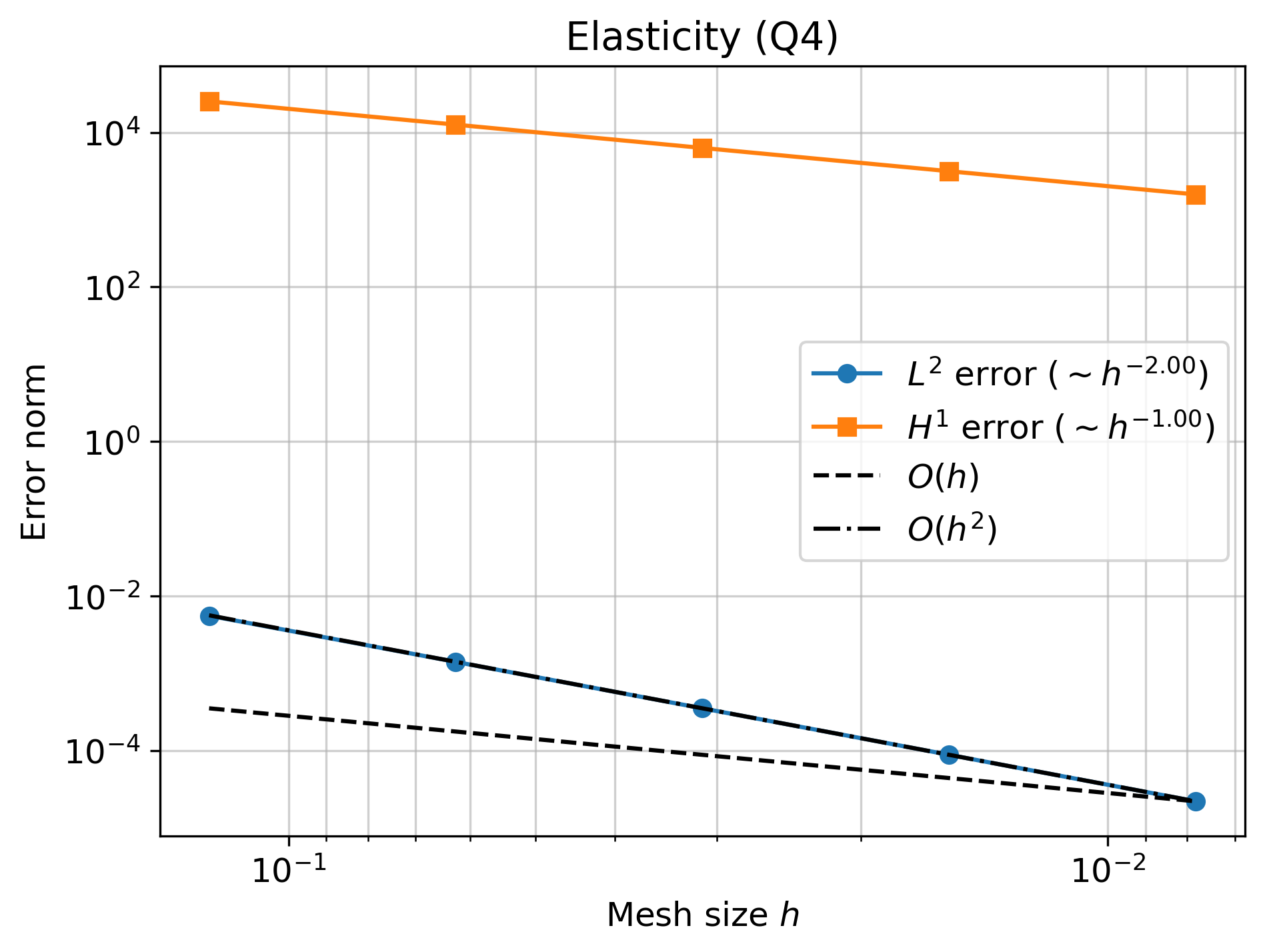
This paper presents a verification-to-adaptivity analysis of a finite element framework for scalar and vector-valued elliptic problems that employs recovery-based a posteriori error estimation. Conforming bilinear quadrilateral (Q4) and linear triangular (T3) finite elements are used to discretise the thermal Poisson equation and the linear elasticity equations. Standard Galerkin methods are combined with uniform and adaptive mesh refinement in this approach. The approach of manufactured solutions under uniform refinement is first used for verification, where both discretizations regain the theoretical H1- and L2-norm convergence rates, proving the accuracy of the scalar and vector formulations. The Zienkiewicz–Zhu (ZZ) recovery approach is then used to incorporate adaptive refinement, using stress recovery for elasticity and gradient recovery for the thermal problems. The adaptive meshes show conservative effectivity behaviour, monotonic estimator–error correlation, and stable localisation. Differences between Q4 and T3 outcomes are consistent with their known approximation features across all test cases. The findings show that for thermal diffusion and linear elasticity issues, ZZ-driven adaptivity offers a dependable extension of a validated finite element framework.References
[1] M. R. Gosz, Finite element method: applications in solids, structures, and heat transfer, 1st ed., CRC press, Boca raton, Florida, 2006. https://doi.org/10.1201/9781315275857.
[2] P. George, “Finite element formulation for heat transfer,” in: Introduction to finite element analysis, S. U. Nair & S. somanath (Eds.), Springer, Singapore, 12 (2024) 139. https://doi.org/10.1007/978-981-19-7989-7_7.
[3] R. Verfürth, “Adaptive finite element methods: lecture notes winter term 2018/19,” fakultät für mathematik, Ruhr-Universität Bochum, 2019. https://www.ruhr-uni-bochum.de/num1/files/lectures/AdaptiveFEM.pdf.
[4] T. Grätsch & K. J. Bathe, “A posteriori error estimation techniques in practical finite element analysis,” Computers & structures, 83 (2005) 1247. https://doi.org/10.1016/j.compstruc.2004.11.010.
[5] L. Chamoin & F. Legoll, “An introductory review on a posteriori error estimation in finite element computations,” SIAM Review, 65 (2023) 963. https://doi.org/10.1137/21M1464841.
[6] K. I. Aycock, N. Rebelo & B. A. Craven, “Method of manufactured solutions code verification of elastostatic solid mechanics problems in a commercial finite element solver,” Computers & structures, 229 (2020) 106175. https://doi.org/10.1016/j.compstruc.2019.106175.
[7] M. O. Durojaye, J. K. Odeyemi & I. J. Ajie, “Numerical solution of two dimensional Laplace's equation on a regular domain using Chebyshev differentiation matrices,” Physical science international journal, 23 (2019) 1. https://doi.org/10.9734/psij/2019/v23i130144.
[8] J. K. Odeyemi, O. O. Olaiya & F. O. Ogunfiditmi, “Hermite polynomial-based methods for optimal order approximation of first-order ordinary differential equations,” Journal of advances in mathematics and computer science, 38 (2023) 16. https://doi.org/10.9734/jamcs/2023/v38i61765.
[9] P. J. Roache, “Code verification by the method of manufactured solutions,” Journal of fluids engineering, 124 (2002) 4. https://doi.org/10.1115/1.1436090.
[10] R. E. Bank & Y. Li, “Superconvergent recovery of Raviart-Thomas mixed finite elements on triangular grids,” Journal of scientific computing, 81 (2019) 1882. https://doi.org/10.1007/s10915-019-01068-0.
[11] M. Barakat, W. K. Zahra & A. Elsaid, “Enhancing the recovered gradient of the finite element solution for a class of differential equations,” in: Simulation and modeling methodologies, technologies and applications, G. Wagner, F. Werner & F. De Rango (Eds.), Springer, Cham, 45 (2023) 110. https://doi.org/10.1007/978-3-031-43824-0_6.
[12] C. Anitescu, M. N. Hossain & T. Rabczuk, “Recovery-based error estimation and adaptivity using high-order splines over hierarchical T-meshes,” Computer methods in applied mechanics and engineering, 327 (2018) 380. https://doi.org/10.1016/j.cma.2017.08.032.
[13] Q. Zhang, J. Li & P. Huang, “Recovery type a posteriori error estimates for the conduction convection problem,” Numerical algorithms, 86 (2021) 425. https://doi.org/10.1007/s11075-020-00894-w.
[14] Y. Liu, X. Shen, Z. Guan & Y. Nie, “The adaptive SAV weak Galerkin finite element method for the Allen-Cahn equation,” Computers & mathematics with applications, 151 (2023) 449. https://doi.org/10.1016/j.camwa.2023.10.023.
[15] M. Bode, A. Y. Deshmukh, T. Falkenstein, S. Kang & H. Pitsch, “Hybrid scheme for complex flows on staggered grids and application to multiphase flows,” Journal of computational physics, 474 (2023) 108478. https://doi.org/10.1016/j.jcp.2018.12.041.
[16] N. N. Smirnov, A. B. Kiselev, P. P. Zakharov, R. V. Muratov & D. M. Bukharinskaya, “The usage of adaptive mesh refinement in simulation of high-velocity collision between impactor and thin-walled containment,” Acta astronautica, 194 (2022) 401. https://doi.org/10.1016/j.actaastro.2021.12.017.
[17] H. Guo & Z. Zhang, “Recovery techniques for finite element methods,” in: Advances in applied mechanics, 60 (2025) 399. https://doi.org/10.1016/bs.aams.2025.02.002.
[18] A. Amor-Martin & L. E. Garcia-Castillo, “Adaptive semi-structured mesh refinement techniques for the finite element method,” Applied sciences, 11 (2021) 3683. https://doi.org/10.3390/app11083683.
[19] F. Tian, X. Tang, T. Xu, J. Yang & L. Li, “A hybrid adaptive finite element phase-field method for quasi-static and dynamic brittle fracture,” International journal for numerical methods in engineering, 120 (2019) 1108. https://doi.org/10.1002/nme.6172.
[20] B. B. Xu, F. Peng, P. Junker & P. Wriggers, “Virtual element method with non-matching and adaptive meshes for phase field fracture,” Computational mechanics, 76 (2025) 1621. https://doi.org/10.1007/s00466-025-02665-7.
[21] V. Darrigrand, D. Pardo, T. Chaumont-Frelet, I. Gómez-Revuelto & L. E. Garcia-Castillo, “A painless automatic hp-adaptive strategy for elliptic problems,” Finite elements in analysis and design, 178 (2020) 103424. https://doi.org/10.1016/j.finel.2020.103424.
[22] H. Wang, W. Yang & Y. Huang, “An adaptive edge finite element method for the Maxwell's equations in metamaterials,” Electronic research archive, 28 (2020) 961. https://doi.org/10.3390/era.2020051.
[23] Y. H. You, X. Y. Kou & S. T. Tan, “Adaptive meshing for finite element analysis of heterogeneous materials,” Computer-aided design, 62 (2015) 176. https://doi.org/10.1016/j.cad.2014.11.011.
[24] P. Cheng, X. Zhuang, H. Zhu & J. Fish, “Application of s-version finite element method to phase field modeling for localized fractures,” Computers and geotechnics, 156 (2023) 105204. https://doi.org/10.1016/j.compgeo.2022.105204.
[25] T. J. R. Hughes, The finite element method: linear static and dynamic finite element analysis, Dover publications, Mineola, NY, 2000.
[26] O. A. Olaiju, E. O. Fatunmbi, O. A. Agbolade, J. K. Odeyemi & O. C. Akeremale, “High-fidelity h-adaptive finite element simulation of transient thermal fields in laser-based additive manufacturing,” Asian research journal of mathematics, 22 (2026) 295. https://doi.org/10.9734/arjom/2026/v22i41079.
[27] W. K. Liu, S. Li & H. S. Park, “Eighty years of the finite element method: birth, evolution, and future,” Archives of computational methods in engineering, 29 (2022) 4431. https://doi.org/10.1007/s11831-022-09740-9.
[28] A. Bonito, C. Canuto, R. H. Nochetto & A. Veeser, “Adaptive finite element methods,” Acta numerica, 33 (2024) 163. https://doi.org/10.1017/S0962492924000011.
[29] R. Verfürth, A review of a posteriori error estimation and adaptive mesh-refinement techniques, Wiley-Teubner, Chichester, UK, 1996.
[30] G. Kunert & S. Nicaise, “Zienkiewicz--Zhu error estimators on anisotropic tetrahedral and triangular finite element meshes,” ESAIM: mathematical modelling and numerical analysis, 37 (2003) 1013. https://doi.org/10.1051/m2an:2003065.
[31] Z. Cai, C. He & S. Zhang, “Improved ZZ a posteriori error estimators for diffusion problems: conforming linear elements,” Computer methods in applied mechanics and engineering, 313 (2017) 433. https://doi.org/10.1016/j.cma.2016.10.006.
[32] Y. Li & L. Zikatanov, “A posteriori error estimates of finite element methods by preconditioning,” Computers & mathematics with applications, 91 (2021) 192. https://doi.org/10.1016/j.camwa.2020.08.001.
Published
How to Cite
Issue
Section
Copyright (c) 2026 J. K. Odeyemi, S. A. Odunlami (Author)

This work is licensed under a Creative Commons Attribution 4.0 International License.