Modeling traffic-light systems: A neutrosophic graph approach
Keywords:
Neutrosophic graph coloring, Chromatic number, Single-valued neutrosophic graph, Traffic-light scheduling, Uncertainty modelingAbstract
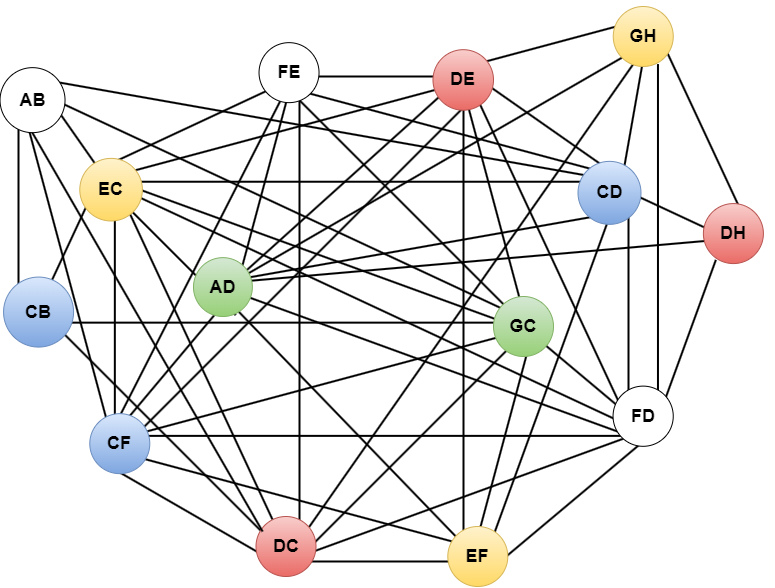
The coloring of neutrosophic graphs (NGs) is an important concept with extensive real-world applications. This research focuses on chromatic numbers for NGs and their operations. We define the neutrosophic chromatic number based on the alpha-, beta-, and gamma-cuts, as well as the strong alpha-, beta-, and gamma-cuts, of an NG. Furthermore, a comparative analysis of the proposed neutrosophic chromatic number is performed using the neutrosophic independent vertex set, demonstrating the effectiveness of the proposed approach. Several properties related to the union of NGs are also investigated using the proposed neutrosophic chromatic number. Finally, an illustrative traffic-light case study demonstrates the applicability of the proposed graph-coloring framework. The case study shows how the framework can model uncertain traffic conflicts and determine the minimum number of signal phases required for safe traffic operation. In the illustrative example, the obtained neutrosophic chromatic numbers indicate that the traffic network can be managed using five (k=5) signal phases under the proposed model, illustrating the framework's potential for efficient traffic-light scheduling, the reduction of potential traffic conflicts, and support for intelligent traffic-management decisions under uncertainty.
References
[1] L. A. Zadeh, ``Fuzzy sets'', Information and Control 8 (1965) 338. https://doi.org/10.1016/S0019-9958(65)90241-X.
[2] A. Rosenfeld, ``Fuzzy graphs'', in Fuzzy sets and their applications to cognitive and decision processes, L. A. Zadeh, K.-S. Fu, K. Tanaka & M. Shimura (Eds.), Academic Press, New York, USA, 1975, pp. 77--95. https://doi.org/10.1016/B978-0-12-775260-0.50008-6.
[3] P. Bhattacharya, ``Some remarks on fuzzy graphs'', Pattern Recognition Letters 6 (1987) 297. https://doi.org/10.1016/0167-8655(87)90012-2.
[4] J. N. Mordeson & C.-S. Peng, ``Operations on fuzzy graphs'', Information Sciences 79 (1994) 159. https://doi.org/10.1016/0020-0255(94)90116-3.
[5] I. Rosyida, Widodo, C. R. Indrati & K. A. Sugeng, ``A new approach for determining fuzzy chromatic number of fuzzy graph'', Journal of Intelligent & Fuzzy Systems 28 (2015) 2331. https://doi.org/10.3233/IFS-141521.
[6] A. Kishore & M. S. Sunitha, ``Chromatic number of resultant of fuzzy graphs'', Fuzzy Information and Engineering 8 (2016) 229. https://doi.org/10.1016/j.fiae.2016.04.001.
[7] I. Rosyida, Widodo, C. R. Indrati & D. Indriati, ``Some properties on fuzzy chromatic number of union of fuzzy graphs through $alpha$-cut graphs coloring'', Journal of Physics: Conference Series 1306 (2019) 012042. https://doi.org/10.1088/1742-6596/1306/1/012042.
[8] I. Rosyida, Widodo, C. R. Indrati & D. Indriati, ``Fuzzy chromatic number of union of fuzzy graphs: An algorithm, properties and its application'', Fuzzy Sets and Systems 384 (2020) 115. https://doi.org/10.1016/j.fss.2019.04.028.
[9] R. Mahapatra, S. Samanta & M. Pal, ``Applications of edge colouring of fuzzy graphs'', Informatica 31 (2020) 313. https://doi.org/10.15388/20-INFOR403.
[10] Z. Gong & J. Zhang, ``Chromatic number of fuzzy graphs: Operations, fuzzy graph coloring, and applications'', Axioms 11 (2022) 697. https://doi.org/10.3390/axioms11120697.
[11] K. T. Atanassov, ``Intuitionistic fuzzy sets'', Fuzzy Sets and Systems 20 (1986) 87. https://doi.org/10.1016/S0165-0114(86)80034-3.
[12] K. T. Atanassov, Intuitionistic fuzzy sets: theory and applications, Physica-Verlag, Heidelberg, Germany, 1999. https://doi.org/10.1007/978-3-7908-1870-3.
[13] P. A. Ejegwa, S. O. Akowe, P. M. Otene & J. M. Ikyule, ``An overview on intuitionistic fuzzy sets'', International Journal of Scientific & Technology Research 3 (2014) 142. https://www.researchgate.net/publication/283120221_An_Overview_on_Intuitionistic_Fuzzy_Sets.
[14] R. Parvathi & M. G. Karunambigai, ``Intuitionistic fuzzy graphs'', in Computational intelligence, theory and applications, B. Reusch (Ed.), Springer, Berlin, Germany, 2006, pp. 139--150. https://doi.org/10.1007/3-540-34783-6_15.
[15] R. Parvathi, M. G. Karunambigai & K. T. Atanassov, ``Operations on intuitionistic fuzzy graphs'', IEEE International Conference on Fuzzy Systems, Jeju, Republic of Korea, 2009, pp. 1396--1401. https://doi.org/10.1109/FUZZY.2009.5277067.
[16] M. Akram & B. Davvaz, ``Strong intuitionistic fuzzy graphs'', Filomat 26 (2012) 177. https://doi.org/10.2298/FIL1201177A.
[17] F. Smarandache, Neutrosophy: Neutrosophic probability, set, and logic: analytic synthesis & synthetic analysis, American Research Press, Rehoboth, NM, USA, 1998.
[18] H. Wang, F. Smarandache, Y. Zhang & R. Sunderraman, ``Single-valued neutrosophic sets'', Multispace and Multistructure 4 (2010) 410. https://digitalrepository.unm.edu/math_fsp/708.
[19] S. Broumi, M. Talea, A. Bakali & F. Smarandache, ``Single-valued neutrosophic graphs'', Journal of New Theory 10 (2016) 86. https://doi.org/10.5281/zenodo.50940.
[20] R. Sahin, ``An approach to neutrosophic graph theory with applications'', Soft Computing 23 (2019) 569. https://doi.org/10.1007/s00500-017-2875-1.
[21] S. Naz, H. Rashmanlou & M. A. Malik, ``Operations on single-valued neutrosophic graphs with application'', Journal of Intelligent & Fuzzy Systems 32 (2017) 2137. https://doi.org/10.3233/JIFS-161944.
[22] X. Zhang, C. Bo, F. Smarandache & J. Dai, ``New inclusion relation of neutrosophic sets with applications and related lattice structure'', International Journal of Machine Learning and Cybernetics 9 (2018) 1753. https://doi.org/10.1007/s13042-018-0817-6.
[23] A. Chakraborty, S. P. Mondal, A. Ahmadian, N. Senu, S. Alam & S. Salahshour, ``Different forms of triangular neutrosophic numbers, de-neutrosophication techniques, and their applications'', Symmetry 10 (2018) 327. https://doi.org/10.3390/sym10080327.
[24] F. Smarandache, ``The score, accuracy, and certainty functions determine a total order on the set of neutrosophic triplets $(T,I,F)$'', Neutrosophic Sets and Systems 38 (2020) 1. https://doi.org/10.5281/zenodo.4300354.
[25] M. Kaviyarasu, M. Aslam, F. Afzal, M. Mohammed Saeed, A. Mehmood & S. Gul, ``The connectivity indices concept of neutrosophic graph and their application of computer network, highway system and transport network flow'', Scientific Reports 14 (2024) 4891. https://doi.org/10.1038/s41598-024-54104-x.
[26] N. Xiang, ``Neutrosophic graph theory for evaluation of high-quality party building in driving the high-quality development of universities'', Neutrosophic Sets and Systems 86 (2025) 669. https://doi.org/10.5281/zenodo.15514507.
[27] D. Nagarajan, B. Thangavel, Y. Suppiah & K. Anbalagan, ``Dynamic neutrosophic decision matrix (DNDM) for smart city'', in Data-driven decision making and soft computing: applications and advances, CRC Press, Boca Raton, USA, 2026, pp. 156--173. https://doi.org/10.1201/9781003634836-9.
[28] A. S. Sasipriya & L. Madireddy, ``Distance spectrum and energy in single-valued neutrosophic graphs'', Neutrosophic Sets and Systems 90 (2025) 343. https://doi.org/10.5281/zenodo.16340798.
[29] J. Muthuerulappan & S. Chelliah, ``Exploring edge-neighbor distinguishing proper coloring in neutrosophic graphs: Theory and applications'', Journal of Computational Analysis and Applications 33 (2024) 24. https://eudoxuspress.com/index.php/pub/article/view/675.
[30] I. Mary, S. Sandhiya & S. Broumi, ``Advancing sustainable mobility: Comparative analysis of MCDM methods with plithogenic and neutrosophic sets'', International Journal of Applied Mathematics 38 (2025) 1090. https://doi.org/10.12732/ijam.v38i7s.536.
[31] S. M. Balaji, D. Meiyappan, R. Sujatha & M. Kaviyarasu, ``Exploring relationship between neutrosophic topological indices and enhancing chemical reaction pathway optimization through F-index and edge F-index in neutrosophic graphs'', Journal of Computational and Applied Mathematics 485 (2026) 117571. https://doi.org/10.1016/j.cam.2026.117571.
[32] A. Syropoulos, B. Papadopoulos & B. K. Sharma, ``Neutrosophic graph rewriting as a computational model'', in Neutrosophic computing and vague data analysis, Chapman & Hall/CRC, Boca Raton, USA, 2026, pp. 49--63. https://doi.org/10.1201/9781003683339-5.
[33] S. Iftikhar, M. K. Jamil & S. Anwar, ``Energy-based neutrosophic fuzzy graphs for cognition-driven organizational decision-making'', Cognitive Computation 18 (2026) 70. https://doi.org/10.1007/s12559-026-10603-9.
[34] G. Suriyakumar & V. J. Sudhakar, ``The Randi? index in neutrosophic graphs and its applications'', Uncertainty Discourse and Applications 3 (2026) 72. https://doi.org/10.48313/uda.vi.71.
[35] A. Jacob, P. B. Ramkumar & P. M. Dhanya, ``Directed neutrosophic graph using morphological operators and its applications'', Neutrosophic Sets and Systems 96 (2026) 1. https://doi.org/10.5281/zenodo.17096007.
[36] T. Fujita, ``Modeling reliability, ambiguity, and risk in information technology management using quaternion fuzzy and quaternion neutrosophic graphs'', Journal of Engineering Management and Systems Science (2026) 1. https://www.researchgate.net/publication/406088432.
[37] S. V. Arokia Pratheesha & R. Radha, ``A novel approach for the shortest path computation in networks using quadripartitioned single-valued neutrosophic refined numbers'', in Neutrosophic computing and vague data analysis, Chapman & Hall/CRC, Boca Raton, USA, 2026, pp. 316--328. https://www.routledge.com/Neutrosophic-Computing-and-Vague-Data-Analysis/Smarandache-Khan/p/book/9781041162025.
[38] F. Karaaslan & B. Davvaz, ``Properties of single-valued neutrosophic graphs'', Journal of Intelligent & Fuzzy Systems 34 (2018) 57. https://doi.org/10.3233/JIFS-17009.
[39] A. Rohini, M. Venkatachalam, Dafik, S. Broumi & F. Smarandache, ``Operations of single-valued neutrosophic coloring'', Neutrosophic Sets and Systems 31 (2020) 172. https://fs.unm.edu/nss8/index.php/111/article/view/440.
[40] M. Akram, S. Siddique & B. Davvaz, ``New concepts in neutrosophic graphs with application'', Journal of Applied Mathematics and Computing 57 (2018) 279. https://doi.org/10.1007/s12190-017-1106-3.
[41] A. Bhaumik, S. K. Roy & D.-F. Li, ``$(alpha,beta,gamma)$-cut-set-based ranking approach to solving bi-matrix games in a neutrosophic environment'', Soft Computing 25 (2021) 2729. https://doi.org/10.1007/s00500-020-05332-6.
[42] M. Akram & G. Shahzadi, ``Operations on single-valued neutrosophic graphs'', Journal of Uncertain Systems 11 (2017) 1. https://fs.unm.edu/neut/OperationsOnSingleValued.pdf.
[43] A. Dey & A. Pal, ``Vertex coloring of a fuzzy graph using alpha cut'', International Journal of Management, IT and Engineering 2(2012) 340. https://www.academia.edu/download/32564101/IJMRA-MIE1535.pdf.
[44] S. Ismail Mohideen & M. A. Rifayathali, ``Coloring of intuitionistic fuzzy graph using $(alpha,beta)$-cuts'', International Research Journal of Mathematics, Engineering and IT 2 (2015) 14. https://www.researchgate.net/publication/334272894_COLORING_OF_INTUITIONISTIC_FUZZY_GRAPH_USING_-CUTS.
[45] M. A. Rifayathali, A. Prasanna & S. Ismail Mohideen, ``Intuitionistic fuzzy graph coloring'', International Journal of Research and Analytical Reviews 5 (2018) 734. https://www.academia.edu/download/79005754/ijrar_issue_1749.pdf.
Published
How to Cite
Issue
Section
Copyright (c) 2026 K Deva, K Siva, Gamachu Adugna Ganati, Walid Abdelfattah, Fikadu Tesgera Tolasa, Naisr Ali, Aseel Smerat, A. Mehmood (Author)

This work is licensed under a Creative Commons Attribution 4.0 International License.