Exploring the effect of ensemble size and technique on predictive accuracy of hepatitis B outcome
Keywords:
Hepatitis B virus (HBV), Machine learning, Ensemble learning, Synthetic minority over-sampling technique (SMOTE), Predictive accuracyAbstract
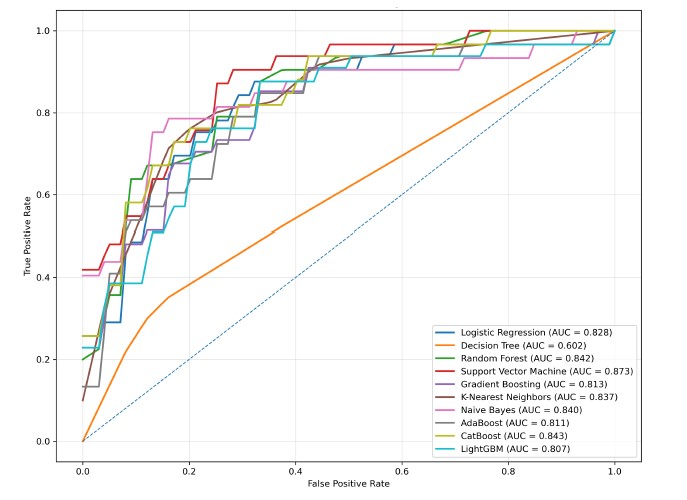
Machine learning (ML) models for hepatitis B virus (HBV) outcome prediction must address high variance, bias, and class imbalance. Previous ensemble-learning studies have commonly combined only two models or considered a limited set of ensemble techniques. This study evaluates how ensemble size, from two to five models, affects performance across voting, bagging, boosting, and stacking approaches. Experiments evaluated ten machine learning models on the UCI Hepatitis dataset using 5-fold cross-validation, with performance assessed using accuracy, precision, recall, F1-score, and area under the receiver operating characteristic curve (AUC). Among individual models, the support vector machine (SVM) achieved the highest accuracy (84.52%) and an AUC of 0.873, while CatBoost and random forest (RF) achieved accuracies of 83.87% and 83.23%, respectively; K-nearest neighbors (KNN) and naïve Bayes (NB) produced comparatively high recall. The five-model soft-voting ensemble achieved 91.84% accuracy, 0.960 AUC, 92.16% F1-score, and 95.92% recall. These findings indicate that multi-model ensembles can improve outcome prediction and high-risk patient identification. The results also suggest that performance depends on strategic model selection rather than ensemble size alone. The proposed 2 + n framework provides a structured approach to flexible model combination across ensemble techniques. Validation using larger, independent clinical datasets is required before broader application.
References
[1] M. Z. Hossain, M. M. Khan, I. Ahmad, F. Yasmin & M. S. Rahman, ``Transparent and explainable AI for liver disease diagnosis using SHAP and LIME'', 2025 4th International Conference on Electronics Representation and Algorithm (ICERA), Yogyakarta, Indonesia, 2025, pp. 599--604. https://doi.org/10.1109/ICERA66156.2025.11087306.
[2] T. G. Dietterich, ``Ensemble methods in machine learning'', in Multiple Classifier Systems, J. Kittler & F. Roli (Eds.), Springer, Berlin, Heidelberg, 2000, pp. 1--15. https://doi.org/10.1007/3-540-45014-9_1.
[3] L. Breiman, ``Bagging predictors'', Machine Learning 24 (1996) 123. https://doi.org/10.1007/BF00058655.
[4] Y. Freund & R. E. Schapire, ``A decision-theoretic generalization of on-line learning and an application to boosting'', Journal of Computer and System Sciences 55 (1997) 119. https://doi.org/10.1006/jcss.1997.1504.
[5] B. Das, R. Sutradhar & D. C. Dalal, ``Exploration of hepatitis B virus infection dynamics through virology-informed neural network: A novel artificial intelligence approach'', arXiv (2025), arXiv:2503.10708. https://doi.org/10.48550/arXiv.2503.10708.
[6] D. N. Tien, H. T. T. Bui, T. H. T. Ngoc, T. T. Pham, D. T. Nguyen, H. N. T. T. Thu, T. T. H. Vu, T. L. A. Luong, L. T. Hoang, H. C. Tu, N. K"orber, T. Bauer & L. K. Ho, ``A data-driven approach to assessing hepatitis B mother-to-child transmission risk prediction model: Machine learning perspective'', JMIR Formative Research 9 (2025) e69838. https://doi.org/10.2196/69838.
[7] A. Ali, A. Ashraf & K. Rahouma, Exploring explainable machine learning in early liver disease detection: Insights from fatty liver and hepatitis B, 2024 6th Novel Intelligent and Leading Emerging Sciences Conference (NILES), Giza, Egypt, 2024, pp. 5--10. https://doi.org/10.1109/NILES63360.2024.10753181.
[8] B. I. Ajuwon, A. Richardson, K. Roper & B. A. Lidbury, ``Clinical validity of a machine learning decision support system for early detection of hepatitis B virus: A binational external validation study'', Viruses 15 (2023) 1735. https://doi.org/10.3390/v15081735.
[9] A. B. Ahosan, F. Islam, K. M. M. Uddin, N. Hasan & M. A. Uddin, ``Improving hepatitis B outcome prediction with ensemble machine learning: A study on predictive models and interpretability'', Digital Health 11 (2025) 20552076251350755. https://doi.org/10.1177/20552076251350755.
[10] B. Adepu & T. Archana, ``Multi-model stack ensemble deep learning approach for multi-disease prediction in healthcare application'', Journal of Mechanics of Continua and Mathematical Sciences 20 (2025) 135. https://doi.org/10.26782/jmcms.2025.03.00009.
[11] G. Obaido, B. Ogbuokiri, T. G. Swart, N. Ayawei, S. M. Kasongo, K. Aruleba, I. D. Mienye, I. Aruleba, W. Chukwu, F. Osaye, O. F. Egbelowo, S. Simelane & E. Esenogho, ``An interpretable machine learning approach for hepatitis B diagnosis'', Applied Sciences 12 (2022) 11127. https://doi.org/10.3390/app122111127.
[12] M. Li, S. Han, F. Liang, C. Hu, B. Zhang, Q. Hou & S. Zhao, ``Machine learning for predicting risk and prognosis of acute kidney disease in critically ill elderly patients during hospitalization: Internet-based and interpretable model study'', Journal of Medical Internet Research 26 (2024) e51354. https://doi.org/10.2196/51354.
[13] V. Harabor, R. Mogoc{s}, A. Nechita, A.-M. Adam, G. Adam, A.-S. Melinte-Popescu, M. Melinte-Popescu, M. Stuparu-Crec{t}u, I.-A. Vasilache, E. Mihu{a}lceanu, A. Cu{a}ru{a}uleanu, A. R. Bivoleanu & A. Harabor, ``Machine learning approaches for the prediction of hepatitis B and C seropositivity'', International Journal of Environmental Research and Public Health 20 (2023) 2380. https://doi.org/10.3390/ijerph20032380.
[14] H. Desalegn, X. Yang, Y.-S. Yen, N. Berhe, B. Kenney, G. H. Siwo, W. Tang, J. Zhu, A. K. Waljee & A. Johannessen, ``Machine-learning methodologies to predict disease progression in chronic hepatitis B in Africa'', Hepatology Communications 8 (2024) e0584. https://doi.org/10.1097/HC9.0000000000000584.
[15] N. Yao, Y. Liu, J. Xu, Q. Wang, Q. Zhou, Y. Wang, D. Yi & Y. Wu, ``Identification of associated risk factors for serological distribution of hepatitis B virus via machine learning models'', BMC Infectious Diseases 24 (2024) 66. https://doi.org/10.1186/s12879-023-08911-8.
[16] D. Shen, L. Sha, L. Yang & X. Gu, ``Identification of multiple complications as independent risk factors associated with 1-, 3-, and 5-year mortality in hepatitis B-associated cirrhosis patients'', BMC Infectious Diseases 25 (2025) 151. https://doi.org/10.1186/s12879-025-10566-6.
[17] P. Pavani, P. Sravanthi, C. Suneetha, M. Azhar, L. H. Supriya Reddy & T. Maddineni, Advanced machine learning approaches for liver disease prediction: A focus on feature selection and hybrid ensemble model, 2025 6th International Conference on Mobile Computing and Sustainable Informatics (ICMCSI), 2025, pp. 1003--1010. https://doi.org/10.1109/ICMCSI64620.2025.10883633.
[18] G. Rekha, M. H. Teja, S. Priyadarshani, K. S. Babu, R. Brindha & R. K. Pongiannan, Optimized machine learning framework for liver disease prediction using ensemble learning and feature selection, 2025 International Conference on Machine Learning and Autonomous Systems (ICMLAS), Prawet, Thailand, 2025, pp. 476--481. https://doi.org/10.1109/ICMLAS64557.2025.10968566.
[19] I. Arupzhanov, D. Syssoyev, A. Alimbayev, G. Zhakhina, Y. Sakko, S. Yerdessov, A. Zollanvari & A. Gaipov, ``One-year mortality prediction of patients with hepatitis in Kazakhstan based on administrative health data: A machine learning approach'', Electronic Journal of General Medicine 21 (2024) em618. https://doi.org/10.29333/ejgm/15747.
[20] S. Dhulipala, B. Maram, R. R. R. Rao, M. Naved, J. K. S. Seles & M. S. Nidhya, A comparative analysis of deep learning and ensemble methods for time series forecasting, 2025 6th International Conference on Mobile Computing and Sustainable Informatics (ICMCSI), 2025, pp. 1713--1716. https://doi.org/10.1109/ICMCSI64620.2025.10883177.
[21] S. Agrawal, M. I. Khan, H. K. Pushpat & S. K. Jain, Optimized stacked classifier to predict hepatitis B disease, 2024 International Conference on Intelligent Computing and Sustainable Innovations in Technology (IC-SIT), 2024, pp. 383--386. https://doi.org/10.1109/IC-SIT63503.2024.10862853.
[22] X. Bai, C. Pu, W. Zhen, Y. Huang, Q. Zhang, Z. Li, Y. Zhang, R. Xu, Z. Yao, W. Wu, M. Sun & X. Li, ``Identifying liver cirrhosis in patients with chronic hepatitis B: An interpretable machine learning algorithm based on LSM'', Annals of Medicine 57 (2025) 2477294. https://doi.org/10.1080/07853890.2025.2477294.
[23] M. Butkevych, S. Yakovlev & D. Chumachenko, ``Data-driven forecasting of acute and chronic hepatitis B in Ukraine with recurrent neural networks'', Applied Sciences 15 (2025) 7573. https://doi.org/10.3390/app15137573.
[24] V. C. Chiawa & K. I. Chibueze, ``Predictive modeling of hepatitis using machine learning algorithms and mathematical formulations'', International Journal of Development Mathematics 2 (2025) 278. https://doi.org/10.62054/ijdm/0202.16.
[25] N. V. Chawla, K. W. Bowyer, L. O. Hall & W. P. Kegelmeyer, ``SMOTE: Synthetic minority over-sampling technique'', Journal of Artificial Intelligence Research 16 (2002) 321. https://doi.org/10.1613/jair.953.
[26] S. M. Lundberg & S.-I. Lee, ``A unified approach to interpreting model predictions'', Advances in Neural Information Processing Systems 30 (2017) 4765. https://doi.org/10.48550/arXiv.1705.07874.
[27] M. T. Ribeiro, S. Singh & C. Guestrin, Why should I trust you? Explaining the predictions of any classifier, Proceedings of the 22nd ACM SIGKDD International Conference on Knowledge Discovery and Data Mining, San Francisco, CA, USA, 2016, pp. 1135--1144. https://doi.org/10.1145/2939672.2939778.
Published
How to Cite
Issue
Section
Copyright (c) 2027 Solomon M. Emmanuel, Moses Timothy, Ovre J. Agushaka (Author)

This work is licensed under a Creative Commons Attribution 4.0 International License.