
Heterogeneous Catalyzed Synthesis of Biodiesel from Crude Sunflower Oil
Keywords:
Crude sunflower oil, Calcium hydroxide, Transesterification, BiodieselAbstract
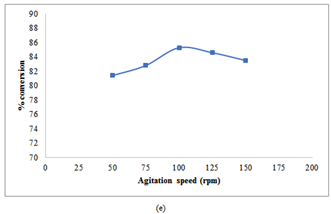
Biodiesel is the fatty acid alkyl esters that are used as the substitute for petro-diesel. The aim of the present work is to optimize biodiesel production from plant based non-edible crude oils with methanol using heterogeneous catalyst by transesterification for its commercialization. The factors affecting the biodiesel production from plant oils are volume of feedstock (oil), volume of alcohol (excess reactant), quantity of calcium hydroxide (catalyst), reaction time, temperature, and agitation speed. Transesterification is the reaction between acid and alcohol to produce ester in the presence of alkali catalyst. In this work, transesterification was carried out between crude sunflower oil and methanol in the presence of calcium hydroxide as catalyst. Finally, the maximum conversion of 85.6% was achieved at the optimum process parameters of 2 L of crude sunflower oil, 0.3 L methanol, 23 g of calcium hydroxide, reaction time of 24 h, temperature of 65 °C, and agitation speed of 100 rpm. The results showed that crude sunflower oil could serve as potential renewable substrate for biodiesel commercialization.Biodiesel is the fatty acid alkyl esters that are used as the substitute for petro-diesel. The aim of the present work is to optimize biodiesel production from plant based non-edible crude oils with methanol using heterogeneous catalyst by transesterification for its commercialization. The factors affecting the biodiesel production from plant oils are volume of feedstock (oil), volume of alcohol (excess reactant), quantity of calcium hydroxide (catalyst), reaction time, temperature, and agitation speed. Transesterification is the reaction between acid and alcohol to produce ester in the presence of alkali catalyst. In this work, transesterification was carried out between crude sunflower oil and methanol in the presence of calcium hydroxide as catalyst. Finally, the maximum conversion of 85.6% was achieved at the optimum process parameters of 2 L of crude sunflower oil, 0.3 L methanol, 23 g of calcium hydroxide, reaction time of 24 h, temperature of 65 ?C, and agitation speed of 100 rpm. The results showed that crude sunflower oil could serve as potential renewable substrate for biodiesel commercialization.
References
Y. Chisti, ”Biodiesel from microalgae”, Biotechnol. Adv. 25 (2007) 294.
J. Van Gerpen, ”Biodiesel processing and production”, Fuel Process. Technol. 86 (2005) 1097.
H. Fukuda, A. Kondo & H. Noda, ”Biodiesel fuel production by transesterification of oils”, J. Biosci. Bioeng. 92 (2001) 405.
L.C.Meher,D.VidyaSagar&S.N.Naik,”Technicalaspectsofbiodiesel production by transesterification—a review”, Renew. Sust. Energ. Rev. 10 (2006) 248.
J. M. Marchetti, V. U. Miguel & A. F. Errazu, ”Possible methods for biodiesel production”, Renew. Sust. Energ. Rev. 11 (2007) 1300.
W. Cao, H. Han & J. Zhang, ”Preparation of biodiesel from soybean oil using supercritical methanol and co-solvent”, Fuel 84 (2005) 347-351.
S. Saka & D. Kusdiana, ”Biodiesel fuel from rapeseed oil as prepared in supercritical methanol”, Fuel 80 (2001) 225.
M. I. Al-Widyan & A. O. Al-Shyoukh, ”Experimental evaluation of the transesterification of waste palm oil into biodiesel”, Bioresour. Technol. 85 (2002) 253.
A. K. Tiwari, A. Kumar & H. Raheman, ”Biodiesel production from jatropha oil (Jatropha curcas) with high free fatty acids: an optimized process”, Biomass Bioenergy 31 (2007) 569.
T. Issariyakul & A. K. Dalai, ”Comparative kinetics of transesterification for biodiesel production from palm oil and mustard oil”, Can. J. Chem. Eng. 90 (2012) 342.
M.Ali, I. A.Watson, ”Comparisonofoil extraction methods, energy analysis and biodiesel production from flax seeds”, Int. J. Energy Res. 38 (2014) 614.
M.Ahmad,K.Ullah,M.A.Khan,M.Zafar,M.Tariq,S.Ali&S.Sultana, ”Physicochemical analysis of hemp oil biodiesel: a promising non edible new source for bioenergy”m Energy Sources A: Recovery Util. Environ. Eff. 33 (2011) 1365.
E. L. Almeida, C. M. G. Andrade & O. A. dos Santos, ”Production of biodiesel via catalytic processes: A brief review”, Int. J. Chem. React. Eng. 16 (2018).
M. Berrios, M.C. Guti´errez, M.A. Mart´?n & A. Mart´?n, ”Application of the factorial design of experiments to biodiesel production from lard”, Fuel Process. Technol. 90 (2009) 1447.
M.Canakci&J.H.VanGerpen, ”Comparisonofengine performance and emissions for petroleum diesel fuel, yellow grease biodiesel, and soybean oil biodiesel”, Trans. ASAE 46 (2003) 937.
V. F. Marulanda, G. Anitescu & L. L. Tavlarides, ”Investigations on supercritical transesterification of chicken fat for biodiesel production from low-cost lipid feedstocks”, J. Supercrit. Fluids 54 (2010) 53.
R. Yahyaee, B. Ghobadian & G. Najafi, ”Waste fish oil biodiesel as a source of renewable fuel in Iran”, Renew. Sust. Energ. Rev. 17 (2013) 312.
Y. Shimada, Y. Watanabe, A. Sugihara & Y. Tominaga, ”Enzymatic alcoholysis for biodiesel fuel production and application of the reaction to oil processing”, J. Mol. Catal., B Enzym. 17 (2002) 133.
R. M.Joshi &M.J.Pegg, ”Flowproperties of biodiesel fuel blends at low temperatures”, Fuel 86 (2007) 143.
A. A. Refaat, ”Different techniques for the production of biodiesel from waste vegetable oil”, Int. J. Environ. Sci. Technol. (Tehran) 7 (2010) 183.
A. A. Refaat, N. K. Attia, H. Aazid Sibak, S. T. El Sheltawy & G. I. ElDiwani, ”Production optimization and quality assessment of biodiesel from waste vegetable oil”, Int. J. Environ. Sci. Technol. (Tehran) 5 (2008) 75.
Q. Shu, J. Gao, Z. Nawaz, Y. Liao, D. Wang & J. Wang, ”Synthesis of biodiesel from waste vegetable oil with large amounts of free fatty acids using a carbon-based solid acid catalyst”, Appl. Energy 87 (2010) 2589.
T.Suresh, N.Sivarajasekar & K. J. R. E.Balasubramani, ”Enhanced ultrasonic assisted biodiesel production from meat industry waste (pig tallow) using green copper oxide nanocatalyst: Comparison of response surface and neural network modelling”, Renew. Energy 164 (2021) 897.
A. Demirbas & M. F. Demirbas, ”Importance of algae oil as a source of biodiesel”, Energy Convers. Manag. 52 (2011) 163.
A. B. M. S. Hossain, A. Salleh, A. N. Boyce, P. Chowdhury & M. Naqiuddin. ”Biodiesel fuel production from algae as renewable energy”, Am. J. Biochem. Biotechnol. 4 (2008) 250.
S. K. Karmee & A. Chadha, ”Preparation of biodiesel from crude oil of Pongamia pinnata”, Bioresour. Technol. 96 (2005) 1425.
E. Crabbe, C. Nolasco-Hipolito, G. Kobayashi, K. Sonomoto & A. Ishizaki, ”Biodiesel production from crude palm oil and evaluation of butanol extraction and fuel properties”, Process Biochem. 37 (2001) 65.
S. Sivamani, A. P. Chandrasekaran, M. Balajii, M. Shanmugaprakash, A. Hosseini-Bandegharaei & R. Baskar. ”Evaluation of the potential of cassava-based residues for biofuels production”, Rev. Environ. Sci. Biotechnol. 17 (2018) 553.
O. Andersen & J. Weinbach, ”Residual animal fat and fish for biodiesel production. Potentials in Norway”, Biomass Bioenergy 34 (2010) 1183.
S. Sadasivam & A. Manickam, Biochemical methods for agricultural sciences. Wiley eastern limited, 1992.
A. S. Ramadhas, S. Jayaraj & C. Muraleedharan, ”Biodiesel production from high FFA rubber seed oil”, Fuel 84 (2005) 335.
M. Balajii & S. Niju, ”A novel biobased heterogeneous catalyst derived from Musa acuminata peduncle for biodiesel production–Process optimization using central composite design”, Energy Convers. Manag. 189 (2019) 118.
J. Zhang, S. Chen, R. Yang & Y. Yan, ”Biodiesel production from vegetable oil using heterogenous acid and alkali catalyst”, Fuel 89 (2010) 2939.
S. Sivamani, S. Selvakumar, K. Rajendran & S. Muthusamy, ”Artificial neural network–genetic algorithm-based optimization of biodiesel production from Simarouba glauca”, Biofuels 10 (2019) 393.
O. S. Stamenkovi´c, M.L. Lazi´c, Z. B. Todorovi´c, V. B. Veljkovi´c & D. U. Skala, ”The effect of agitation intensity on alkali-catalyzed methanolysis of sunflower oil”, Bioresour. Technol. 98 (2007) 2688.
Published
How to Cite
Issue
Section
Copyright (c) 2022 Journal of the Nigerian Society of Physical Sciences

This work is licensed under a Creative Commons Attribution 4.0 International License.







