Mathematical modelling and optimal-control strategies of schistosomiasis–typhoid fever co-infection: using the demographic setting of Makurdi, Benue State, Nigeria
Keywords:
Co-infection, Mathematical model, Schistosomiasis-Typhoid fever, Optimal controlAbstract
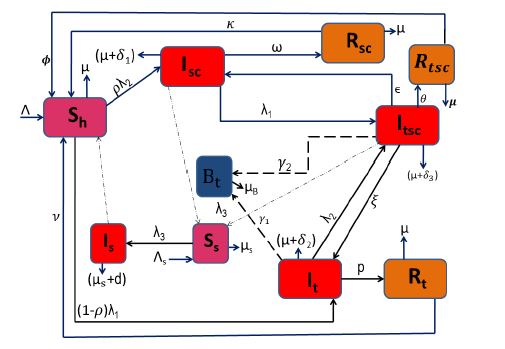
Co-infection of schistosomiasis and typhoid fever presents a significant public-health challenge and complicates clinical management. Both diseases are prevalent and endemic in African regions, particularly Nigeria, but their co-dynamics remain insufficiently studied. This study developed a deterministic mathematical model to examine the co-dynamics of schistosomiasis and typhoid fever in Makurdi, Benue State, Nigeria. The basic reproduction number (R0) for the sub-models and the full co-infection model was calculated to assess the stability of the disease-free equilibrium and to conduct bifurcation analysis. The endemic equilibrium was derived. Global sensitivity analysis was conducted, and an optimal-control model was formulated with five time-dependent controls: prevention of schistosomiasis, prevention of typhoid fever, screening and treatment for schistosomiasis, screening and treatment for typhoid fever, and screening and treatment for co-infections. The model was analysed using the Pontryagin maximum principle and the forward--backward sweep method. Numerical simulations included single, pairwise, and combined interventions. The results indicate that prevention strategies for both diseases are more effective than treatment alone. The study recommends implementing concurrent control interventions for both diseases to achieve optimal co-infection management.
References
[1] World Health Organization, ``Schistosomiasis'', 2023. Available online: https://www.who.int/news-room/fact-sheets/detail/schistosomiasis.
[2] World Health Organization, Guideline on Control and Elimination of Human Schistosomiasis, World Health Organization, Geneva, Switzerland, 2022. Available online: https://www.who.int/publications/i/item/9789240041608.
[3] Centers for Disease Control and Prevention, ``Schistosomiasis'', 2024. Available online: https://www.cdc.gov/dpdx/schistosomiasis/index.html.
[4] A. Marege, M. Seid, B. Boke, S. Thomas, M. Arage, N. Mouze, T. Yohanes, M. Woldemariam & A. Manilal, ``Prevalence of Schistosoma mansoni--Salmonella coinfection among patients in southern Ethiopia'', New Microbes and New Infections 40 (2021) 100842. https://doi.org/10.1016/j.nmni.2021.100842.
[5] R. S. Barsoum, G. Esmat & T. El-Baz, ``Human schistosomiasis: clinical perspective: review'', Journal of Advanced Research 4 (2013) 433. https://doi.org/10.1016/j.jare.2013.01.005.
[6] World Health Organization, ``Typhoid'', 2023. Available online: https://www.who.int/news-room/fact-sheets/detail/typhoid.
[7] Centers for Disease Control and Prevention, ``About typhoid fever and paratyphoid fever'', 2024. Available online: https://www.cdc.gov/typhoid-fever/about/index.html.
[8] J. Bhandari, P. K. Thada, M. F. Hashmi & E. DeVos, ``Typhoid fever'', in StatPearls, StatPearls Publishing, Treasure Island, FL, 2026. Available online: https://www.ncbi.nlm.nih.gov/books/NBK557513/.
[9] K. A. Tijani, C. E. Madubueze & R. I. Gweryina, ``Typhoid fever dynamical model with cost-effective optimal control'', Journal of the Nigerian Society of Physical Sciences 5 (2023) 1579. https://doi.org/10.46481/jnsps.2023.1579.
[10] K. O. Okosun & R. Smith, ``Optimal control analysis of malaria--schistosomiasis co-infection dynamics'', Mathematical Biosciences and Engineering 14 (2017) 377. https://doi.org/10.3934/mbe.2017024.
[11] E. T. Chiyaka, G. Magombedze & L. Mutimbu, ``Modelling within host parasite dynamics of schistosomiasis'', Computational and Mathematical Methods in Medicine 11 (2010) 124376. https://onlinelibrary.wiley.com/doi/10.1080/17486701003614336.
[12] H. O. Nyaberi & J. S. M. Musaili, ``Mathematical modeling of the impact of treatment on the dynamics of typhoid'', Journal of the Egyptian Mathematical Society 29 (2021) 15. https://doi.org/10.1186/s42787-021-00125-8.
[13] M. Ghosh, P. Chandra, P. Sinha & J. B. Shukla, ``Modelling the spread of bacterial infectious disease with environmental effect in a logistically growing human population'', Nonlinear Analysis: Real World Applications 7 (2006) 341. https://doi.org/10.1016/j.nonrwa.2005.03.005.
[14] T. D. Mangal, S. Paterson & A. Fenton, ``Predicting the impact of long-term temperature changes on the epidemiology and control of schistosomiasis: a mechanistic model'', PLoS ONE 3 (2008) e1438. https://doi.org/10.1371/journal.pone.0001438.
[15] Macrotrends, ``Nigeria life expectancy 1950--2025'', 2025. Available online: https://www.macrotrends.net/global-metrics/countries/nga/nigeria/life-expectancy.
[16] I. J. Uloko & A. J. Michael, ``Comparative studies of water leaf (Talinnu triangulare), pawpaw leaf (Carica papaya), Siam weed (Chromolaena dorata) and growers mash on the growth of African giant snail (Achatina achatina)'', East African Scholars Journal of Agriculture and Life Sciences 2 (2019). https://doi.org/10.36349/easjals.2019.v02i07.004.
[17] J. M. Mutua, F. B. Wang & N. K. Vaidya, ``Modeling malaria and typhoid fever co-infection dynamics'', Mathematical Biosciences 264 (2015) 128. https://doi.org/10.1016/j.mbs.2015.03.014.
[18] C. DerSarkissian, ``Typhoid fever (Salmonella Typhi)'', 2024. Available online: https://www.webmd.com/a-to-z-guides/typhoid-fever.
[19] M. Kgosimore & G. Kelatlhegile, ``Mathematical analysis of typhoid infection with treatment'', Journal of Mathematical Science: Advances and Applications 40 (2016) 75. http://dx.doi.org/10.18642/jmsaa_7100121689.
[20] A. Hsiao, T. Toy, H. J. Seo & F. Marks, ``Interaction between Salmonella and schistosomiasis: a review'', PLoS Pathogens 12 (2016) e1005928. https://doi.org/10.1371/journal.ppat.1005928.
[21] A. A. F. Mahmoud, ``Schistosomiasis'', in Tropical Medicine: Science and Practice, A. A. F. Mahmoud (Ed.), Imperial College Press, London, UK, 2001. https://www.amazon.co.uk/Schistosomiasis-Tropical-Medicine-Science-Practice/dp/186094146X?asin=186094146X&revisionId=&format=4&depth=1.
[22] P. I. Eche & P. O. Adikwu, ``Assessment of water and sanitation conditions in Benue South Senatorial District, Benue State, Nigeria'', European Journal of Biology and Medical Science Research 13 (2025) 61. Available online: https://doi.org/10.37745/ejbmsr.2013.
[23] O. Maxwell, A. Oklo & A. Bernard, ``Profile of water related diseases in Benue State, Nigeria'', American Journal of Human Ecology 1 (2012) 87. https://scispace.com/pdf/profile-of-water-related-diseases-in-benue-state-nigeria-f4yk2ya6ru.pdf.
[24] V. U. Obisike, E. M. Victor, V. C. Uzoma & E. U. Amuta, ``Urinary schistosomiasis in some Otukpo communities in Otukpo Local Government Area of Benue State Nigeria'', Asian Journal of Medical Principles and Clinical Practice 4 (2021) 1. Available online: https://journalajmpcp.com/index.php/AJMPCP/article/view/66.
[25] H. O. Okpala, G. O. Nwobu, M. I. Agba & J. O. Akor, ``Prevalence of schistosomiasis in Wurukum, Makurdi Local Government Area of Benue State, Nigeria'', Journal of Medical Laboratory Sciences 12 (2005) 47. https://doi.org/10.4314/jmls.v12i2.35288.
[26] D. Yandev, V. N. Chigor & E. A. Eze, ``Studies on biochemical characterization of Salmonella and mixed infection cases with schistosomiasis in Kwande LGA, Benue State, Nigeria'', International Journal of Sciences: Basic and Applied Research 61 (2022) 1. https://www.gssrr.org/JournalOfBasicAndApplied/article/view/12870.
[27] G. Zaman, I. H. Jung, F. M. D. Torres & A. Zeb, ``Mathematical modelling and control of infectious disease'', Computational and Mathematical Methods in Medicine 2017 (2017) 7149154. https://doi.org/10.1155/2017/7149154.
[28] G. T. Tilahun, O. D. Makinde & D. Malonza, ``Modelling and optimal control of typhoid fever disease with cost-effective strategies'', Computational and Mathematical Methods in Medicine 2017 (2017) 2324518. https://doi.org/10.1155/2017/2324518.
[29] S. Musa, N. Bello & A. Umar, ``Mathematical modelling of the transmission dynamics, control and vaccination of schistosomiasis with a variable population size'', Bayero Journal of Pure and Applied Sciences 12 (2019) 70. https://doi.org/10.4314/bajopas.v12i1.10.
[30] W. Nur, Trisilowati, A. Suryanto & W. M. Kusumawinahyu, ``Mathematical model of schistosomiasis with health education and molluscicide intervention'', Journal of Physics: Conference Series 1821 (2021) 012033. https://doi.org/10.1088/1742-6596/1821/1/012033.
[31] E. Kanyi, A. S. Afolabi & N. O. Onyango, ``Mathematical modeling and analysis of transmission dynamics and control of schistosomiasis'', Journal of Applied Mathematics 2021 (2021) 6653796. https://doi.org/10.1155/2021/6653796.
[32] F. E. T. Nkuimeni & B. Tsanou, ``Schistosomiasis mathematical model in a spatially heterogeneous environment'', Results in Applied Mathematics 23 (2024) 100488. https://doi.org/10.1016/j.rinam.2024.100488.
[33] O. Robert & A. M. Baba, ``Mathematical model for schistosomiasis transmission dynamics and optimal control in Uganda'', International Journal of Science for Global Sustainability 11 (2025) 195. Available online: https://fugus-ijsgs.com.ng/index.php/ijsgs/article/view/802.
[34] K. A. Tijani, C. E. Madubueze & R. I. Gweryina, ``Modelling typhoid fever transmission with treatment relapse response: optimal control and cost-effectiveness analysis'', Mathematical Models and Computer Simulations 16 (2024) 457. https://doi.org/10.1134/S2070048224700169.
[35] K. S. Abdulai & S. Baba, ``A mathematical model on the transmission dynamics of typhoid fever with treatment and booster vaccination'', Frontiers in Applied Mathematics and Statistics 9 (2023) 1151270. https://doi.org/10.3389/fams.2023.1151270.
[36] O. F. Lawal, T. T. Yusuf & A. Abidemi, ``On mathematical modelling of optimal control of typhoid fever with efficiency analysis'', Journal of the Nigerian Society of Physical Sciences 6 (2024) 2057. https://doi.org/10.46481/jnsps.2024.2057.
[37] J. Nthiiri, O. Lawi, C. Akinyi, D. Oganga, W. Muriuki, M. Musyoka, P. Otieno & L. Koech, ``Mathematical modelling of typhoid fever disease incorporating protection against infection'', British Journal of Mathematics & Computer Science 14 (2016) 1. https://doi.org/10.9734/BJMCS/2016/23325.
[38] F. K. Alalhareth, M. H. Alharbi & M. A. Ibrahim, ``Modeling typhoid fever dynamics: stability analysis and periodic solutions in epidemic model with partial susceptibility'', Mathematics 11 (2023) 3713. https://doi.org/10.3390/math11173713.
[39] S. Nana-Kyere, J. K. K. Asamoah, J. D. Ankamah, E. Okyere, B. Seidu, D. Kwarteng, E. L. Ayetey & J. B. Odum, ``Mathematical modeling and cost-effectiveness analysis of an $S_eE_eI_eR_e$ typhoid fever model'', Journal of Mathematics 2025 (2025) 1212057. https://doi.org/10.1155/jom/1212057.
[40] S. Mushayabasa & C. P. Bhunu, ``Modeling schistosomiasis and HIV/AIDS codynamics'', Computational and Mathematical Methods in Medicine 2011 (2011) 846174. https://onlinelibrary.wiley.com/doi/10.1155/2011/846174.
[41] E. A. Bakare & R. C. Nwozo, ``Mathematical analysis of malaria--schistosomiasis coinfection model'', Epidemiology Research International 2016 (2016) 3854902. https://doi.org/10.1155/2016/3854902.
[42] E. Bonyah, K. O. Okosun, O. O. Okosun & L. Ossei, ``Mathematical modeling of lymphatic filariasis--schistosomiasis co-infection dynamics: insight through public education'', International Journal of Ecology & Development 33 (2018). https://www.researchgate.net/publication/325115297_Mathematical_modeling_of_Lymphatic_filariasis-schistosomiasis_co-infection_dynamicsInsight_through_public_education.
[43] I. I. Ako & R. U. Omoregie, ``Sensitivity analysis of a mathematical model for tuberculosis--schistosomiasis model with vaccination and treatment'', Earthline Journal of Mathematical Sciences 15 (2025) 849. https://doi.org/10.34198/ejms.15525.849872.
[44] L. Matsebula & F. Nyabadza, ``Mathematical analysis of cholera--typhoid co-infection transmission dynamics'', Frontiers in Applied Mathematics and Statistics 8 (2022) 892098. https://doi.org/10.3389/fams.2022.892098.
[45] D. S. Mgonja, A. Hugo, A. Hassan & O. D. Makinde, ``Mathematical modeling and analysis of COVID-19 and typhoid fever co-dynamics with treatment'', Scientific Reports 15 (2025) 33206. https://doi.org/10.1038/s41598-024-82955-x.
[46] M. S. Wameko, P. R. Koya & A. G. Wedajo, ``Mathematical modeling of co-infections of hepatitis A viral disease and typhoid fever with optimal control strategies'', International Journal of Nonlinear Analysis and Applications 13 (2022) 899. https://doi.org/10.22075/ijnaa.2022.21134.2237.
[47] K. A. Tijani & C. E. Madubueze, ``Understanding the dynamics of ameobiasis using mathematical modelling approach: optimal control strategies and cost-effectiveness analysis'', International Journal of Mathematical Sciences and Optimization: Theory and Applications 11 (2025) 138. https://ijmso.unilag.edu.ng/article/view/2908.
[48] A. A. Modebe, A. U. Nnachi, C. O. Ukaegbu, N. Tata, M. V. Agah, O. E. Udu-Ibiam & I. A. Nnachi, ``Dual infections of Enteric Salmonella species with Schistosoma mansoni among Patients from Two Hospitals in Jos, Nigeria '', Journal of Applied & Environmental Microbiology 2(4) (2014) 198. https://doi.org/10.12691/jaem-2-4-14.
[49] A. M. A. Mohamed & M. N. M. Hamad, ``Relationship between intestinal schistosomiasis and enteric fever among Sudanese patients, New Halfa Town, Kassala State, Sudan'', Journal of Microbiology & Experimentation 8 (2020) 109. https://doi.org/10.15406/jmen.2020.08.00293.
[50] C. E. Madubueze, R. I. Gweryina & K. A. Tijani, ``A dynamic of typhoid fever model with optimal control analysis'', Ratio Mathematica 41 (2021) 255. http://dx.doi.org/10.23755/rm.v41i0.657.
[51] A. J. Sayooj, R. Raja, B. T. Omede, R. P. Agarwal, J. Alzabut, J. Cao & V. E. Balas, ``Mathematical modeling on co-infection: transmission dynamics of Zika virus and Dengue fever'', Nonlinear Dynamics 111 (2023) 4879. https://doi.org/10.1007/s11071-022-08063-5.
[52] P. van den Driessche & J. Watmough, ``Reproduction numbers and sub-threshold endemic equilibria for compartmental models of disease transmission'', Mathematical Biosciences 180 (2002) 29. https://www.sciencedirect.com/science/article/abs/pii/S0025556402001086.
[53] M. M. Lunga, Mathematical Models for the Coinfection Dynamics of Cholera and Typhoid, Ph.D. dissertation, University of Johannesburg, Johannesburg, South Africa, 2012. Available online: https://ujcontent.uj.ac.za/esploro/outputs/doctoral/Mathematical-models-for-the-coinfection-dynamics/9910470507691#file-0.
[54] J. M. Heffernan, R. J. Smith & L. M. Wahl, ``Perspectives on the basic reproductive ratio'', Journal of the Royal Society Interface 2 (2005) 281. https://doi.org/10.1098/rsif.2005.0042.
[55] C. Castillo-Chavez & B. Song, ``Dynamical models of tuberculosis and their applications'', Mathematical Biosciences and Engineering 1 (2004) 361. https://doi.org/10.3934/mbe.2004.1.361.
[56] C. Castillo-Chavez, Z. Feng & W. Huang, ``On the computation of $R_0$ and its role on the global stability'', in Mathematical Approaches for Emerging and Reemerging Infectious Diseases: An Introduction, C. Castillo-Chavez, S. Blower, P. van den Driessche, D. Kirschner & A. A. Yakubu (Eds.), Springer, New York, NY, USA, 2002, pp. 229--250. Available online: https://www.researchgate.net/profile/Carlos-Castillo-Chavez/publication/228915276_ON_THE_COMPUTATION_OF_R_AND_ITS_ROLE_ON_GLOBAL_STABILITY/links/0fcfd50a569d32c708000000/ON-THE-COMPUTATION-OF-R-AND-ITS-ROLE-ON-GLOBAL-STABILITY.pdf.
[57] W. Okongo, C. Muhumuza, N. S. Aguegboh, E. Bwambale & B. Diallo, ``Mathematical modelling of the co-infection dynamics of soil-transmitted helminths and schistosomiasis with optimal control'', Boundary Value Problems 2025 (2025) 160. https://doi.org/10.1186/s13661-025-02146-z.
[58] Macrotrends, ``Makurdi, Nigeria metro area population 1950--2026'', 2025. Available online: https://www.macrotrends.net/global-metrics/cities/23539/makurdi/population.
[59] S. M. Blower & H. Dowlatabadi, ``Sensitivity and uncertainty analysis of complex models of disease transmission: an HIV model, as an example'', International Statistical Review 62 (1994) 229. https://doi.org/10.2307/1403510.
[60] W. H. Fleming & R. W. Rishel, Deterministic and Stochastic Optimal Control, Springer, New York, NY, USA, 1975. https://doi.org/10.1007/978-1-4612-6380-7.
[61] L. S. Pontryagin, V. G. Boltyanskii, R. V. Gamkrelidze & E. F. Mishchenko, The Mathematical Theory of Optimal Processes, John Wiley & Sons, London, UK, 1962. https://doi.org/10.1002/zamm.19630431023.
[62] World Health Organization, Guidelines for Laboratory and Field Testing of Molluscicides for Control of Schistosomiasis, World Health Organization, Geneva, Switzerland, 2019. Available online: https://www.who.int/publications/i/item/9789241515405.
Published
How to Cite
Issue
Section
Copyright (c) 2026 Kazeem A. Tijani, Chinwendu E. Madubueze, Reuben I. Gweryina, Terhemen Aboiyar (Author)

This work is licensed under a Creative Commons Attribution 4.0 International License.