Modeling the dynamics of type 2 diabetes with modifiable lifestyle influence
Keywords:
Type 2 diabetes mellitus, Differential transformation method, Compartmental mode, Stability analysis, Lifestyle pressureAbstract
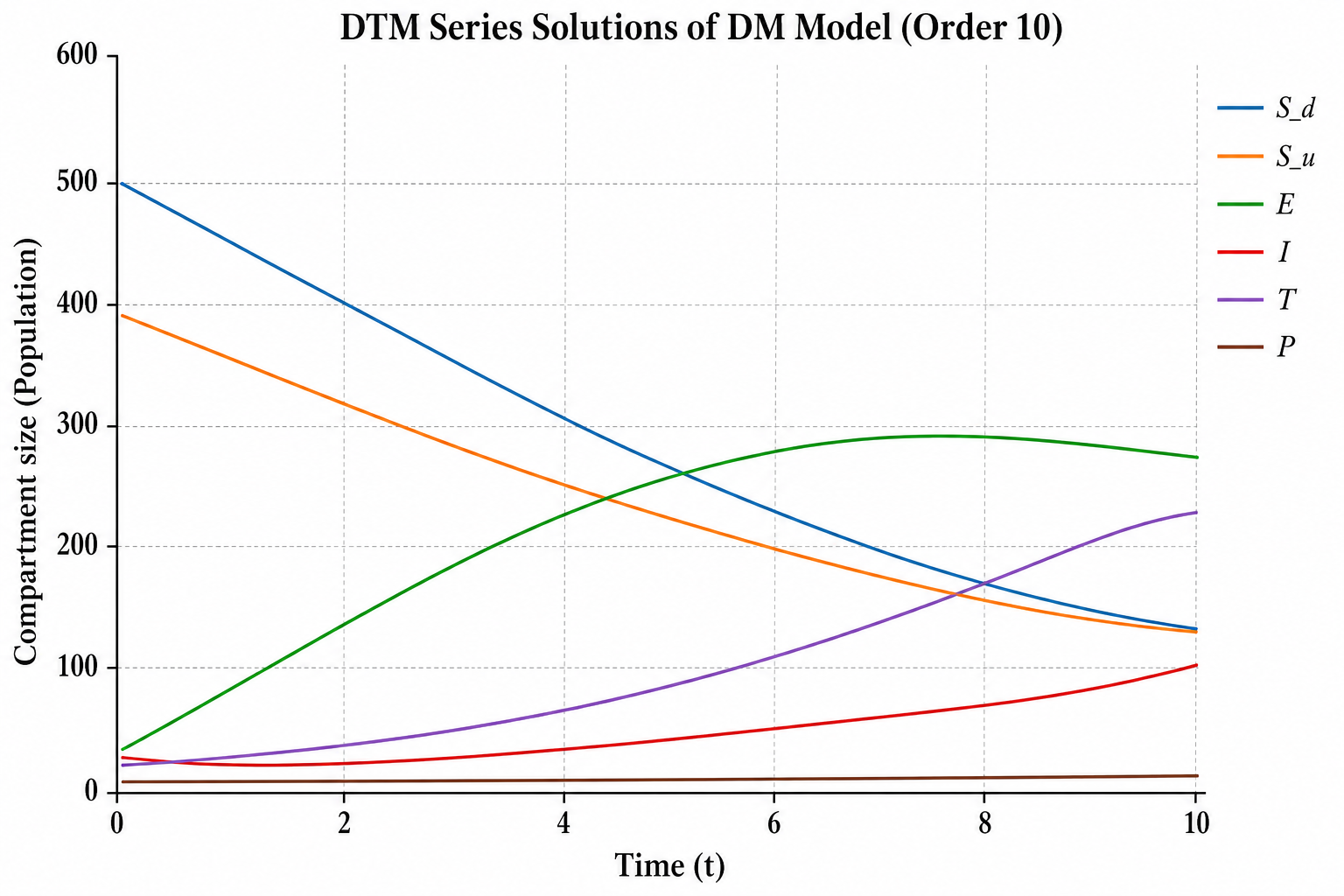
Type 2 diabetes mellitus (T2DM) is a multifactorial metabolic disorder driven by the interaction of insulin resistance, $\beta$-cell dysfunction, and modifiable lifestyle and environmental factors. Despite substantial advances in treatment, the global burden of T2DM continues to increase, highlighting the need for integrative frameworks that capture both biological and behavioral drivers of disease progression. In this study, we develop and analyze a deterministic compartmental model that incorporates genetic susceptibility, environmental exposure, diagnosis, treatment, and a modifiable lifestyle pressure variable representing socioeconomic and behavioral influences. The model is formulated as a system of nonlinear ordinary differential equations and analyzed using standard qualitative techniques, including positivity, boundedness, and stability analysis. We establish key dynamical properties and show that a disease-free equilibrium exists only under restrictive conditions, whereas an endemic equilibrium persists when environmental pressure and disease conversion are active. A semi-analytical solution obtained via the differential transformation method (DTM) is used to explore system dynamics and intervention scenarios. The results indicate that reducing lifestyle pressure, improving awareness, and increasing treatment initiation significantly reduce disease prevalence. Specifically, lowering lifestyle pressure or enhancing its dissipation reduces the equilibrium burden, while increasing awareness limits transitions into disease states and reduces overall disease spread.
References
[1] American Diabetes Association, ``Standards of medical care in diabetes---2022'', Diabetes Care 45 (2022) S97. https://doi.org/10.2337/dc22-S007.
[2] International Diabetes Federation, IDF Diabetes Atlas, 10th ed., International Diabetes Federation, Brussels, Belgium, 2021. Available online: https://www.diabetesatlas.org.
[3] International Diabetes Federation, IDF Diabetes Atlas, 10th ed., International Diabetes Federation, Brussels, Belgium, 2022. Available online: https://diabetesatlas.org/data/en/country/16/bd.html.
[4] M. J. Hossain, M. Al-Mamun & M. R. Islam, ``Diabetes mellitus, the fastest growing global public health concern: Early detection should be focused'', Health Science Reports 7 (2024) e2004. https://doi.org/10.1002/hsr2.2004.
[5] M. Fang, D. Wang, J. Coresh & E. Selvin, ``Trends in diabetes treatment and control in U.S. adults, 1999--2018'', The New England Journal of Medicine 384 (2021) 2219. https://doi.org/10.1056/NEJMsa2032271.
[6] S. T. Hardy, B. C. Jaeger, K. Foti, L. Ghazi, G. Wozniak & P. Muntner, ``Trends in blood pressure control among U.S. adults with hypertension, 2013--2014 to 2021--2023'', American Journal of Hypertension 38 (2025) 120. https://doi.org/10.1093/ajh/hpae141.
[7] J. A. Campbell, R. J. Walker, B. L. Smalls & L. E. Egede, ``Use of social adaptability index to explain self-care and diabetes outcomes'', BMC Endocrine Disorders 17 (2017) 34. https://doi.org/10.1186/s12902-017-0185-3.
[8] S. E. Nissen & K. Wolski, ``Effect of rosiglitazone on the risk of myocardial infarction and death from cardiovascular causes'', The New England Journal of Medicine 356 (2007) 2457. https://doi.org/10.1056/NEJMoa072761.
[9] D. X. Brown & M. Evans, ``Choosing between GLP-1 receptor agonists and DPP-4 inhibitors: A pharmacological perspective'', Journal of Nutrition and Metabolism 2012 (2012) 381713. https://doi.org/10.1155/2012/381713.
[10] S. P. Marso, S. C. Bain, A. Consoli, F. G. Eliaschewitz, E. J'odar, L. A. Leiter, I. Lingvay, J. Rosenstock, J. Seufert, M. L. Warren, V. Woo, O. Hansen, A. G. Holst, J. Pettersson & T. Vilsbo{}ll, ``Semaglutide and cardiovascular outcomes in patients with type 2 diabetes'', The New England Journal of Medicine 375 (2016) 1834. https://doi.org/10.1056/NEJMoa1607141.
[11] B. Zinman, C. Wanner, J. M. Lachin, D. Fitchett, E. Bluhmki, S. Hantel, M. Mattheus, T. Devins, O. E. Johansen, H. J. Woerle, U. C. Broedl & S. E. Inzucchi, ``Empagliflozin, cardiovascular outcomes, and mortality in type 2 diabetes'', The New England Journal of Medicine 373 (2015) 2117. https://doi.org/10.1056/NEJMoa1504720.
[12] L. Fregoso-Aparicio, J. Noguez, L. Montesinos & J. A. Garc'ia-Garc'ia, ``Machine learning and deep learning predictive models for type 2 diabetes: A systematic review'', Diabetology & Metabolic Syndrome 13 (2021) 148. https://doi.org/10.1186/s13098-021-00767-9.
[13] I. Kavakiotis, O. Tsave, A. Salifoglou, N. Maglaveras, I. Vlahavas & I. Chouvarda, ``Machine learning and data mining methods in diabetes research'', Computational and Structural Biotechnology Journal 15 (2017) 104. https://doi.org/10.1016/j.csbj.2016.12.005.
[14] E. G. Dada, A. I. Birma & A. A. Gora, ``Ensemble machine learning algorithm for cost-effective and timely detection of diabetes in Maiduguri, Borno State'', Journal of the Nigerian Society of Physical Sciences 6 (2024) 2175. https://doi.org/10.46481/jnsps.2024.2175.
[15] S. S. Lim, E. Carnahan, E. C. Nelson, C. W. Gillespie, A. H. Mokdad, C. J. L. Murray & E. S. Fisher, ``Validation of a new predictive risk model: Measuring the impact of the major modifiable risks of death for patients and populations'', BMJ Open 13 (2015) 27. https://doi.org/10.1186/s12963-015-0059-8.
[16] V. Hohberg, E. Lichtenstein, J. N. Kreppke, C. Zanitti, F. Streckmann, M. Gerber & O. Faude, ``Effects of lifestyle interventions to promote physical activity on physical activity and glycated hemoglobin in patients with type 2 diabetes: A systematic review and meta-analysis'', Sports Medicine 55 (2025) 1165. https://doi.org/10.1007/s40279-025-02184-8.
[17] Q. Ying, Y. Xu, Z. Zhang, L. Cai, Y. Zhao & L. Jin, ``Gestational diabetes mellitus and risk of long-term all-cause and cardiac mortality: A prospective cohort study'', Cardiovascular Diabetology 23 (2024) 47. https://doi.org/10.1186/s12933-024-02131-3.
[18] A. A. Irawan, N. Anggriani, Y. Andriyana & R. Abdulah, ``Mathematical modeling for community-based intervention for managing diabetes: A systematic literature review'', Journal of Multidisciplinary Healthcare 18 (2025) 2429. https://doi.org/10.2147/JMDH.S510753.
[19] O. R. Amanso, J. O. Abonyo, P. R. Kiogora & O. C. Collins, ``A novel mathematical model for transmission dynamics of HPV and cervical cancer progression with cancer-reliant awareness'', Journal of the Nigerian Society of Physical Sciences 8 (2026) 3224. https://doi.org/10.46481/jnsps.2026.3224.
[20] A. Makroglou, J. Li & Y. Kuang, ``Mathematical models and software tools for the glucose--insulin regulatory system and diabetes: An overview'', Applied Numerical Mathematics 56 (2006) 559. https://doi.org/10.1016/j.apnum.2005.04.023.
[21] P. F. De Paola, A. Borri, A. Paglialonga, P. Palumbo & F. Dabbene, ``A model-based approach for glucose control via physical activity'', arXiv (2025). Available online: https://arxiv.org/abs/2503.09435.
[22] K. Wagh, A. Kirpich & G. Chowell, ``The future diabetes mortality: Challenges in meeting the 2030 Sustainable Development Goal of reducing premature mortality from diabetes'', Journal of Clinical Medicine 14 (2025) 3364. https://doi.org/10.3390/jcm14103364.
[23] M. T. Islam, M. Bruce & K. Alam, ``Prevalence and correlates of health care utilization for non-communicable diseases in Bangladesh'', BMC Health Services Research 25 (2025) 736. https://doi.org/10.1186/s12913-025-12906-3.
[24] M. I. Hossain, M. D. Gupta, T. F. Ohi & M. M. Rahman, ``Bayesian analysis of non-communicable diseases risk factors: A focus on the lower-educated population in Bangladesh'', International Health 17 (2025) 499. https://doi.org/10.1093/inthealth/ihae087.
[25] M. Islam, A. Sarkar, M. Hossain, M. Ahmed & A. Ferdous, ``Prediction of attention and short-term memory loss by EEG workload estimation'', Journal of Biosciences and Medicines 11 (2023) 304. https://doi.org/10.4236/jbm.2023.114022.
[26] E. Bernardi, T. Lorenzi, M. Sensi & A. Tosin, ``Heterogeneously structured compartmental models of epidemiological systems: From individual-level processes to population-scale dynamics'', Studies in Applied Mathematics 155 (2025) e70091. https://doi.org/10.1111/sapm.70091.
[27] S. Li, J. Wang, B. Zhang, X. Li & Y. Liu, ``Diabetes mellitus and cause-specific mortality: A population-based study'', Diabetes & Metabolism Journal 43 (2019) 319. https://doi.org/10.4093/dmj.2018.0060.
[28] S. Li, R. J. MacInnis, A. Lee, T. Nguyen-Dumont, L. Dorling, S. Carvalho, G. S. Dite, M. Shah, C. Luccarini, Q. Wang, R. L. Milne, M. A. Jenkins, G. G. Giles, A. M. Dunning, P. D. P. Pharoah, M. C. Southey, D. F. Easton, J. L. Hopper & A. C. Antoniou, ``Segregation analysis of 17,425 population-based breast cancer families: Evidence for genetic susceptibility and risk prediction'', American Journal of Human Genetics 109 (2022) 1777. https://doi.org/10.1016/j.ajhg.2022.09.006.
[29] J. K. Zhou, Differential Transformation and Its Applications for Electrical Circuits, Huazhong University Press, Wuhan, China, 1986. Available online: https://www.scirp.org/reference/referencespapers?referenceid=1912818.
[30] O. Odetunde, J. Lawal & A. Y. Ayinla, ``Role of reinfection in transmission dynamics of COVID-19: A semi-analytical approach using differential transform method'', Malaysian Journal of Computing 6 (2021) 745. Available online: https://mjoc.uitm.edu.my/main/index.php/journal/23-volume-6-1-2021/116-9814.
[31] Diabetes Prevention Program Research Group, ``10-year follow-up of diabetes incidence and weight loss in the Diabetes Prevention Program Outcomes Study'', The Lancet 374 (2009) 1677. https://doi.org/10.1016/S0140-6736(09)61457-4.
Published
How to Cite
Issue
Section
Copyright (c) 2026 Opeyemi Odetunde, Tunde Alesinloye, Omoniyi Francis (Author)

This work is licensed under a Creative Commons Attribution 4.0 International License.