Analysis of a fractional order climate model due to excessive emission and accumulation of carbon dioxide in the atmosphere
Keywords:
Climate change, Fractional order, Carbon dioxide, Excessive emissionAbstract
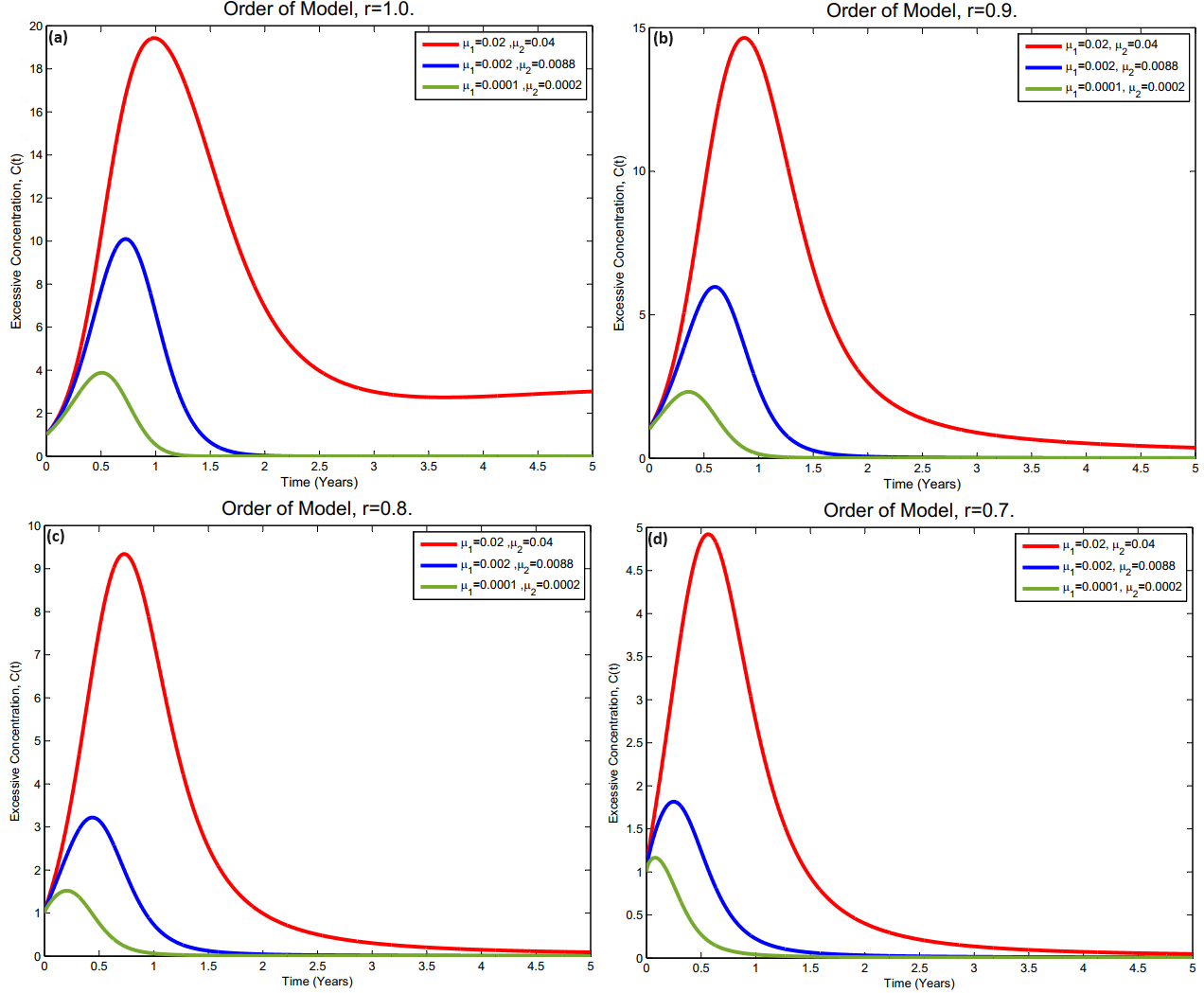
The devastating consequences of climate change on our planet cannot be taken lightly. Greenhouse gas emissions due to the various activities of the increasing human population are solely responsible for this change. The chief and most significant of these gases is carbon dioxide. A fractional-order model of five compartments is considered. The uniqueness and existence, the positivity, and the boundedness of the model solution are established. The equilibrium points of the model are given. By formulating different Lyapunov functions, the global stability of the four equilibrium points was determined. The numerical simulation of the model was done using the Predict-Evaluate-Correct-Evaluate method of Adam-Bashforth-Moulton by considering four different orders of 0.7, 0.8, 0.9, and 1.0. According to the results, excessive concentrations of carbon dioxide in the atmosphere can be reduced by the joint employment of mitigation measures.
Published
How to Cite
Issue
Section
Copyright (c) 2023 Peter Urane Achimugwu, Mathew Ngugi Kinyanjui, David Mumo Malonza

This work is licensed under a Creative Commons Attribution 4.0 International License.
How to Cite
Similar Articles
- Richard Olu Awonusika, Oluwaseun Akinlo Mogbojuri, Approximate Analytical Solution of Fractional Lane-Emden Equation by Mittag-Leffler Function Method , Journal of the Nigerian Society of Physical Sciences: Volume 4, Issue 2, May 2022
- Joshua Sunday, Joel N. Ndam, Lydia J. Kwari, An Accuracy-preserving Block Hybrid Algorithm for the Integration of Second-order Physical Systems with Oscillatory Solutions , Journal of the Nigerian Society of Physical Sciences: Volume 5, Issue 1, February 2023
- O. M. Ogunlaran, M. A. Kehinde, M. A. Akanbi, E. I. AKINOLA, A Chebyshev polynomial based block integrator for the direct numerical solution of fourth order ordinary differential equations , Journal of the Nigerian Society of Physical Sciences: Volume 6, Issue 2, May 2024
- Dalal Khalid Almutairi, Mohamed A. Abdoon, Salih Yousuf Mohamed Salih, Shahinaz A.Elsamani, Fathelrhman EL Guma, Mohammed Berir, Modeling and Analysis of a Fractional Visceral Leishmaniosis with Caputo and Caputo–Fabrizio derivatives , Journal of the Nigerian Society of Physical Sciences: Volume 5, Issue 3, August 2023
- Saddam Husain Dhobi, Kishori Yadav, Suresh Prasad Gupta, Jeevan Joyti Nakarmi, Ajay Kumar Jha, Non-monochromatic laser assist scattering in thermal environment , Journal of the Nigerian Society of Physical Sciences: Volume 7, Issue 1, February 2025
- Mark I. Modebei, Olumide O. Olaiya, Ignatius P. Ngwongwo, Computational study of a 3-step hybrid integrators for third order ordinary differential equations with shift of three off-step points , Journal of the Nigerian Society of Physical Sciences: Volume 3, Issue 4, November 2021
- K. Issa, A. T. AbdulKareem, A D. Adeshola, R. A. Bello, Numerical solution of fractional advection-diffusion equation with generalized Caputo derivative using shifted ultraspherical collocation method , Journal of the Nigerian Society of Physical Sciences: Volume 8, Issue 2, May 2026
- Benson Ade Eniola Afere, On the fourth-order hybrid beta polynomial kernels in kernel density estimation , Journal of the Nigerian Society of Physical Sciences: Volume 6, Issue 1, February 2024
- Richard O. Akinola, Ezekiel O. Omole, Joshua Sunday, Stephen Y. Kutchin, A ninth-order first derivative method for numerical integration , Journal of the Nigerian Society of Physical Sciences: Volume 7, Issue 1, February 2025
- G. Ajileye, A. A. James, Collocation Method for the Numerical Solution of Multi-Order Fractional Differential Equations , Journal of the Nigerian Society of Physical Sciences: Volume 5, Issue 3, August 2023
You may also start an advanced similarity search for this article.