Hybrid deep belief network and fuzzy clustering approach for geothermal prospectivity mapping in northeastern Nigeria using magnetic and landsat data
Keywords:
Geothermal mapping, DBN, FCM, Unsupervised learningAbstract
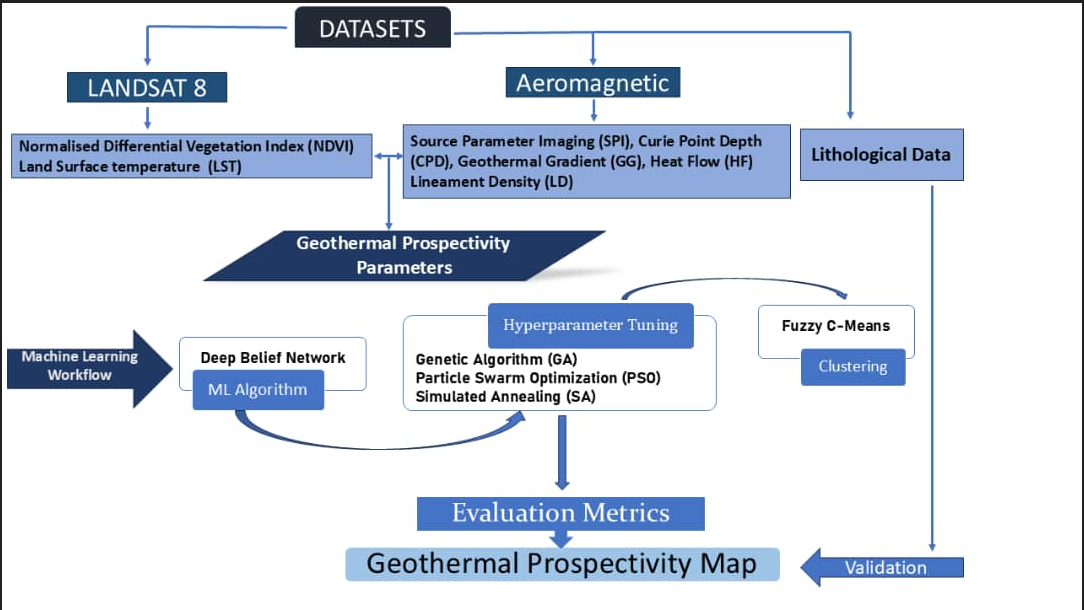
Nigeria faces persistent energy supply challenges, particularly in its northeastern region, where grid access is limited and dependence on fossil fuels undermines sustainability goals. Although the National Renewable Energy Action Plan (NREAP 2015–2030) outlines ambitious targets for renewable energy integration, it notably lacks specific strategies for geothermal development—leaving a critical gap in policy and resource utilization. This study addresses that gap by developing a scalable, cost-effective geothermal prospectivity mapping framework using remote sensing and aeromagnetic data integrated through a hybrid machine learning model. A novel combination of Deep Belief Networks (DBN) for feature extraction and Fuzzy C-Means (FCM) clustering for spatial classification was employed, with optimization achieved using three metaheuristic algorithms: Genetic Algorithm (GA), Particle Swarm Optimization (PSO), and Simulated Annealing (SA). Among these, the DBN-SA model achieved the best internal validity, with superior Silhouette Score, Davies–Bouldin Index, and cluster compactness, ensuring robust and interpretable prospectivity results. Key geothermal indicators—including land surface temperature, vegetation stress, Curie depth, heat flow, and magnetic source depth—were derived from Landsat and airborne magnetic datasets. The resulting map classifies the study area into low, moderate, and high geothermal potential zones, with validation supported by geological correlation and the presence of known thermal features like the Wikki Warm Spring. Approximately one-third of the area was identified as high-potential, particularly over basement terrains with high heat production and structural permeability. This approach offers both scientific insight and practical direction for decentralized, low-carbon energy deployment in northeastern Nigeria, aligning with broader national renewable energy goals and filling a crucial gap in geothermal resource planning.
Published
How to Cite
Issue
Section
Copyright (c) 2025 A. K. Usman, Y. A. Hassan, A. A. Bery, A. A. Sunny, M. D. Dick, A. B. Mohammed, R. O. Aderoju (Author)

This work is licensed under a Creative Commons Attribution 4.0 International License.
How to Cite
Similar Articles
- G. G. James, A. P. Ekong, A. U. Unyime, A. Akpanobong, J. A. Odey, D. O. Egete, S. Inyang, I. Ohaeri, C. M. Orazulume, E. Etuk, P. Okafor, Compiler-assisted code generation for quantum computing: leveraging the unique properties of quantum architectures , Journal of the Nigerian Society of Physical Sciences: Volume 7, Issue 2, May 2025
- Santosh Kumar Upadhyay, Rajesh Prasad, Efficient-ViT B0Net: A high-performance light weight transformer for rice leaf disease recognition and classification , Journal of the Nigerian Society of Physical Sciences: Volume 7, Issue 4, November 2025
- Oluwaseun IGE, Keng Hoon Gan, Ensemble feature selection using weighted concatenated voting for text classification , Journal of the Nigerian Society of Physical Sciences: Volume 6, Issue 1, February 2024
- O. E. Osafile, O. N. Nenuwe, Lattice Dynamics and thermodynamic Responses of XNbSn Half-Heusler Semiconductors: A First-Principles Approach , Journal of the Nigerian Society of Physical Sciences: Volume 3, Issue 2, May 2021
- C. E. Duru, C. E. Enyoh, I. A. Duru, M. C. Enedoh, Degradation of PET Nanoplastic Oligomers at the Novel PHL7 Target:Insights from Molecular Docking and Machine Learning , Journal of the Nigerian Society of Physical Sciences: Volume 5, Issue 1, February 2023
- Amos Orenyi Bajeh, Mary Olayinka Olaoye, Fatima Enehezei Usman-Hamza, Ikeola Suhurat Olatinwo, Peter ogirima Sadiku, Abdulkadir Bolakale Sakariyah, An adaptive neuro-fuzzy inference system for multinomial malware classification , Journal of the Nigerian Society of Physical Sciences: Volume 7, Issue 1, February 2025
- F. C. Ugbe, O. E. Ominigbo, A. O. Akano, Tectonic Setting of the Syenite Around Igarra, Southwestern Nigeria: Constraints from Geochemistry , Journal of the Nigerian Society of Physical Sciences: Volume 5, Issue 1, February 2023
- Majid Khan Bin Majahar Ali, Shahida Shahnawaz, An inverse physics-informed neural network (I-PINN) framework for parameter estimation in mixed convection and melting effects , Journal of the Nigerian Society of Physical Sciences: Volume 8, Issue 2, May 2026
- Yusuf Ibrahim, Strong Convergence Theorems for Split Common Fixed Point Problem of Bregman Generalized Asymptotically Nonexpansive Mappings in Banach Spaces , Journal of the Nigerian Society of Physical Sciences: Volume 1, Issue 2, May 2019
- M. M. Tanko, M. S. Liman, W. L. Lumbi, U. S. Aliyu, M. U. Sarki, Field Strength Variability Mapping of Nigeria , Journal of the Nigerian Society of Physical Sciences: Volume 4, Issue 3, August 2022
You may also start an advanced similarity search for this article.