Contamination levels, occurrence pattern and associated risk of organophosphate pesticide residues in spices and herbs sold in southern Nigeria
Keywords:
OPPs, GC-MS, Daily dietary intake, Hazard indexAbstract
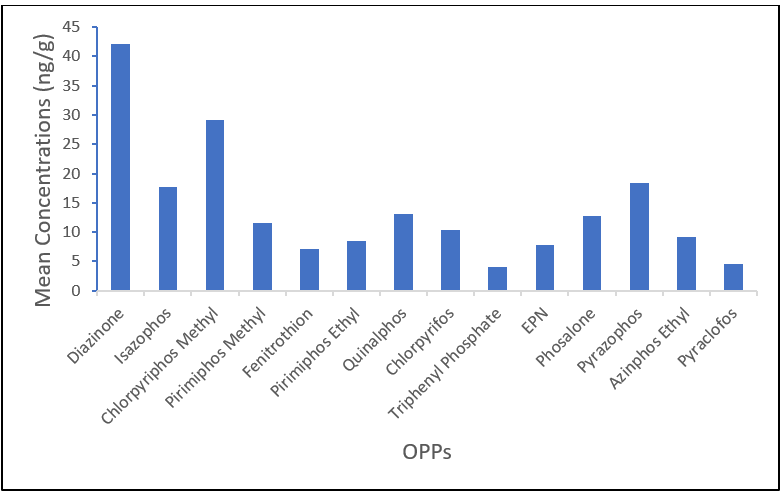
This study investigated the contamination levels, occurrence pattern and associated health risks of organophosphate pesticide residues in spices and herbs sold in southern Nigeria. Fifty-two samples of commonly consumed spices and herbs were purchased from multiple locations in southern Nigeria and subjected to extraction using dichloromethane/n-hexane (1:1, v/v). Thereafter, the extracts were analysed for 14 OPPs on gas chromatograph-mass spectrometry. The contamination levels of the$\mathrm{\sum}$14 OPPs in the spices and herbs ranged between 4.96 and 795 ng/g. The average OPP concentrations in the spices and herbs were in the order of diazinone > chlorpyriphos methyl > pyrazophos > isazophos > quinalphos > phosalone > pirimiphos methyl > chlorpyrifos > azinphos ethyl > pirimiphos ethyl > EPN > fenitrothion > pyraclofos > triphenyl phosphate. The OPPs concentrations in the spices and herbs were below the maximum residue limits (MRLs) established by FAO/WHO. The risk estimated using hazard index indicated the absence of non-carcinogenic risk from the intake of these spices and herbs except for seven samples in the case of children intake. Although the findings suggest minimal health risks from OPPs through intake of these spices and herbs, we recommended that there is need for continuous monitoring of spices and herbs sold generally in Nigeria markets for pesticides contamination and the appropriate regulators should establish MRLs for OPPs in foodstuffs in Nigeria and ensure strict compliance with the MRLs of contaminants in food and drugs.
References
[1] O. Green, F.C. Nworgu & M.N. Obazee, “Spices and food condiments in Niger-Delta region of Nigeria”, African Journal of Biotechnology 11 (2012) 14468. https://doi.org/10.5897/AJB12.1088.
[2] U. Parthasarathy, O.P. Nandakishore, R.S. Kumar & V.A. Parthasarathy, “A comparison on the physio-chemical parameters of seed-butters of selected Indian garcinia SPP”, Journal of Global Biosciences 3 (2014) 872. https://www.mutagens.co.in/jgb/vol.03/6/01.pdf.
[3] R. Vazquez-Fresno, A.R.R. Rosana, T. Sajed, T. Onookome-Okome, N.A. Wishart & D.S. Wishart, “Herbs and spices-biomarkers of intake based on human intervention studies - A Systematic Review”, Genes Nutr. 14 (2019) 18. https://doi.org/10.1186/s12263-019-0636-8.
[4] S. Raghavan, Handbook of spices, seasonings and flavorings, 2nd Edition, CRC Press, Boca Raton, FL, USA (2007). https://api.pageplace.de/preview/DT0400.9781420004366 A25101312/preview-9781420004366 A25101312.pdf.
[5] R. Mahajan, S. Verma, S. Chandel & S. Chatterjee, “Chapter 24 - Organophosphate pesticides: usage, environmental exposure, health effects, and microbial bioremediation”, in Techniques and Case Studies for Environmental Pollution, Vol. 2, Elsevier, 2022, pp. 473–490. https://doi.org/10.1016/B978-0-323-85455-9.00013-8.
[6] E.L. Robb & M.B. Baker, “Organophosphate toxicity”, in StatPearls (Internet), Treasure Island (FL): StatPearls Publishing, 2023. https://assets.ctfassets.net/vkzvxhuznjvt/2Ji7OWaFDHWLfCyKIFLNsQ/b62813cf17953bf2da3d0444ff72a7fb/Organophosphate Toxicity - StatPearls - NCBI Bookshelf.pdf.
[7] A. Adeyinka, E. Muco & A.C. Regina, “Organophosphates”, in StatPearls (Internet), Treasure Island (FL): StatPearls Publishing, 2023. https://pubmed.ncbi.nlm.nih.gov/static-page/down bethesda.html.
[8] H. Mali, C. Shah, D.M. Rudakiya, D.H. Patel, U. Trivedi & R.B. Subramanian, “A novel organophosphate hydrolase from Arthrobacter SP. HMOI: Characterization and applications”, Bioresource Technology 349 (2022) 126870. https://doi.org/10.1016/j.biortech.2022.126870.
[9] D.M. Dash & W.J. Osborne, “A systematic review on the implementation of advance and revolutionary bioremediation of organophosphorus pesticides”, Chemosphere 313 (2023) 137506. https://doi.org/10.1016/j.chemosphere.2022.137506.
[10] H. Mali, C. Shah, B.H. Raghunandan, A.S. Prajapati, D.H. Patel, U. Trivedi & R.B. Subramanian, “Organophosphate pesticides an emerging environmental contaminant: Pollution, toxicity, bioremediation progress, and remaining challenges”, Journal of Environmental Science 127 (2023) 234. https://doi.org/10.1016/j.jes.2022.04.023.
[11] C.E. Fulco, C.T. Liverman & H.C. Sox, “Effects of long-term exposure to organophosphate pesticides in human”, in Gulf War and Health, Vol. 1, National Academies Press, Washington, DC, USA, 2000. https://pubmed.ncbi.nlm.nih.gov/static-page/down bethesda.html.
[12] G.O. Tesi, K.E. Okpara, J.N. Tesi, I.E. Agbozu & K. Techato, “Human exposure to endocrine-disrupting organochlorine and organophosphate pesticides in locally produced and imported honey in Nigeria”, Int. J. Environ. Health. Res. 35 (2024) 784. https://doi.org/10.1080/09603123.2024.2373169.
[13] G.O. Tesi, K.E. Okpara, J.N. Tesi, I.E. Agbozu & K. Techato, “Assessment of organophosphate pesticides in soils and vegetables from agricultural areas of Delta Central District, Nigeria”, Scientific Reports 15 (2025) 8267. https://doi.org/10.1038/s41598-024-83518-w.
[14] A.I. Amusat, S.A. Okewole, R.A. Rafiu & M.A. Amusat, “Overview of pesticides usage, misuse and its impact on environmental degradation in south western states and some part of Northern states in Nigeria”, Journal of Pesticides Science and Pest Control 2 (2023) 1. https://doi.org/10.58489/2833-0943/013.
[15] C. Olisah, O.O. Okoh & A.I. Okoh, “Global evolution of organochlorine pesticides research in biological and environmental matrices from 1992 to 2018: A bibliometric approach”, Emerg. Contam 5 (2019) 157. https://doi.org/10.1016/j.emcon.2019.05.001.
[16] O.T. Fatunsin, A.O. Oyeyiola, M.O. Moshood, L.M. Akanbi & D.E. Fadahunsi, “Dietary risk assessment of organophosphate and carbamate pesticide residues in commonly eaten food crops”, Sci. Afr. 8 (2020) e00442. https://doi.org/10.1016/j.sciaf.2020.e00442.
[17] C.E. Ogwuche, J.O. Origbon & G.O. Tesi, “Evaluation of human exposure to organophosphate pesticides in some brands of canned fish available in the Nigerian market”, Chem. Afr. https://doi.org/10.1007/s42250-025-01458-y.
[18] M.O. Edema, F.O. Alawuru, S.E. Ekpamaku & G.O. Tesi, “Occurrence and potential risk of organophosphorus pesticide residues in some edible vegetable oils sold in markets in Warri, Delta State”, Afr. Sci. 26 (2025) 151. https://doi.org/10.26538/africanscientist.26.2.20250607.
[19] G.O. Tesi, B. Lari, A.A. Ogbuta, I. Felagha, G.C. Obodoka, W.E. Ogbomade, K.E. Okpara, E. Osioma & I.E. Agbozu, “Organophosphate pesticides in herbal mixtures from Bayelsa State, Nigeria: implication for human exposure and risks”, J. Environ. Expo. Assess 4 (2025) 2. https://dx.doi.org/10.20517/jeea.2024.30.
[20] Y.T. Awe, A.Y. Sangodoyin & M.B. Ogundiran, “Assessment of organophosphate pesticide residues in environmental media of Araromi farm settlement, Osun State, Nigeria”, Environ Anal. Health Toxicol. 37 (2022) e2022035. https://doi.org/10.5620/eaht.2022035.
[21] J.O. Akinneye, A.O. Adedolapo & F.P. Adesina, “Quantification of Organophosphate and Carbamate residue on stored grains in Ondo State, Nigeria”, J. Biol. Med. 2 (2018) 001. http://dx.doi.org/10.17352/aur.000003.
[22] European Commission, “Analytical quality control and method validation for pesticide residues analysis in food and feed”, SANTE/12682/2019 (2019). https://www.eurl-pesticides.eu/userfiles/file/eurlall/aqcguidance sante 2019 12682.pdf.
[23] USEPA, “Regional screening levels (RSL) summary tables” (2022). http://www.epa.gov/risk/risk-based-screening-table-generic-tables.
[24] USEPA, “Mid Atlantic risk assessment, regional screening level (RSL). Summary Table” (2012). https://www.epa.gov/region9/surperfund/prg.
[25] G. Kowalska, “Pesticide residues in some polish herbs”, Agriculture 10 (2020) 54. https://doi.org/10.3390/agriculture10050154.
[26] F.M. Siméon, A. Coralie, L. Clara, H. Johann & K. Sylvain, “Pesticide residues in botanics used in feed additives: focusing on wild vs. cultivable plants”, Int. J. Environ. Pollut. Remed 7 (2019) 36. https://doi.org/10.11159/ijepr.2019.004.
[27] G. Di Bella, A.G. Potortì, A.B. Tekaya, A. Beltifa, H.B. Mansour, E. Sajia, G. Bartolomeo, C. Naccari, G. Dugo & V. Lo Turco, “Organic contamination of Italian and Tunisian culinary herbs and spices”, J. Environ. Sci. Health. B. 54 (2019) 345. https://doi.org/10.1080/03601234.2019.1571364.
[28] H. Tong, Y. Tong, J. Xue, D. Liu & X. Wu, “Multi-residual pesticide monitoring in commercial Chinese herbal medicines by gas chromatography–triple quadrupole tandem mass spectrometry”, Food Anal. Methods 7 (2024) 135. https://doi.org/10.1007/s12161-013-9609-5.
[29] I. Reinholds, I. Pugajeva, K. Bavrins, G. Kuckovska & V. Bartkevics, “Mycotoxins, pesticides and toxic metals in commercial spices and herbs”, Food Addit. Contam. Part B Surveill. 10 (2017) 5. https://doi.org/10.1080/19393210.2016.1210244.
[30] L. Chen, F. Song, Z. Liu, Z. Zheng, J. Xing & S. Liu, “Multi-residue method for fast determination of pesticide residues in plants used in traditional Chinese medicine by ultra-high-performance liquid chromatography coupled to tandem mass spectrometry”, J. Chromatogr. A. 1225 (2012) 132. https://doi.org/10.1016/j.chroma.2011.12.071.
[31] G. Du, Y. Song & Y. Wang, “Rapid simultaneous determination of multiple pesticide residues in traditional Chinese medicines using programmed temperature vaporizer injection-fast gas chromatography coupled with mass spectrometry”, J. Sep. Sci. 34 (2011) 3372. https://doi.org/10.1002/jssc.201100712.
[32] R.S. Farag, L.M. Abdel, E.G.A. Abd & S.M. Dogheim, “Monitoring of pesticide residues in some Egyptian herbs, fruits and vegetables”, Int. Food Res. J. 18 (2011) 659. http://www.ifrj.upm.edu.my/18%20(02)%202011/(27)%20IFRJ.
[33] E.S.J. Harris, S. Cao, B.A. Littlefield, J.A. Cracroft, R. Scholten, T. Kaptchuk, Y. Fu, W. Wang, Y. Liu, H. Chen, Z. Zhao, J. Clardy, A.D. Woolf & D.M. Eisenberg, “Heavy metal and pesticide content in commonly prescribed individual raw Chinese herbal medicines”, Sci. Total Environ. 409 (2011) 4297. https://doi.org/10.1016/j.scitotenv.2011.07.032.
[34] FAO and WHO, “Report 2021 - Pesticide residues in food - Joint FAO/WHO Meeting on Pesticide Residues”, Rome (2022). https://doi.org/10.4060/cb8313en.
[35] B. Klier, E. Häfner, H. Albert, G. Bender, M. Knodler, M. Kuhn, A. Schenk & B. Steinhoff, “Pesticide residues in herbal drugs: evaluation of a database”, J. Appl. Res. Med. Aromat. Plants 15 (2019) 100223. https://doi.org/10.1016/j.jarmap.2019.100223.
[36] A.A.K. Abou-Arab & M.A. Abou-Donia, “Pesticides residue in some Egyptian spices and medicinal plants as affected by processing”, Food Chemistry 72 (2001) 439. https://doi.org/10.1016/S0308-8146(00)00254-5.
[37] A. Ambrus, “Evaluation of pesticide residues in spices”, Hungarian Food Safety Office, Budapest, Hungary (2010). https://www.fao.org/fileadmin/user_upload/IPM_Pesticide/JMPR/Evaluations/2010/Spices.pdf.
[38] J.R. Suarez-Lopez, H. Checkoway, D.R. Jacobs, W.K. Al-Delaimy & S. Gahagan, “Potential short-term neurobehavioral alteration in children associated with peak pesticide spray season: The mother day flower harvest in Ecuador”, Neurotoxicity 60 (2017) 125. https://doi.org/10.1016/j.neuro.2017.02.002.
Published
How to Cite
Issue
Section
Copyright (c) 2025 Duke Okoro, Oghenenyerhovwo E. Ididama, Godswill O. Tesi, Jude C. Ossai (Author)

This work is licensed under a Creative Commons Attribution 4.0 International License.