Physicochemical Characteristics and Toxicity Studies of Crude Oil, Dispersant and Crude Oil-Dispersant Test Media to Marine Organisms
Keywords:
Ecobest® dispersant, Tilapia guineensis, Palaeomontes africanus, Crude oil, Toxicity studyAbstract
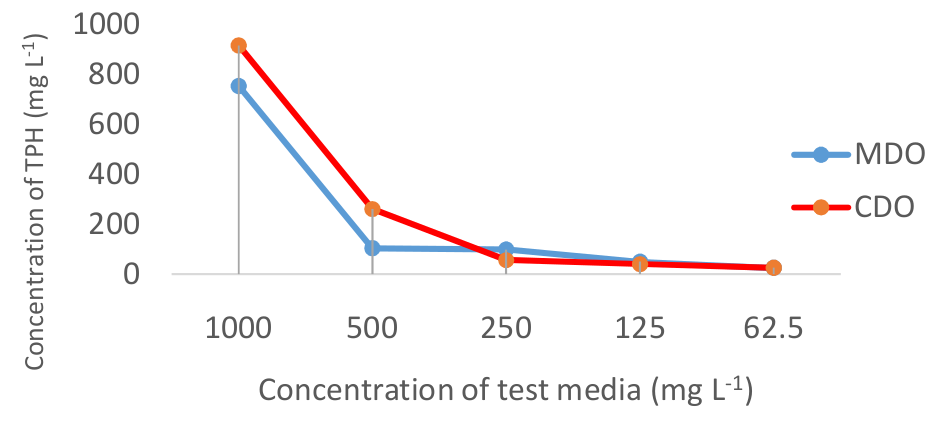
In this study, the physicochemical characteristics of crude oil, dispersant and crude oil-dispersant test systems and their toxicities on representative marine organisms in a simulated marine ecosystem was assessed. Mechanically dispersed crude oil-in-water test system (MDO) and its water accommodated fraction (WAF) alone, and in combination with a third generation dispersant (D) (Ecobest®), which gave rise to chemically dispersed crude oil-in-water test system (CDO) and its water accommodated fraction (CEWAF), as well as a reference toxicant, sodium dodecyl sulphate (SDS) were used to evaluate toxicities on selected marine organisms (Fish – Tilapia guineensis, Crustacean – Palaeomontes africanus, and Bacteria – Total heterotrophic bacteria and hydrocarbon utilizing bacteria). Physicochemical characteristics were done using standard methods. The static with renewal bioassay option was employed for toxicity tests involving Fish and Crustacean, while the static without renewal option was used for microbial bioassays. Marine organisms were exposed to the following concentrations: 1000, 500, 250, 125, 62.5 and 0 mg/L of MDO, CDO, D, WF and CEWAF, respectively. The LC50 (lethal concentration that resulted in 50% mortality) at 96h and toxicity factors were determined. Results for physicochemical characteristics of the test systems showed that the pH, dissolved oxygen levels were sufficient for sustaining aquatic habitation. Lead metal was present in high amounts in the dispersant test system, but relatively low in chemically dispersed test systems. Cd and Ni were also present at relative amounts that could be toxic to aquatic lives. Toxicity data showed that the new dispersant, Ecobest® was non-toxic to the tested marine organisms relative to the reference toxicant (SDS), which was moderately toxic. The 96h LC50 of MDO, CDO, D, WAF, CEWAF and SDS were 89.8, 225.6, 1891.8, 683.9, 528.1 and 1.37 for T. guineensis, and 275.5, 137.7, 3800.9, 76.1, 168.3 and 9.99 for P. africanus, and 1658.5, 944.1, 17221.9, 228641.0, 1036319.3 and 3.84 for total heterotrophic bacteria. The reference toxicant, SDS, was the most toxic of the toxicants, but the dispersant reduced the toxicity y several folds. However, with the presence of some heavy metals, notably Pb, Cd and Ni, and some levels of polycyclic aromatic hydrocarbons in the test media water, there may be likelihood for bioaccumulation to occur in the tissues of marine organisms.
References
Joint Experts on the Scientific Aspects of Marine Pollution (JESAMP), “The atmospheric input of species to the World Oceans” 38 (1998) 111.
T. Milinkovitch, J. Lucas, S. Le Floch, H. Thomas-Guyon & C.Lefrançois, “Effect of dispersed crude oil exposure upon the aerobic metabolic scope in juvenile golden greymullet (Liza aurata)”, Marine Pollution Bulletin 64 (2012) 865.
R. C. Prince, B. A. Kelley & J. D. Butler, “Three widely-available dispersants substantially increase the biodegradation of otherwise undispersed oil”,Journal of Marine Science and Resource Development 6 (2016) 183.
W. O. Odiete, “Environmental physiology of animals and pollution”.Lagos: Diversified ResLtd. Lagos. Nigeria (1999). ISBN: 978-028-957-7.
Q. Lin & I. A. Mendelssohn, “The combined effects of phytoremediation and biostimulation in enhancing habitat restoration and oil degradation of petroleum contaminated wetlands”, Ecology and Engineering 10 (1998) 263.
A. George-Ares & J. R. Clark, “Aquatic toxicity of two Corexitr dispersants”, Chemosphere 40 (2000) 897.
R. Alameda, C. Hyatt & E. J. Buskey, “Toxicity of dispersant Corexit 9500A and crude oil to marine microzooplankton”,Ecotoxicology, Environment and Safety 106 (2014) 76.
M. Dussauze, K. Pichavant-Rafini, S. Le Floch, P. Lemaire & M. Theron, “Acute toxicity of chemically and mechanically dispersed crude oil to juvenile sea bass (Dicentrarchuslabrax ): absence of synergistic effects between oil and dispersants”, Environmental Toxicology and Chemistry 34 (2015) 1543.
M. Fingas, “A review of literature related to oil spill dispersants especially relevant to Alaska”for Prince William Sound Regional Citizens, Advisory Council (PWSRCAC) Anchorage, Alaska, (2002).
L. DeMiguel-Jiménez, N. Etxebarria, X. Lekube, U. Izagirre & I. Marigómez, “Influence of dispersant application on the toxicity to sea urchin embryos of crude and bunker oils representative of prospective oil spill threats in Arctic and Sub-Arctic seas”,Marine Pollution Bulletin 172 (2021) 112922.
P. E. Ndimele, A. Jenyo-Oni & C. C. Jibuike, “Investigation of acute toxicities of Nigerian crude oil, dispersant, sodium dodecyl sulphate and a mixture of crude oil plus dispersant to Desmocaristrispinisa”, American-Eurasian Journal of Toxicological Sciences 2 (2010a) 100.
P. E. Ndimele, A. Jenyo-Oni & C. C.Jibuike, “Comparative toxicity of crude oil, dispersant and crude oil-plus-dispersant to Tilapia guineensis”,Research Journal of Environmental Toxicology 4 (2010b) 13.
L. O. Odokuma & G. C.Okpokwasili, “Response of microbial enzymes synthesis to toxicity of weathered and biodegraded oils”, Global Journal of Pure and Applied Science 9 (2003) 465.
K. E. Lelei & S. D. Sikoki, “Effects of dispersed Bonny light crude oil on two life stages of Oreochromisniloticus(Linnaeus, 1975)”,Trends in Applied Sciences Research 9 (2013) 480.
M. J. Hemmer, M. G. Barron & R. M. Greene, “Comparative toxicity of eight oil dispersants, Louisiana sweet crude oil (LSC), and chemically dispersed LSC to two aquatic test species”, Environmental Toxicology and Chemistry 30 (2011) 2244.
A. Özdemir, “Usage of TPH (total petroleum hydrocarbons) in water analysis for oil and gas exploration: first important results from Turkey”, Journal of Engineering Sciences and Design 6 (2018) 615.
J. W. Anderson,J. M. Neff, B. A. Cox, H. Tatem &G. M. Hightower,“Characteristics of dispersions and water-soluble extracts of crude and refined oils and their toxicity to estuarine Crustaceans and Fish”. Marine Biology 27 (1974) 75.
APHA (American Public Health Association),Standard methods for the examination of water and wastewater , 23rd edition, Washington USA (2017).
M. Csuros & C.Csuros,“Environmental sampling and analysis for metals”, Lewis Publishers (2002).
OECD 203 Guideline for testing of chemicals: fish, acute toxicity test. Adopted by the Council on 17 th July 1992.
Department of Petroleum Resources (DPR), “Environmental guidelines and standards for the petroleum industry in Nigeria”. Revised Edition, (2002).
M. G. Barron, M. G. Carls,J. W. Short &S. D. Rice,“Photoenhanced toxicity of aqueous-phase and chemically dispersed weathered Alaska North Slope crude oil to Pacificherring eggs and larvae”,Environmental Toxicology and Chemistry 22 (2003) 650.
D. J. Finney,“Probit Analysis”, 3rd Edition, Cambridge University Press, Cambridge, England (1971).
C. A. Ajuzieogu, “Risk assessment of produced water discharged in a tropical marine ecosystem”, Ph.D. Thesis, Department of Microbiology, University of Port Harcourt, Nigeria (2019).
C. E. Boyd & F.R. Lichtkoppler,“Water quality management for pond fish culture. Research and Development Series”. 22 International Centre forAquaculture Agricultural Experimental Station, Anburn University Auburn, Alabama (1979).
B. Swistock, “Interpreting water tests for ponds and lakes”, College of Agricultural Sciences, Pennsylvania State University”(2015). Retrieved from https:extension.psu.edu/interpreting-water-tests-for-ponds-and-lakes.
C.M.O. Ademoroti. “Standard methods for water and effluents analysis”, Foludex Press Ltd., Ibadan (1996).
D. V. Chapman, “Water quality assessments: a guide to the use of biota, sediments and water in environment monitoring”, World Health Organization, UNESCO & United Nations Environment Programme,2nd Edition, E & FN Spon, London (1996).
S. I. Ovie & H.A. Adeniji,“A simple guide to water quality management in fish ponds”, National Institute for Freshwater Fisheries Research, New Bussa. Technical Report Series No. 23 (1990).
B. Oram, “Phosphates in the environment”, Water Research Watershed Centre (2014), Retrieved from www.waterresearch.net/index.php/phosphates on 12/12/2018
P. D. Vowels & D.W. Connel, ”Experiments in environmental chemistry”,Pergamin Press, New York. (1980).
D. Mara, “Sewage Treatment in Hot Climates”, John Wiley and Sons, Toronto (1983).
J. A. Adakole, J. K. Balogun & F.A. Lawal, “The effect of pollution on benthic fauna in Buidare streams, Zaria, Nigeria”, Nigerian Journal of Chemical Resources 3 (1998) 13.
World Health Organisation (WHO),“Guidelines for drinking water”, WHO Geneva, (2005).
S. A. Sakroon, “Effect of oil field brine on groundwater quality in Marmul area”, M.Sc. Thesis,Sultanate of Oman, United Arab Emirates University (2008).
A. A. Otitoloju & T. O. Popoola, “Estimation of“environmentally sensitive” dispersal ratios forchemical dispersants used in crude oil spill control”,The Environmentalist 29 (2009) 371. DOI: 10.1007/S10669-008-9212-2.
C. A. Ajuzieogu & L. O. Odokuma. “Comparison of the sensitivity of Crassostreagigas and V. fischeri (Microtox) for toxicity assessment of produced water”, Journal of Advances in Biology and Biotechnology 17 (2018) 1.
C. B. Chikere, C. A. Ajuzieogu & M. C. Miller, “Characterisation of indigenous bacterial communities in crude oil-impacted sites at Obagi town, Onelga, Rivers State, Nigeria”, Fine Focus Journal 2 (2015) 7.
Published
How to Cite
Issue
Section
Copyright (c) 2022 Journal of the Nigerian Society of Physical Sciences

This work is licensed under a Creative Commons Attribution 4.0 International License.