Biochemical synthesis, characterization and electrodeposition of silver nanoparticles on a gold substrate
Keywords:
Silver nanoparticles, characterisation, electrodeposition, diffusion coefficient, AFM.Abstract
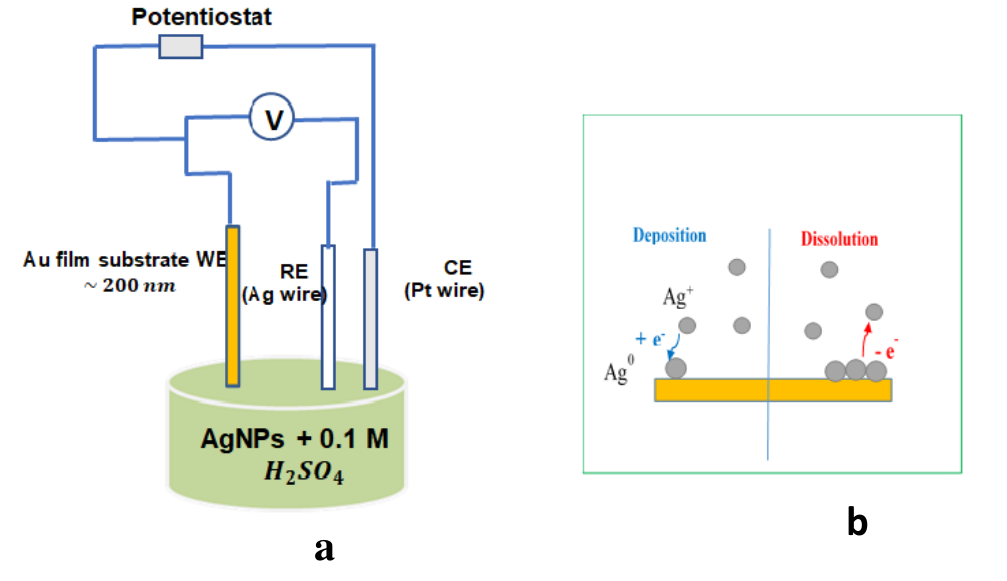
Silver nanoparticles (AgNPs) antibacterial and antimicrobial properties have made them useful in the fields of medicine, for health care, consumer products, industrial purposes and more specifically food packaging industries. Though AgNPs can be synthesized by various methods, the more environmentally friendly option was adopted. Available literature shows that AgNPs can be infused into plastic and polyethylene containers and used for packaging foods and drinks to shield them from fungal or bacterial decay thereby extending their shelf lives. Tests to ascertain the concentration and rate of migration of the AgNPs from the packaging to the food are deemed necessary. In this research Ocimum gratissimum (Og) and Vernonia amygdalina (Va) silver nanoparticles were biosynthesized, and were of varied sizes with some agglomeration with mean sizes 41 nm and 28 nm, respectively. Their Surface Plasmon Resonance (SPR) occurred in the range 432 nm - 442 nm. Electrodeposition of these nanoparticles on a gold substrate from an acidic medium was done and AFM images show that the Va-silver nanoparticles had small grains and provided a better surface coverage than the larger round flakes of the Og-silver nanoparticles. The nanoparticles were found to have diffusion coefficient values which tallied with their sizes. Thus for the smaller Va-silver nanoparticles it was 1.76 X 10^{-7} \ cm^2/s, while for the Og silver nanoparticles it was 3.94 \times 10^{-7} cm^2/s showing that the migration rate of the Og- silver nanoparticles was higher than that of the Va-silver nanoparticles. Hence for faster nanoparticle migration, the Og-nanoparticles is ideal but for a uniform, and even surface coverage, the Va-silver nanoparticles should be employed.
Published
How to Cite
Issue
Section
Copyright (c) 2022 R. E. Mfon, J. J. Deshi, Z. Al Amri , J. S. Madugu

This work is licensed under a Creative Commons Attribution 4.0 International License.
How to Cite
Similar Articles
- W. A. Yahya, A. A. Yahaya, A. A. Adewale, A. A. Sholagberu, N. K. Olasunkanmi, A DFT study of optoelectronic, elastic and thermo-electric properties of the double perovskites Rb2SeX6 (X=Br,Cl) , Journal of the Nigerian Society of Physical Sciences: Volume 5, Issue 2, May 2023
- Gerard Shu Fuhnwi, Janet O. Agbaje, Kayode Oshinubi, Olumuyiwa James Peter, An Empirical Study on Anomaly Detection Using Density-based and Representative-based Clustering Algorithms , Journal of the Nigerian Society of Physical Sciences: Volume 5, Issue 2, May 2023
- Pushap Lata Sharma, Mohini Kapalta, Ashok Kumar, Deepak Bains, Sumit Gupta, Pankaj Thakur, Electrohydro dynamics convection in dielectric rotating Oldroydian nanofluid in porous medium , Journal of the Nigerian Society of Physical Sciences: Volume 5, Issue 2, May 2023
- Rafiu Adewale Busari, Ezekiel Omotoso, Lukman O. Animasahun, Saheed Adekunle Adewinbi, Emmanuel O. Adewumi, Comfort T. Famoroti, Bidini A. Taleatu, Adeniyi Y. Fasasi, Tuning the optical properties and some surface structure of Cd-O thin film electrodeposited by two-electrode: An effect of Cobalt incorporation , Journal of the Nigerian Society of Physical Sciences: Volume 5, Issue 2, May 2023
- A. Y. Fasasi, E. Ajenifuja, E. Osagie, L. O. Animasaun, A. E. Adeoye, E. I. Obiajunwa, Optical, Dielectric and Optoelectronic Properties of Spray Deposited Cu-doped Fe2O3 Thin Films , Journal of the Nigerian Society of Physical Sciences: Volume 5, Issue 3, August 2023
- Daud Olaoluwa, Abdulhadi E. Abdulmalik, Taoreed A. Muraina, Sadisu Girigisu, Ayo F. Balogun, Dissolution of a Nigerian sourced Muscovite ore for use as an ingredient in paint production , Journal of the Nigerian Society of Physical Sciences: Volume 2, Issue 3, August 2020
You may also start an advanced similarity search for this article.