Concentrations of heavy metal content in indoor dust and potential exposure in preschool children
Keywords:
Heavy metal, Indoor dust, Preschool environment, Metal concentrationAbstract
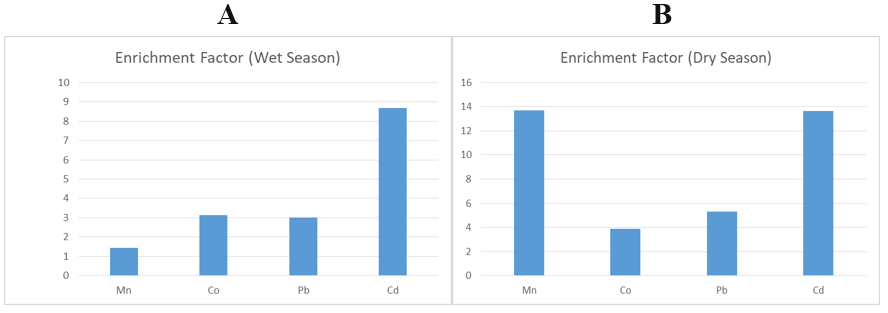
Indoor dust serves as a medium for the deposition of heavy metals, and young children's rapid physical growth and hand-to-mouth behavior expose them to the impacts of heavy metals. This project aimed to measure the concentrations of heavy metals in classroom dust from the selected preschools in southwestern Nigeria. Dust samples were taken via a dust collector and analyzed quantitatively and qualitatively via the Atomic Absorption Spectroscopy (AAS) scheme. The descriptive and inferential statistical method was employed for the data analysis, and standard calibration, recovery analysis, and blank determination were carried out for the quality control measures. It was found that, in the dry season, the total metal concentrations in dust were 1.82 gg-1 Cu to 80.00 gg-1 Zn, whereas, in the wet season, the heavy metal concentrations were 0.83 gg-1 Co to 38.43 gg-1 Zn. Hence, the selected preschool dust was significantly enriched with high levels of Cd and As contamination but unpolluted for Co, Cu, Mn, and Pb across all examined metals. The results indicate elevated concentrations of lead (Pb) and cadmium (Cd) in high-traffic indoor spaces, with levels exceeding recommended safety thresholds. Lead (Pb) exposure is linked to neurodevelopmental disorders and reduced cognitive function, Cadmium (Cd) can cause kidney damage and impair bone development, while arsenic (As) is associated with immunotoxicity and an increased risk of cancer. To mitigate these risks, this study recommends practical measures, including frequent wet cleaning of floors and surfaces to reduce dust accumulation and limiting the use of materials known to contain heavy metals, such as lead-based paints and older plumbing fixtures.
References
[1] A. Christoforidis & N. Stamatis, “Heavy metal contamination in street dust and roadside soil along the major national road in Kavala’s region, Greece”, Geoderma 151 (2009) 257. https://doi.org/10.1016/j.geoderma.2009.04.016.
[2] A. A. El-Imam, F. B. Auta, H. K. Okoro, M. M. Orosun, A. M. Olabode & A. R. Bamidele, “Physicochemical properties, heavy metal composition, and metal resistant microorganisms associated with gold mine tailings in Jebba”, Nigeria, Geomicrobiology J. 40 (2023) 3772. https://doi.org/10.1080/01490451.2023.2196278.
[3] N. Gault, C. Sandre, J. L. Poncy, C. Moulin, J. L. Lefaix & C. Bresson, “Cobalt toxicity: chemical and radiological combined effects on HaCaT keratinocyte cell line”, Toxicology in Vitro 24 (2010) 92. https://doi.org/10.1016/j.tiv.2009.08.027.
[4] M. M. Orosun, S. O. Inuyomi, M. R. Usikalu et al., “Heavy metal contamination of selected mining fields in North-Central Nigeria”, MethodsX 10 (2023) 102201. https://doi.org/10.1016/j.mex.2023.102201.
[5] M. M. Orosun, “Assessment of arsenic and its associated health risks due to mining activities in parts of North-central Nigeria: Probabilistic approach using Monte Carlo”, J. of Hazardous Materials 412 (2021) 125262. https://doi.org/10.1016/j.jhazmat.2021.125262.
[6] F. O. Aweda & O. A. Falaiye, “Chemical characterization of harmattan dust across Oyo and Minna, Nigeria”, Jordan Journal of Physics 13 (2020) 17. https://doi.org/10.47011/131.
[7] S. D. Olatunde, N. E. Joshua, E. P. Oluseun & O. O. John, “Health risk assessment of heavy metals on primary school learners from dust and soil within school premises in Lagos State, Nigeria”, in IntechOpen, IntechOpen Limited, London, United Kingdom, 2017, pp. 319. https://doi.org/10.5772/intechopen.74741.
[8] L. Poggio, B. Vrscaj, R. Schulin, E. Hepperle & M. F. Ajmone, “Metals pollution and human bioaccessibility of topsoils in Grugliasco”, Environmental Pollution 157 (2009) 680. https://doi.org/10.1016/j.envpol.2008.08.009.
[9] G. O. Olutona & M. O. Dawodu, “Identification and quantification of phthalates in water and sediment of Ori Stream, Iwo, Southwestern Nigeria using high-performance liquid chromatography”, J. of Environmental Chemistry and Ecotoxicology 8 (2016) 82. https://doi.org/10.5897/JECE2016.0377.
[10] A. Turner, “Oral bioaccessibility of trace metals in household dust: a review”, Environmental geochemistry and health 33 (2011) 331. https://doi.org/10.1007/s10653-011-9386-2.
[11] I. Q. Abdul-Rahman, A. D. Kusag & A. T. Hassein, “Measuring the concentrations of some heavy elements indoor and outdoor during dust storms in Anbar province in Iraq”, Int. J. of Emerging Technology and Advanced Engineering 3 (2013) 578. https://doi.org/10.13140/RG.2.2.28558.97606.
[12] J. McComb, T. C. Alexander, F. X. Han & P. B. Tchounwou, “Understanding biogeochemical cycling of trace elements and heavy metals in estuarine ecosystems”, J. of bioremediation & biodegradation 5 (2014) 1000e148. https://doi.org/10.4172/2155-6199.1000e148.
[13] C. Knight, G. C. Kaiser, H. Lailor & J. V. Robothum, “Witter, heavy metals in surface water and stream sediments in Jamaica”, Environmental Geochemistry and Health 19 (1997) 63. https://doi.org/10.1023/A:1018442219943.
[14] S. Strachan, “Heavy metal”, Current Anaesthesia and Critical Care 21 (2010) 44. https://doi.org/10.1016/B978-0-323-90222-9.00010-8.
[15] K. Steenland & P. Boffetta, “Lead and cancer in humans: Where are we now”? American Journal of Industrial Medicine 38 (2000) 295. https://doi.org/10.1002/1097-0274(200009)38:3<295::AID-AJIM8>3.0.CO;2-L.
[16] M. O. C. Ogwuegbu & W. Muhanga, “Investigation of lead concentration in the blood of people in the copper belt province of Zambia”, Journal of Environment 1 (2005) 66. https://doi.org/10.4236/gep.2018.612004.
[17] S. Davydova, “Heavy metals as toxicants in big cities”, Microchemical Journal 79 (2005) 133. https://doi.org/10.1016/j.microc.2004.06.010.
[18] S. K. Bharti, D. Kumar, S. Anand, S. C. Barman & N. Kumar, “Characterization and morphological analysis of individual aerosol of PM10 in urban area of Lucknow, India”, Micron 103 (2017) 90. https://doi.org/10.1016/j.micron.2017.09.004.
[19] M. T. Latif, S. M. Yong, A. Saad, N. Mohamad, N. H. Baharudin, M. B. Mokhtar & N. M. Tahir, “Composition of heavy metals in indoor dust and their possible exposure: a case study of preschool children in Malaysia”, Air Qual Atmos Health 7 (2013) 181. https://doi.org/10.1007/s11869-013-0224-9.
[20] T. L. Mohd, M. Y. Saw, S. Azlina, M. Noorlin, H. B. Nor, B. M. Mazlin & M. T. Norhayati, “Composition of heavy metals in indoor dust and their possible exposure: a case study of preschool children in Malaysia”, Air Qual Atmos Health 7 (2018) 224. https://doi.org/10.1005/s11879-013-0234-29.
[21] M. A. Nkansah, J. R. Fianko, S. Mensah, M. Debrah & G. W. Francis, “Determination of heavy metals in dust from selected nursery and kindergarten classrooms within the Kumasi metropolis of Ghana”, Cogent Chemistry 11 (2015) 1119005. https://doi.org/10.1080/23312009.2015.1119005.
[22] M. A. Al-Rajhi, M. R. D. Seaward & A. S. Al-Aamer, “Metal levels in indoor and outdoor dust in Riyadh, Saudi Arabia”, Environment international 22 (1996) 315. https://doi.org/10.1016/0160-4120(96)00017-7.
[23] T. Y. Tong & K. C. Lam, “Home sweet home? a case study of household dust contamination in Hong Kong”, Sci Total Environ 256 (2000) 115. https://doi.org/10.1016/S0048-9697(00)00471-X.
[24] B. E. Tvermoes, B. I. Finley, K. M. Unice, J. M. Otani, D. D. Paustenbach & D. A. Galbraith, “Cobalt whole blood concentrations in healthy adult male volunteers following two-weeks of ingesting a cobalt supplement”, Food and Chemical Toxicology 53 (2013) 432. https://doi.org/10.1016/j.fct.2012.11.033.
[25] A. O. Abolaji, K. D. Fasae, C. E. Iwezor, M. Aschner & E. O. Farombi, “Curcumin attenuates copper-induced oxidative stress and neurotoxicity in Drosophila melanogaster”, Toxicol. Reports 7 (2020) 261. https://doi.org/10.1016/j.toxrep.2020.01.015.
[26] U. Okereafor, M. Makhatha, L. Mekuto, N. Uche-Okereafor, T. Sebola & V. Mavumengwana, “Toxic metal implications on agricultural soils, plants, animals, aquatic life and human health”, Int. J. of environmental research and public health 17 (2020) 22. https://doi.org/10.3390/ijerph17072204.
[27] Y. Du, B. Gao, H. Zhou, X. Ju, H. Hao & S. Yin, “Health risk assessment of heavy metals in road dusts in urban parks of Beijing, China”, Procedia Environmental Sciences 18 (2013) 299. https://doi.org/10.1016/j.proenv.2013.04.039.
[28] G. Muller, “Distribution, enrichment and ecological risk assessment of six elements in bed sediments of a tropical river, Chottanagpur Plateau: A Spatial and Temporal Appraisal”, Journal of Environmental Protection 5 (2014) 385. https://doi.org/10.4236/jep.2014.514136.
[29] S. Ali, Z. Awan, S. Mumtaz, H. A. Shakir, F. Ahmad, M. Ulhaq, H. M. Tahir, M. Awan, S. Sharif, M. Irfan & M. A. Khan, “Cardiac toxicity of heavy metals (cadmium and mercury) and pharmacological intervention by vitamin C in rabbits”, Environ. Sci. Pollut. Res. 27 (2020) 29266. https://doi.org/10.1007/s11356-020-09011-9.
[30] Department of Environmental Affairs (DEA), “The framework for the management of contaminated Land”, South Africa, 2010.
[31] S. S. Elblehi, M. H. Hafez & Y. S. El-Sayed, “L-a-Phosphatidylcholine attenuates mercury-induced hepatorenal damage through suppressing oxidative stress and inflammation”, Environ. Sci. Pollut. Res. 26 (2019) 9333. https://doi.org/10.1007/s11356-019-04395-9.
[32] Z. Gong, H. T. Chan, Q. Chen & H. Chen, “Application of nanotechnology in analysis and removal of heavy metals in food and water resources”, Nanomaterials 11 (2021) 1792. https://doi.org/10.3390/nano11071792.
[33] J. Sun, M. Yu, Y. Lu, C. Thakur, B. Chen, P. Qiu & F. Chen, “Carcinogenic metalloid arsenic induces expression of mdig oncogene through JNK and STATS activation”, Cancer Letters 5 (2014) 65. https://doi.org/10.1016/j.canlet.2014.01.002.
[34] H. Chen, X. Lu, Y. Chang & W. Xue, “Heavy metal contamination in dust from kindergartens and elementary schools in Xi’an, China”, Environ Earth Sci 71 (2014) 2701. https://doi.org/10.1007/s12665-013-2648-9.
[35] P. R. Guvvala, J. P. Ravindra, S. Selvaraju, A. Arangasamy & K. M. Venkata, “Ellagic and ferulic acids protect arsenic-induced male reproductive toxicity via regulating Nfe2l2, Ppargc1a and StAR expressions in testis”, Toxicology 413 (2019) 1. https://doi.org/10.1016/j.tox.2018.11.012.
Published
How to Cite
Issue
Section
Copyright (c) 2025 J. A. Akinpelu, K. P. Ojo, S. O. Salawu, G. O. Olutona, F. O. Aweda, O. O. Jegede (Author)

This work is licensed under a Creative Commons Attribution 4.0 International License.