Multi-proxy evidence from the exposed strata at Okpekpe, Imiegba, and environs for nomenclature as Mamu Formation, Benin Flank, NW Anambra basin, Nigeria
Keywords:
Dinoflagellates, Mamu formation, Thalassinoides, Age datingAbstract
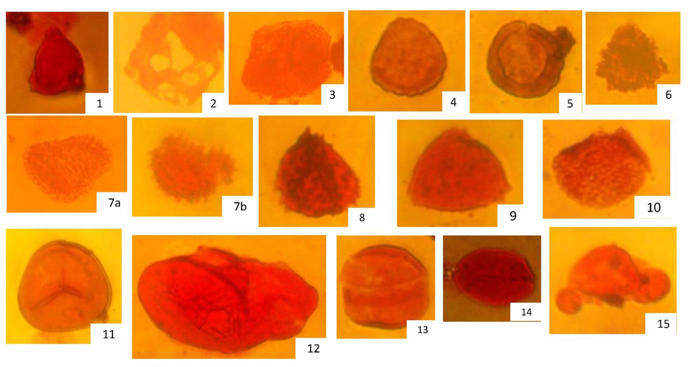
Litho-sections along Okpekpe, Imiegba, and environs have been studied for their textural and microfossil contents to elucidate this recently exposed lithostratigraphic unit in the Benin Flank of the Anambra Basin. Five of the road-cut sections were mapped for their textural characteristics, facies types and associations, and palynostratigraphy to decipher their age, and palaeoenvironment, for proper assignment to a lithostratigraphic unit. Facies analysis reveals four facies types namely: shale, sandstone, mudstone, and coal facies. The mudstone facies is characterised by abundant Thalassinoides ichnogenus that suggest a deposition under littoral environment. Index palynomorphs markers: Trichodinum lasstaneum, Andahisiella polymorpha, Cingulatisporites ornatus, Dinogymnium sp., Cerodinium diebelii, Buttinea andreevi, Cyclonephelium sp., Laevigatosporites major, Odontochitina operculata, and Longapertites marginatus, recovered from both the shale and mudstone facies revealed Early Maastrichtian age. The sandstone facies is coarse-grained, poorly-sorted, nearly symmetrical, mesokurtic sandstone. Bivariate plots, linear discriminant and multivariant functions revealed deposition in a range of depositional environments, including shallow marine, beach, and fluvial environments. The combination of facies association and the microfossils suggests a transition between non-marine and marine environments for the exposed litho-sections. The facies types and associations, age, and palaeoenvironment revealed by the exposed sections correlate with the Mamu Formation, suggesting that this lithostratigraphic unit is not restricted to the eastern part of the Anambra basin but also in the Benin Flank.
References
[1] C.S. Nwajide & T.J.A. Reijers, "Geology of Southern Anambra Basin”, in Selected chapters on geology, sedimentary geology and sequence stratigraphy in Nigeria and three case studies and a field guide, T. J. A. Reijers (Ed.), SPDC Corporate Reprographic Services, Warri, Nigeria, 1996, p. 131.
[2] C. S. Nwajide, Geology of Nigeria’s sedimentary basins, 1st ed., CSS Bookshops Ltd., Lagos, Nigeria, 2013, pp. 1–565.
[3] C. S. Nwajide, Geology of Nigeria’s sedimentary basins, 2nd ed., Albishara Educational Publications, Enugu, Nigeria, 2022, pp. 349–445. https://virtuall.nln.gov.ng/resource/NLN-XAHR16DM8PVRJL6.
[4] I. M. Akaegbobi, J. I. Nwachukwu & M. Schmitt, “Aromatic hydrocarbon distribution and calculation of oil and gas volumes in post-Santonian shale and coal, Anambra Basin, Nigeria”, in Petroleum systems of South Atlantic margins, M. R. Mello & B. J. Katz (Eds.), American Association of Petroleum Geologists Memoir 73, 2000, 233. https://doi.org/10.1306/M73705C17.
[5] S. O. Akande, I. B. Ogunmoyero, H. I. Petersen & H. P. Nytoft, “Source rock evaluation of coals from the lower Maastrichtian Mamu Formation, SE Nigeria”, Journal of Petroleum Geology 30 (2007) 303. https://doi.org/10.1111/j.1747-5457.2007.00303.x.
[6] J. E. Ogala, O. A. Ola-Buraimo & M. I. Akaegbobi, “Palynological and palaeoenvironmental study of the Middle–Upper Maastrichtian Mamu coal facies in Anambra Basin, Nigeria”, World Applied Sciences Journal 7 (2009) 1566. https://www.idosi.org/wasj/wasj7(12)/18.pdf.
[7] A. Adedosu, O. O. Sonibare, O. Ekundayo & J. Tuo, “Hydrocarbon generative potential of coal and interbedded shale of Mamu Formation, Benue Trough, Nigeria”, Petroleum Science and Technology 28 (2010) 412. https://doi.org/10.1080/10916460902725306.
[8] M. Abubakar, “Petroleum potentials of the Nigerian Benue Trough and Anambra Basin: a regional synthesis”, Natural Resources 5 (2014) 25. https://doi.org/10.4236/nr.2014.51005.
[9] M. A. Adeleye, C. Y. Ugboaja & L. Yuhong, “Aspects of the hydrocarbon potential of the coals and associated mudstones and shales of the Mamu Formation in Anambra Basin, Nigeria”, Journal of Environment and Earth Science 7 (2017) 1. https://www.iiste.org/Journals/index.php/JEES/article/view/37710.
[10] J. N. Chukwuma-Orji, E. A. Okosun, J. C. Ekom & J. F. Abolarin, “A palynology and paleoenvironmental study of a section from the Amansiodo-1 well, Anambra Basin, southeastern Nigeria”, Geology, Geophysics and Environment 43 (2017) 293. https://doi.org/10.7494/geol.2017.43.4.293.
[11] C. I. P. Dim, K. M. Onuoha, I. C. Okwara, I. A. Okonkwo & P. O. Ibemesi, “Facies analysis and depositional environment of the Campano Maastrichtian coal bearing Mamu Formation in the AnambraBasin, Nigeria”, Journal of African Earth Sciences 152 (2019) 69. https://doi.org/10.1016/j.jafrearsci.2019.01.011.
[12] A. J. Edegbai, L. Schwark & F. E. Oboh-Ikuenobe, “Campano Maastrichtian paleoenvironment, paleotectonics and sediment provenance of western Anambra Basin, Nigeria: multi-proxy evidences from the MamuFormation”, Journal of African Earth Sciences 156 (2019) 203. https://doi.org/10.1016/j.jafrearsci.2019.04.001.
[13] J. E. Ogala, “Depositional conditions of the Upper Cretaceous shales from the Anambra Basin, SE Nigeria: constraints from mineralogy and geochemistry”, Journal of African Earth Sciences 196 (2022) 104670. https://doi.org/10.1016/j.jafrearsci.2022.104670.
[14] O. I. Ejeh, I. A. A. Etobro, K. Perleros, J. E. Ogala, A. O. Ehinola, K. Christanis & S. Kalaitzidis, “Hydrocarbon generation potential of Campano-Maastrichtian to Paleogene shales in the Benin Flank of the Anambra Basin, SW Nigeria”, Energy Geoscience 5 (2024) 100286. https://doi.org/10.1016/j.engeos.2024.100286.
[15] K. K. Okeke, H. Slimani, H. Jbari, N. Ukpabi & A. N. Asadu, “Palynostratigraphy and palaeoenvironment of the Danian sediments from the Nsukka Formation of the Anambra Basin at the vicinity of Ikpankwu, southeastern Nigeria”, Journal of African Earth Sciences 210 (2024) 105133. https://doi.org/10.1016/j.jafrearsci.2023.105133.
[16] O. Odedede, “Palaeopalynology and sequence stratigraphy of the Mamu Formation around Orhua, southwestern Nigeria”, Nigerian Journal of Science and Environment 12 (2013) 128. https://doi.org/10.5987/UJ-NJSE.17.106.1.
[17] O. F. Adebayo, A. O. Ola-Buraimo, H. Y. Madukwe & A. O. Aturamu, “Palynological and sequence stratigraphy characterization of the Early Late Campanian Nkporo Shale, Okpekpe–Imiegba area, Anambra Basin, Nigeria”, European Journal of Basic and Applied Sciences 2 (2015) 1. https://www.idpublications.org/ejbas-vol-2-no-1-2015/.
[18] O. I. Ejeh, “The Maastrichtian sedimentary successions of the Anambra Basin recently exposed around Okpekpe and Imiegba: part of the Mamu or Ajali Formation?”, Nigerian Journal of Science and Environment 14 (2016) 38. https://doi.org/10.5987/UJ-NJSE.16.056.1.
[19] A. O. Jayeola, A. O. Oluwajana, O. A. Olatunji, M. U. Udofia & O. Danjuma, “Sedimentological, palynological and foraminiferal biostratigraphic studies of the Upper Cretaceous Mamu Formation at Imiegba, Anambra Basin, Edo State, Nigeria”, Achievers Journal of Scientific Research 1 (2016) 37. https://achieverssciencejournal.org/ajosrojs/index.php/ajosr/issue/archive.
[20] S. O. Obaje, O. Akinyele, R. Ahmed, B. Alli & A. Adefemisoye, “Paly nomorphs content and paleodepositional environments of Mamu Formation in kpekpe-1, Imiegba-1 and Imiegba-2, Benin Flank of Anambra Basin, Nigeria”, Journal of Applied Science, Environment and Management 26 (2022) 15. https://doi.org/10.4314/jasem.v26i9.13.
[21] C. A. Kogbe, “The Cretaceous and Paleogene sediments of southern Nigeria”, in Geology of Nigeria, 2nd ed., C. A. Kogbe (Ed.), Rock-view (Nigeria) Limited, Jos, Nigeria, 1989, 325.
[22] A. Simpson, “The Nigerian coalfield: the geology of parts of Owerri and Benue Provinces”, Bulletin of Geological Survey of Nigeria 24 (1954) 1. https://ngsa.gov.ng/publications-of-ngsa/.
[23] R. A. Reyment, Aspect of the geology of Nigeria, University of Ibadan Press, Ibadan, Nigeria, 1965, 145.
[24] Nigerian Geological Survey Agency (NGSA), “Geological map of Nigeria”, Published by the authority of the Federal Republic of Nigeria, Abuja, Nigeria, 2006. https://ngsa.gov.ng/geological-maps/.
[25] U. A. Lar, T. P. Bata, H. U. Dibal, R. I. Daspan, L. C. Isah, A. A. Fube &D. A. Bassi, “Field, petrographic and geochemical study of basement, clastic and carbonate petroleum reservoirs in the northern Benue Trough, Nigeria”, Petroleum Technology Development Journal 8 (2018) 36. https://www.ptdjournal.com/?page_id=8.
[26] M. I. Akaegbobi & M. Schmitt, “Organic facies, hydrocarbon source potentials and reconstruction of the depositional paleoenvironment of the Campano–Maastrichtian Nkporo Shale in the Cretaceous Anambra Basin, Nigeria”, Nigerian Association of Petroleum Explorationists Bulletin 13 (1998) 1.
[27] G. O. Ogungbesan & T. A. Adedosu, “Geochemical record for the depositional condition and petroleum potential of the Late Cretaceous Mamu Formation in the western flank of Anambra Basin, Nigeria”, Green Energy and Environment 5 (2020) 83. https://doi.org/10.1016/j.gee.2019.01.008.
[28] R. L. Folk & W. C. Ward, “Brazos River Bar: a study of the significance of grain-size parameters”, Journal of Sedimentary Petrology 29 (1957) 3. https://doi.org/10.1306/74D70646-2B21-11D7-8648000102C1865D.
[29] B. K. Sahu, “Depositional mechanisms from the size analysis of clastic sediments”, Journal of Sedimentary Research 34 (1964) 73. https://doi.org/10.1306/74D70FCE-2B21-11D7-8648000102C1865D.
[30] I. A. A. Etobro, O. I. Ejeh & G. O. Ovwamuedo, “Fluvial sedimentology of the River Ethiope sediments, Niger Delta, southern Nigeria”, Rudarsko-geoloˇsko-naftni zbornik RGNZ/MGPB (The Mining Geology–Petroleum Engineering Bulletin) 39 (2024) 45. https://doi.org/10.17794/rgn.2024.2.4.
[31] B. K. Sahu, “Multigroup discrimination of depositional environments using size distribution statistics”, Indian Journal of Earth Sciences 10 (1983) 20.
[32] G. M. Friedman & J. E. Sanders, Principles of sedimentology, Wiley, New York (1978). https://www.researchgate.net/publication/268449121.
[33] J. S. Boggs, Petrology of sedimentary rocks, Cambridge University Press, Cambridge (2009). https://doi.org/10.1017/CBO9780511626487.
[34] C. Baiyegunhi, K. Liu & O. Gwavava, “Grain size statistics and depositional pattern of the Ecca Group sandstones, Karoo Supergroup in the Eastern Cape Province, South Africa”, Open Geoscience 9 (2017) 554. https://doi.org/10.1515/geo-2017-0042.
[35] E. Schrank, “Organic-walled microfossils and sedimentary facies in the Abu Tartur Phosphate (Late Cretaceous), Egypt”, Berliner geowis senschaftliche Abhandlungen, Reihe A 50 (1984) 177.
[36] G. L. Williams & J. P. Bujak, “Mesozoic and Cenozoic dinoflagellates”, in H. M.Bolli, J. B. Saunders &K.Perch-Nielsen (eds.), Plankton stratigraphy, Cambridge University Press, Cambridge (1985) 847.
[37] C. G. Soronnadi-Ononiwu, A. O. Omoboriowo & N. V. Chukwujekwe, “Palynological and paleoenvironmental studies of the Mamu Formation, Enugu area, Anambra Basin, Nigeria”, International Journal of Pure and Applied Sciences and Technology 10 (2012) 1.
[38] K. C. Chiadikobi, O. I. Chiaghanam, O. C. Onyemesili & A. O. Omo boriowo, “Palynological study of the Campano–Maastrichtian Nkporo Group of Anambra Basin, southeastern Nigeria”, World News of Natural Sciences 20 (2018) 31. https://www.researchgate.net/publication/336303394.
[39] R. J. Moiola & D. Weiser, “Textural parameters: an evaluation”, Journal of Sedimentary Petrology 38 (1968) 45. https://doi.org/10.1306/74D718C5-2B21-11D7-8648000102C1865D.
[40] G. M. Friedman, “The distinction between dune, beach, and river sands from their textural characteristics”, Journal of Sedimentary Petrology 31 (1961) 514. https://doi.org/10.1306/74D70BCD-2B21-11D7-8648000102C1865D.
[41] G. M. Friedman, “Dynamic processes and statistical parameters for size-frequency distributions of beach and river sands”, Journal of Sedimentary Petrology 37 (1967) 327. https://doi.org/10.1306/74D716CC-2B21-11D7-8648000102C1865D.
[42] N. I. Oronsaye, “Origin and depositional environments of the sandstone deposits in Fugar area, Bendel State, Nigeria”, Nigerian Journal of Mining and Geology 4 (1987) 96.
[43] T. A. Adedosu, O. O. Sonibare, J. Tuo & O. Ekundayo, “The occurrence of lacustrine depositional setting in the Mamu Formation, Anambra Basin, Nigeria”, Energy Sources, Part A: Recovery, Utilization and Environmental Effects 36 (2014) 374. https://doi.org/10.1080/15567036.2010.538801.
Published
How to Cite
Issue
Section
Copyright (c) 2025 Israel Aruoriwo Abiodun Etobro, Omobehere Innocent Ejeh (Author)

This work is licensed under a Creative Commons Attribution 4.0 International License.