An exploration of thermal characteristics of a permeable inclined moving inverted exponential fully wet magnetized stretching/shrinking fin
Keywords:
Transposed exponential fin, Magnetized fin, Wet porous parameter, Moving fin, Power indexAbstract
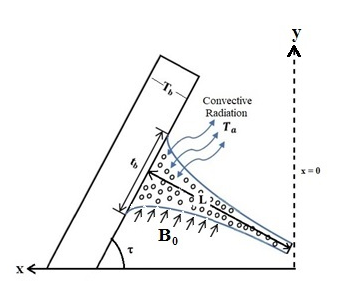
The effective cooling technology aims at removing the excess heat from the thermal components, equipment, and systems by ensuring their reliable operation and proper functioning. The fins play a vital role in such phenomena among various passive and active cooling options. In the present work, the thermal performance of a magnetized, fully wet, moving, porous, convective-radiative longitudinal inverted exponential oblique fin subjected to a shrinking/stretching mechanism is investigated numerically. The problem is modeled as a second-order non-linear ordinary differential equation, which is transformed into a non-dimensional equation, and using bvp4c of MATLAB, a numerical solution is obtained. The impacts of geometric and flow factors such as Hartmann number, wet porous parameter, Peclet number, stretching/shrinking parameter, etc., on the thermal characteristics and fin's base heat transfer rate are analyzed, and the results are presented graphically. It is also inferred that the Peclet number, wet porous parameter, thermal conductivity parameter, and convective sink temperature accelerate heat transfer, whereas the Hartmann number and radiation number decelerates heat transfer. Further, shrinking intensifies the cooling than stagnant and stretching mechanisms. The current examinations set a platform for the engineers to design an efficient fin in heat transfer devices functioning under the influence of an active magnetic field set with a mechanism like a conveyor belt.
Published
How to Cite
Issue
Section
Copyright (c) 2025 M. Siddalinga Prasad (Author)

This work is licensed under a Creative Commons Attribution 4.0 International License.
How to Cite
Similar Articles
- G. Ajileye, A. A. James, Collocation Method for the Numerical Solution of Multi-Order Fractional Differential Equations , Journal of the Nigerian Society of Physical Sciences: Volume 5, Issue 3, August 2023
- B. I. Akinnukawe, K. O. Muka, L-Stable Block Hybrid Numerical Algorithm for First-Order Ordinary Differential Equations , Journal of the Nigerian Society of Physical Sciences: Volume 2, Issue 3, August 2020
- Constantin Falk, Tarek El Ghayed , Ron van de Sand, Jörg Reiff-Stephan, A Data-Driven Approach Towards the Application of Reinforcement Learning Based HVAC Control , Journal of the Nigerian Society of Physical Sciences: Volume 5, Issue 1, February 2023
- Sunday Sani Daku, Ogbonnaya Igwe, Characterization of mine spoils for the reclamation of degraded lands of the Jos-Bukuru tin field, central Nigeria , Journal of the Nigerian Society of Physical Sciences: Volume 6, Issue 3, August 2024
- K. Ahmed, M. Y. Waziri, A. S. Halilu, I. A. R. Moghrab, H. Abdullahi, S. M. Ibrahim, Y. B. Musa, S. Murtala, A. M. Awwal, A. Sambas, A Dai-Kou-Type method with image de-blurring application , Journal of the Nigerian Society of Physical Sciences: Volume 7, Issue 3, August 2025
- Ibukun Akinsola, Alabi Aderemi Babatunde, Adedayo Kayode Seun, Nicola Coppede, Characterizations of Galena as Potential Photosensitizer in a Natural Dye-Sensitized Solar Cell , Journal of the Nigerian Society of Physical Sciences: Volume 3, Issue 2, May 2021
- Tertsea Igbawua, Martha Hembafan Gbanger, Fanan Ujoh, Suitability Analysis for Yam Production in Nigeria using Satellite and Observation Data , Journal of the Nigerian Society of Physical Sciences: Volume 4, Issue 4, November 2022
- C. Gopi, Edward Anand E, A. Charles, C. Manivannan, S .Ponsadai Lakshmi, A. Jose, M. Muthiyan, Physico-Chemical and Trace Metal Analysis in Groundwater of Nagapattinam Region in Nagapattinam District of Tamilnadu State , Journal of the Nigerian Society of Physical Sciences: Volume 5, Issue 2, May 2023
- Abdullahi Moyosore, Haslina Ahmad, Muhammad Alif Muhammad Latif, Mostafa Yousefzadeh Borzehandani, Mohd Basyaruddin AbdulRahman, Emilia Abdelmalek, Carbon (IV) oxide adsorption efficiency of functionalized HKUST-1, IRMF-1, and UiO-66 metal organic frameworks , Journal of the Nigerian Society of Physical Sciences: Volume 6, Issue 1, February 2024
- Sulaiman Awwal Akinwunmi, David Opeoluwa Oyewola, Spectral convolution of star-like transformation semigroups for modeling telecommunication signal strength and user experience in Gombe state, Nigeria , Journal of the Nigerian Society of Physical Sciences: Volume 8, Issue 2, May 2026
You may also start an advanced similarity search for this article.