
Effective tweets classification for disaster crisis based on ensemble of classifiers
Keywords:
Disaster Crisis Management, Social Media Analytics, Twitter, Machine Learning Classifiers, Ensemble Methods, Feature ExtractionAbstract
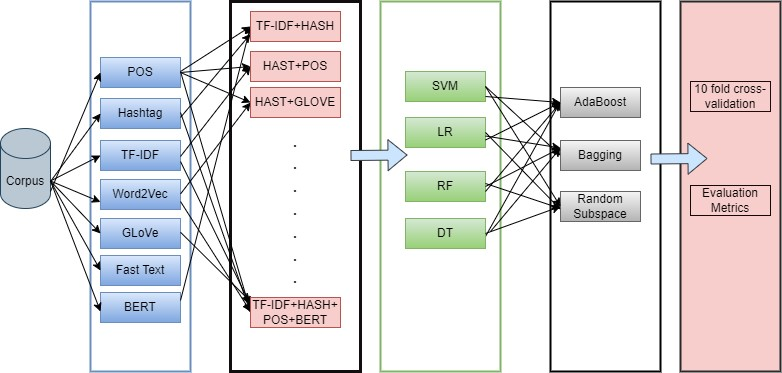
In the field of disaster management, social media analytics has gained significant recognition. Social media platforms, particularly Twitter, have become an invaluable source for disseminating information during disasters, offering real-time updates on events, crisis reports, and casualty information. However, the deluge of information on social media can also be overwhelming, with a substantial amount of irrelevant content. To address this challenge, researchers leverage machine learning (ML) classifiers to automatically categorize disaster-related tweets. However, ML classifiers, while being effective, also face issues such as overfitting and class imbalance. This study proposes an ensemble-based approach that integrates a variety of linguistic and word embedding features, including Parts-Of-Speech (POS), hashtags, Term Frequency-Inverse Document Frequency (TF-IDF), GloVe, Word2Vec, and BERT. A range of supervised learning algorithms like Decision Trees, Logistic Regression, Support Vector Machines, and Random Forests, were evaluated individually and as part of ensemble methods like AdaBoost, Bagging, and Random Subspace. The results show that combining TF-IDF with word embeddings and using the AdaBoost ensemble model yields superior performance, achieving a classification accuracy of 98.92%. This represents a notable improvement over the conventional standalone classifiers and highlights the advantage of ensemble methods in enhancing model robustness and minimizing overfitting. The proposed approach demonstrates not only high predictive capacity but also scalability for real-time tweet filtering during emergencies. In addition to demonstrating the efficacy of ensemble methods in disaster tweet classification, this study also provides valuable insights for improving social media-based crisis response. It also establishes a foundation for future research, particularly in multi-lingual and multi-disaster scenarios.
Published
How to Cite
Issue
Section
Copyright (c) 2025 Christopher Ifeanyi Eke, Kholoud Maswadi, Musa Phiri, Mulenga Mwege, Mohammad Imran, Dekera Kenneth Kwaghtyo, Akeremale Olusola Collins

This work is licensed under a Creative Commons Attribution 4.0 International License.
How to Cite
Similar Articles
- F. U. Salifu, O. A. Oladipo, E. O. Ebock, B. Nava, Deep neural network model for vertical total electron content prediction at a single low latitude station , Journal of the Nigerian Society of Physical Sciences: Volume 7, Issue 4, November 2025
- Olumide O. Olaiya, Mark I. Modebei, Saheed A. Bello, A One-Step Block Hybrid Integrator for Solving Fifth Order Korteweg-de Vries Equations , Journal of the Nigerian Society of Physical Sciences: Volume 4, Issue 3, August 2022
- P. K. Alimo, G. Lartey-Young, S. Agyeman, T. Y. Akintunde, E. Kyere-Gyeabour, F. Krampah, A. Awomuti, O. Oderinde, A. O. Agbeja, O. G. Afolabi, Spatial distribution and policy implications of the exhaust emissions of two-stroke motorcycle taxis: a case study of southwestern state in Nigeria , Journal of the Nigerian Society of Physical Sciences: Volume 6, Issue 2, May 2024
- U. B. Amadi, M. Ogwuegbu, C. K. Enenebeaku, G. onyedika, Design, synthesis and studies on thermodynamic and biological activities of lanthanide III complexes of hydrazinecarbothioamide ligands , Journal of the Nigerian Society of Physical Sciences: Volume 7, Issue 2, May 2025
- Duke Okoro, Oghenenyerhovwo E. Ididama, Godswill O. Tesi, Jude C. Ossai, Contamination levels, occurrence pattern and associated risk of organophosphate pesticide residues in spices and herbs sold in southern Nigeria , Journal of the Nigerian Society of Physical Sciences: Volume 8, Issue 1, February 2026
- S. A. Adesokan, A. A. Giwa, I. A. Bello, Removal of Trimethoprim from Water using Carbonized Wood Waste as Adsorbents , Journal of the Nigerian Society of Physical Sciences: Volume 3, Issue 4, November 2021
- Rhoda Bernard Gusikit, Solomon Nehemiah Yusuf, Hyeladi Usman Dibal, Victor Bulus Diyelmak, Ahmed Isah Haruna, Comparative analysis of lithium enrichment mechanisms in aquifers in the Benue Trough , Journal of the Nigerian Society of Physical Sciences: Volume 7, Issue 3, August 2025
- Bethel Onyeka Ekute, Muluh Emmanuel Khan, Aloysius Akaangee Pam, Jude Ehwevwerhere Emurotu, Assessment of the nutritional and phytochemical composition of selected mushroom species grown in Southern Nigeria , Journal of the Nigerian Society of Physical Sciences: Volume 7, Issue 4, November 2025
- Baba Alfa, Yakubu Adamu, Daniel Alberto Pena Perez, Optimal Power Point on the I-V Curve of a Photovoltaic Solar System (Modelling and Analysis) , Journal of the Nigerian Society of Physical Sciences: Volume 2, Issue 2, May 2020
- Chidi Duru, Ijeoma Duru, Chiagoziem Chidiebere, Virtual Screening of Selected Natural Products as Human Tyrosinase-Related Protein 1 Blockers , Journal of the Nigerian Society of Physical Sciences: Volume 3, Issue 3, August 2021
You may also start an advanced similarity search for this article.




