Detecting network intrusions in cyber-physical systems using deep autoencoder-based dimensionality reduction approach anddeep neural networks
Keywords:
Adversarial attacks, Deep autoencoder, Deep learning, Intrusion detection, Cyber-physical systemsAbstract
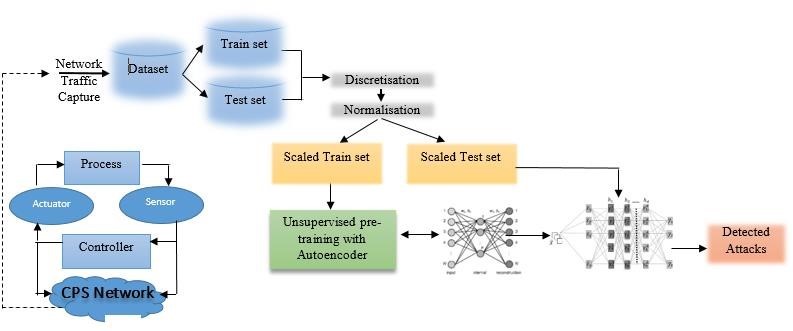
Cyber-Physical Systems (CPSs) that integrate computational and physical processes are the foundation of reliability in prominent areas of critical infrastructure, including transportation, energy, and manufacturing. The expansion in connected CPSs has made them vulnerable to various and changing intrusions into their networks. This research proposes a hybrid deep learning architecture that integrates the utilisation of a denoising autoencoder as a feature dimensionality reduction component with a five-layer deep feedforward neural network as an effective intrusion classifier. The model is trained and tested on CICIDS2017 and UNSW-NB15 datasets with a rich collection of attack patterns such as DoS, DDoS, Shellcode, and Worm attacks. The denoising autoencoder effectively learns higher-level representations of network traffic data, whereas the deep feedforward network facilitates precise multi-class classification. Empirical results demonstrate that the model achieves 99.99% and 99.95% detection accuracies on CICIDS2017 and UNSW-NB15 datasets, respectively, at very low false positive rates. Comparative analysis with state-of-the-art techniques further confirms the superior performance and generalisability of the presented solution, highlighting its applicability to real-time CPS threat detection systems.
Published
How to Cite
Issue
Section
Copyright (c) 2025 A. E. Ibor, D. O. Egete, A. O. Otiko, D. U. Ashishie

This work is licensed under a Creative Commons Attribution 4.0 International License.
How to Cite
Similar Articles
- B. T. Ogunyemi, F. K. Ojo, Corrosion Inhibition Potential of Thiosemicarbazide Derivatives on ALuminium: Insight from Molecular Modelling and QSARs Approaches , Journal of the Nigerian Society of Physical Sciences: Volume 5, Issue 1, February 2023
- K. Nandhini, V. Vidhya, An Alleviation of Cloud Congestion Analysis of Fluid Retrial User on Matrix Analytic Method in IoT-based Application , Journal of the Nigerian Society of Physical Sciences: Volume 5, Issue 2, May 2023
- Ekemini Ituen, Peace Madu, Adewale Olamoyesan, Gospel Asuquo, Chibueze J. Olelewe, Emmanuel E. Etim, Adsorption of dithiazolidine compounds on Fe(110) surface and potential for corrosion inhibition: DFT calculations and adsorption locator/Monte Carlo adsorption simulations , Journal of the Nigerian Society of Physical Sciences: Volume 8, Issue 3, August 2026
- C. W. Chidiebere, C. E. Duru, JP. C. Mbagwu, Application of computational chemistry in chemical reactivity: a review , Journal of the Nigerian Society of Physical Sciences: Volume 3, Issue 4, November 2021
- Bolarinwa Bolaji, B. I. Omede, U. B. Odionyenma, P. B. Ojih, Abdullahi A. Ibrahim, Modelling the transmission dynamics of Omicron variant of COVID-19 in densely populated city of Lagos in Nigeria , Journal of the Nigerian Society of Physical Sciences: Volume 5, Issue 2, May 2023
- T. O. Roy-Layinde, K. O. Olonade, K. A. Omoteso, H. T. Oladunjoye, B. A. Oyero, J. A. Laoye, Exploring vibrational resonance in biophysical systems with fractional-order damping , Journal of the Nigerian Society of Physical Sciences: Volume 7, Issue 3, August 2025
- Philip Ajibola Bankole, Mabel Eruore Adeosun, Sunday Emmanuel Fadugba, Tolulope Fadina, Christopher Thron, Existence and uniqueness results for double jump fractional uncertain differential equations , Journal of the Nigerian Society of Physical Sciences: Volume 8, Issue 2, May 2026
- A. E. Ibor, E. B. Edim, A. A. Ojugo, Secure Health Information System with Blockchain Technology , Journal of the Nigerian Society of Physical Sciences: Volume 5, Issue 2, May 2023
- Monika Saini, Ashish Kumar, Vijay Singh Maan, Deepak Sinwar, Efficient and Intelligent Decision Support System for Smart Irrigation , Journal of the Nigerian Society of Physical Sciences: Volume 4, Issue 4, November 2022
- Chinwendu Emilian Madubueze, Kazeem A. Tijani, Elijah Iji Ajogi, Madumelu H. C. Madubueze, A mathematical model of cybercrime contagion: impact ofemployment on youth offending , Journal of the Nigerian Society of Physical Sciences: Volume 8, Issue 3, August 2026
You may also start an advanced similarity search for this article.