Spectral convolution of star-like transformation semigroups for modeling telecommunication signal strength and user experience in Gombe state, Nigeria
Keywords:
Spectral convolution, Signal strength, Telecommunication networks, Star-like transformation, Semigroup, Gombe stateAbstract
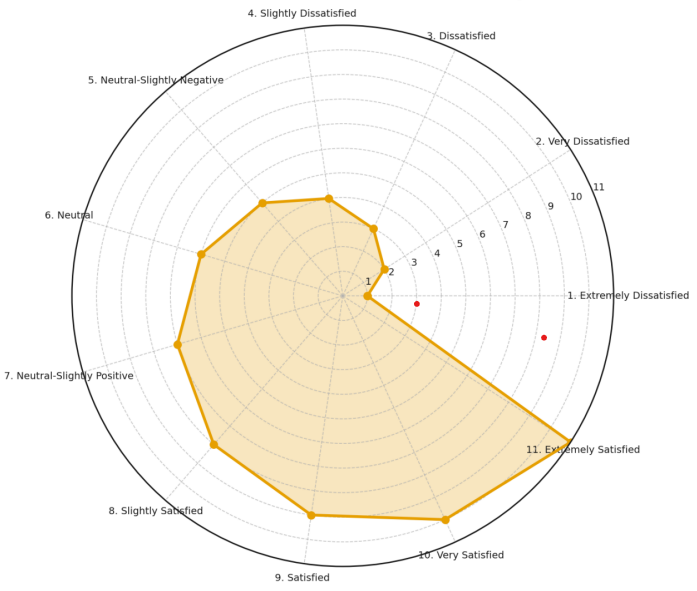
An efficient and mathematically sound method for simulating the distributions of telecommunication signals is the star-like semigroup convolution model. A rigorous operator-theoretic measure of signal strength is provided by the (S3I), which is obtained via semigroup transformations. This study combines empirical field data with the mathematical tools of spectral convolution and star-like transformation semigroups to create a corrective-predictive model for the functioning of telecommunication networks in Gombe State, Nigeria. A poll on signal strength and Quality of Experience (QoE) was conducted using an 11-point star-like scale with 615,510 respondents spread over 11 Local Government Areas (LGAs) and three major providers (MTN, GLO, and Airtel). A star-like signal spectral index (S3I) that generalizes empirical RSS distributions under a continuous semicharacter model was derived by analyzing the data using both formal statistical measures and semigroup-based spectral transformations. Semigroup theory is used with actual telecom data to provide a mathematically sound but practically useful model of network resilience.While GLO urgently needs infrastructure densification, MTN is demonstrated to dominate across LGAs, and Airtel exhibits localized strengths in Billiri and Shongom. Regulators such as the Nigerian Communications Commission are urged to use (S3I) as an impartial performance metric. The model guarantees that transformational semigroups can direct predictive modeling of large-scale communication systems and can be extended to additional Nigerian states and next-generation (5G) networks.
Published
How to Cite
Issue
Section
Copyright (c) 2026 Sulaiman Awwal Akinwunmi, David Opeoluwa Oyewola (Author)

This work is licensed under a Creative Commons Attribution 4.0 International License.
How to Cite
Similar Articles
- Gabriel James, Ifeoma Ohaeri, David Egete, John Odey, Samuel Oyong, Enefiok Etuk, Imeh Umoren, Ubong Etuk, Aloysius Akpanobong, Anietie Ekong, Saviour Inyang, Chikodili Orazulume, A fuzzy-optimized multi-level random forest (FOMRF) model for the classification of the impact of technostress , Journal of the Nigerian Society of Physical Sciences: Volume 7, Issue 3, August 2025
- A. Y. Fasasi, E. Ajenifuja, E. Osagie, L. O. Animasaun, A. E. Adeoye, E. I. Obiajunwa, Optical, Dielectric and Optoelectronic Properties of Spray Deposited Cu-doped Fe2O3 Thin Films , Journal of the Nigerian Society of Physical Sciences: Volume 5, Issue 3, August 2023
- Dekera Kenneth Kwaghtyo, Christopher Ifeanyi Eke, Timothy Moses, CropGAN: A conditional GAN framework for synthetic tabular data augmentation in crop recommendation systems , Journal of the Nigerian Society of Physical Sciences: Volume 8, Issue 3, August 2026
- V Umarani, A Julian, J Deepa, Sentiment Analysis using various Machine Learning and Deep Learning Techniques , Journal of the Nigerian Society of Physical Sciences: Volume 3, Issue 4, November 2021
- Thomas U. Onoja, Benson A. E. Afere, Ayodele Gabriel Fasanya, Sunday Yomi, Bolarinwa Bolaji, Transmission dynamics of dengue–Zika co-infection with antibody-dependent enhancement, cross-immunity, and vaccination: backward bifurcation analysis and data calibration , Journal of the Nigerian Society of Physical Sciences: Volume 8, Issue 3, August 2026
- Oluwaseun IGE, Keng Hoon Gan, Ensemble feature selection using weighted concatenated voting for text classification , Journal of the Nigerian Society of Physical Sciences: Volume 6, Issue 1, February 2024
- Yusuf Olanrewaju Saheed, Mufutau Abiodun Salawu, Aderemi Babatunde Alabi, Mechanical Evaluation and Minerals Phases Identification of Fine and Coarse Okelele Block Clay Composites for Furnace Lining Application , Journal of the Nigerian Society of Physical Sciences: Volume 4, Issue 1, February 2022
- Emmanuel G. Ndoma, Nyakno J. George, Aniekan M. Ekanem, Muyiwa M. Orosun, Patrick O. Ushie, Emmanuel P. Agbo, Benson E. Eze, Charles C. Mbonu, Kolawole E. Adesina, Blessed Yahweh, Francis E. Okon, Evaluating the health risks of radionuclides in welding and fabrication workshops in Akwa Ibom State, Southern Nigeria , Journal of the Nigerian Society of Physical Sciences: Volume 7, Issue 3, August 2025
- B. T. Iorhuna, T. T. Awuhe, I. C. Azuaga, E Isaac, F. Shuaibu, B. Yohanna, Synthesis, Characterization and Antimicrobial Activities of Copper-Tea Leaves (Camellia Sinensis) Extract Nanoparticles.: None , Journal of the Nigerian Society of Physical Sciences: Volume 4, Issue 4, November 2022
- D. N. Ajah, E. Agboeze, J. N. Ihedioha, E. Chukwudi-Madu, C. C. Chime, Levels of Zinc (Zn), Copper (Cu), Iron (Fe), and Cadmium (Cd) in Soil, Rice Stalk, and Oryza Sativa Grain in Ishiagu Rice Field, Ebonyi State, Nigeria; Human Health Risk , Journal of the Nigerian Society of Physical Sciences: Volume 4, Issue 4, November 2022
You may also start an advanced similarity search for this article.
Most read articles by the same author(s)
- Sulaiman Awwal AKINWUNMI, Garba Risqot IBRAHIM, Adenike Olusola ADENIJI, David Opeoluwa OYEWOLA, On the multiplicity order of spinnable star-like transformation semigroup Tw*n , Journal of the Nigerian Society of Physical Sciences: Volume 6, Issue 1, February 2024