An empirical evaluation of mathematical, machine learning, and hybrid modeling approaches for COVID-19 forecasting
Keywords:
SEIR model, Hybrid modeling, Infectious disease prediction, Epidemic forecasting, COVID-19Abstract
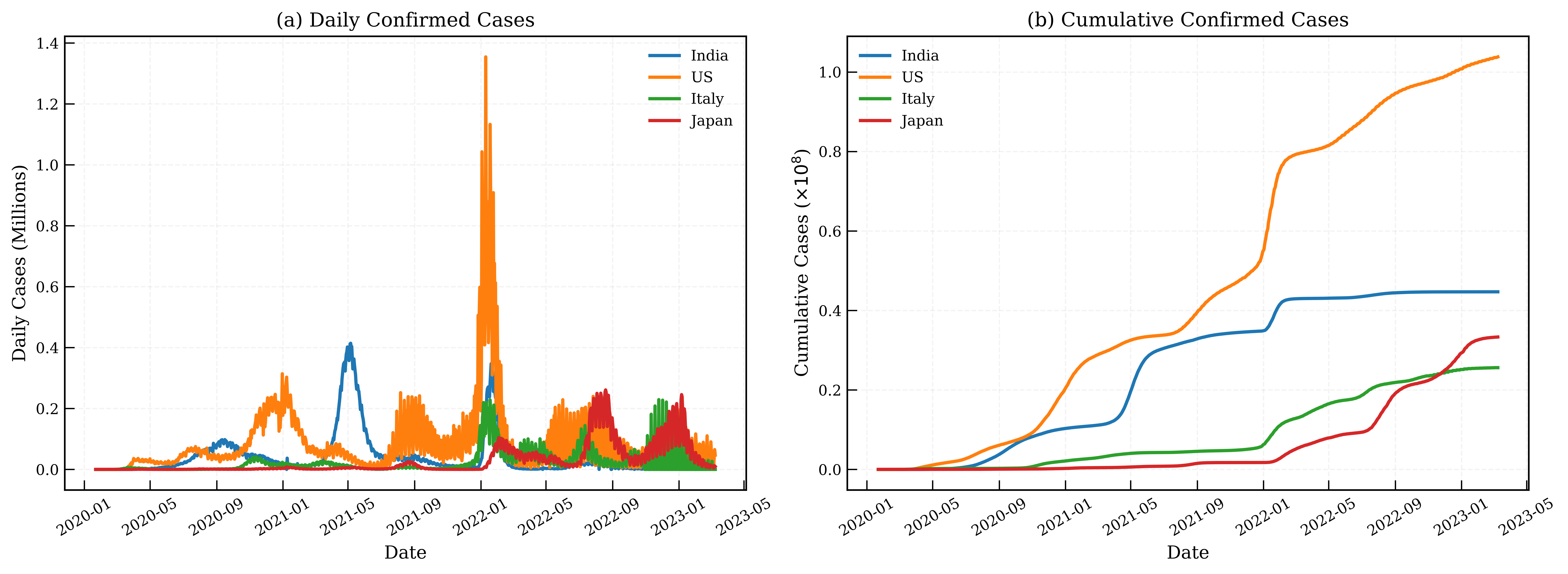
Accurate forecasting of infectious disease spread is essential for public health decision-making. This study compares mechanistic susceptible-exposed-infectious-removed (SEIR) models, machine-learning methods, and hybrid artificial intelligence (AI)-driven epidemiological frameworks using coronavirus disease 2019 (COVID-19) case data from India, the United States, Italy, and Japan. After preprocessing and exploratory analysis, we estimate time-varying transmission rates and develop two hybrid extensions: one predicts beta(t) using machine learning, and the other learns residual errors from the SEIR model. A baseline machine-learning model using lag-based and effective reproduction number (Rt)-driven features is also evaluated. Performance is assessed using mean absolute error (MAE), root mean squared error (RMSE), mean absolute percentage error (MAPE), high-incidence MAPE (on days with observed incidence ge 100 cases), and peak-timing error. With the SEIR transmission-rate spline fitted strictly to training data and all models evaluated on an identical 223-day held-out test window, a simple persistence baseline outperforms the mechanistic SEIR model, both hybrid AI extensions (Tracks A and B), and the pure machine-learning Random Forest model across all four countries (Diebold--Mariano test, p<0.001 in every comparison). The hybrid AI components do not consistently improve forecasting accuracy relative to the SEIR baseline. None of the mechanistic or machine-learning approaches anticipates new epidemic waves beyond the training period, underscoring the difficulty of medium-range epidemic forecasting under genuinely held-out conditions. The comparative evaluation highlights the complementary strengths and limitations of these approaches and provides guidance for future epidemic forecasting models.
Published
How to Cite
Issue
Section
Copyright (c) 2026 Pooja Satwani, Sudhir Kumar Mishra (Author)

This work is licensed under a Creative Commons Attribution 4.0 International License.
How to Cite
Similar Articles
- Oludare Adedire, J. N. Ndam, Mathematical modelling of concentration profiles for species transport through the single and the interconnected multiple-compartment systems , Journal of the Nigerian Society of Physical Sciences: Volume 2, Issue 2, May 2020
- Nneka Ernestina Richard-Nnabu, Chinagolum Ituma, Henry Friday Nweke, Convolutional neural networks method for folded naira currency denominations recognition and analysis , Journal of the Nigerian Society of Physical Sciences: Volume 6, Issue 4, November 2024
- Jatin Kumar, Khem Chand, Pankaj Thakur, Numerical study of hall current and thermophoresis effect on the hydromagnetic casson nano fluid flow over a stretching surface , Journal of the Nigerian Society of Physical Sciences: Volume 8, Issue 2, May 2026
- Eli Danladi, M. Y. Onimisi, S. Garba, R. U. Ugbe, J. A. Owolabi, O. O. Ige, G. J. Ibeh, A. O. Muhammed, Corrigendum to "Simulation and Optimization of Lead-Based Perovskite Solar Cells with Cuprous Oxide as a P-type Inorganic Layer [J. Nig. Soc. Phys. Sci. 1 (2019) 72–81, https://doi.org/10.46481/jnsps.2019.13]" , Journal of the Nigerian Society of Physical Sciences: Volume 3, Issue 3, August 2021
- Pushap Lata Sharma, Deepak Bains, Pankaj Thakur, Throughflow effect on bi-disperse convection in Rivlin-Ericksen fluid , Journal of the Nigerian Society of Physical Sciences: Volume 6, Issue 3, August 2024
- Terver Daniel, Stanimir Kisyov, Patrick Regan, Nicu Marginean, Zsolt Podolyak, R. Marginean, K. Nomura, M. Rudigier, R. Mihai, V. Werner, R. J. Carroll, Laila Gurgi, A. Oprea, Tom Berry, A. Serban, C. R. Nita, C. Sotty, R. Suvaila, A. Turturica, C. Costache, L. Stan, A. Olacel, M. Boromiza, S. Toma, S. J. Gemanam, F. Gbaorun, I. Ochala, E. C. Hemba, Prompt Response Function (PRF) of Lifetime Measurement in the 2+ State of 192Os Nuclei Energy Levels from Triple-Gamma Coincidence Techniques , Journal of the Nigerian Society of Physical Sciences: Volume 2, Issue 4, November 2020
- Yusuf Ibrahim, Common Fixed Point Theorems for Multivalued Generalized F-Suzuki-Contraction Mappings in Complete Strong b-Metric Spaces , Journal of the Nigerian Society of Physical Sciences: Volume 1, Issue 3, August 2019
- A. Abdulrahim, M. D Shehu, E Yisa, Z. A. Ishaq, Mathematical Models and Comparative Analysis for Rice and Soya Bean Irrigation Crop Water Needs: A Case Study of Bida Basin Niger State, Nigeria , Journal of the Nigerian Society of Physical Sciences: Volume 3, Issue 4, November 2021
You may also start an advanced similarity search for this article.