An empirical evaluation of mathematical, machine learning, and hybrid modeling approaches for COVID-19 forecasting
Keywords:
SEIR model, Hybrid modeling, Infectious disease prediction, Epidemic forecasting, COVID-19Abstract
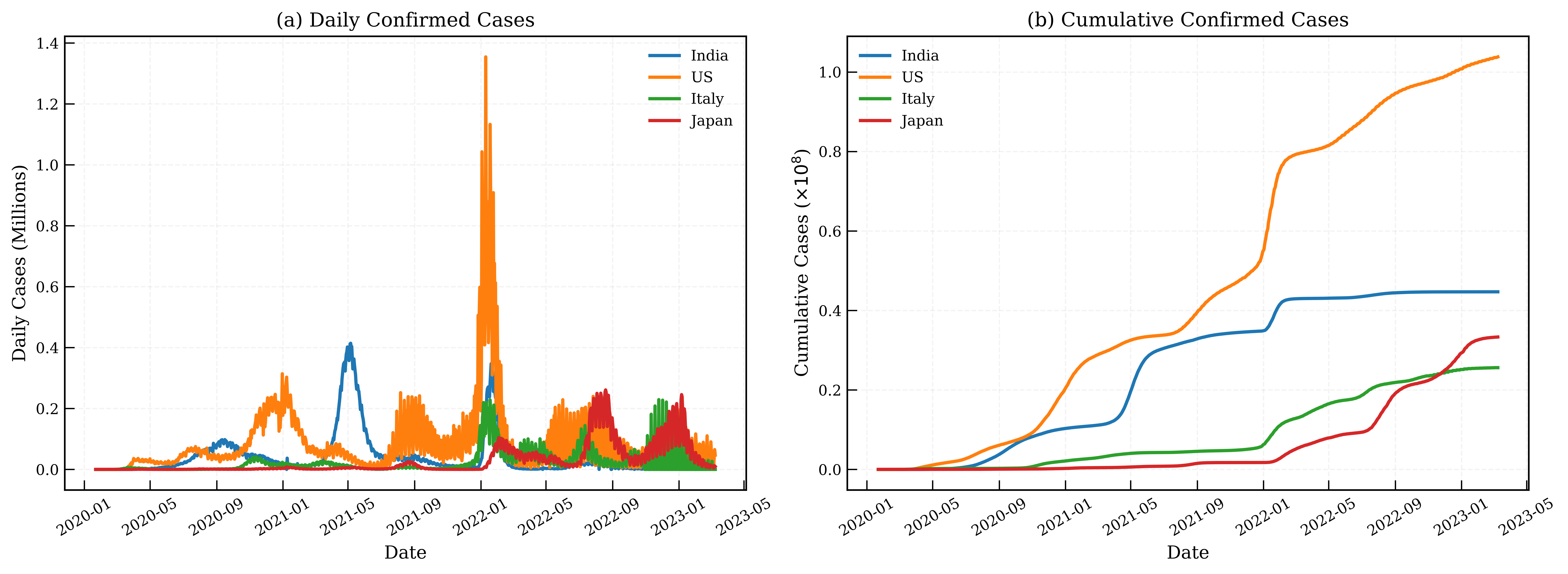
Accurate forecasting of infectious disease spread is essential for public health decision-making. This study compares mechanistic susceptible-exposed-infectious-removed (SEIR) models, machine-learning methods, and hybrid artificial intelligence (AI)-driven epidemiological frameworks using coronavirus disease 2019 (COVID-19) case data from India, the United States, Italy, and Japan. After preprocessing and exploratory analysis, we estimate time-varying transmission rates and develop two hybrid extensions: one predicts beta(t) using machine learning, and the other learns residual errors from the SEIR model. A baseline machine-learning model using lag-based and effective reproduction number (Rt)-driven features is also evaluated. Performance is assessed using mean absolute error (MAE), root mean squared error (RMSE), mean absolute percentage error (MAPE), high-incidence MAPE (on days with observed incidence ge 100 cases), and peak-timing error. With the SEIR transmission-rate spline fitted strictly to training data and all models evaluated on an identical 223-day held-out test window, a simple persistence baseline outperforms the mechanistic SEIR model, both hybrid AI extensions (Tracks A and B), and the pure machine-learning Random Forest model across all four countries (Diebold--Mariano test, p<0.001 in every comparison). The hybrid AI components do not consistently improve forecasting accuracy relative to the SEIR baseline. None of the mechanistic or machine-learning approaches anticipates new epidemic waves beyond the training period, underscoring the difficulty of medium-range epidemic forecasting under genuinely held-out conditions. The comparative evaluation highlights the complementary strengths and limitations of these approaches and provides guidance for future epidemic forecasting models.
Published
How to Cite
Issue
Section
Copyright (c) 2026 Pooja Satwani, Sudhir Kumar Mishra (Author)

This work is licensed under a Creative Commons Attribution 4.0 International License.
How to Cite
Similar Articles
- Muhammad Farman, Kottakkaran Sooppy Nisar, Modeling and stability analysis of a fractional-order tuberculosisvmodel with different exposed populations progressing to infection , Journal of the Nigerian Society of Physical Sciences: Volume 8, Issue 3, August 2026
- Tunde Tajudeen Yusuf, Afeez Abidemi, Ayodeji Sunday Afolabi, Emmanuel Jesuyon Dansu, Optimal Control of the Coronavirus Pandemic with Impacts of Implemented Control Measures , Journal of the Nigerian Society of Physical Sciences: Volume 4, Issue 1, February 2022
- Peter Chibuike Okoye, Samuel Ogochukwu Azi, Taoreed O. Owolabi, Perovskite tetragonality modeling for functional properties enhancement using Newtonian search based support vector regression computational method , Journal of the Nigerian Society of Physical Sciences: Volume 4, Issue 1, February 2022
- Godson Chetachi Uzoaru, Ikechukwu Ignatius Ayogu, Juliet Nnenna Odii, Aloysius Chijioke Onyeka, Bridging context gaps in low-resource language chatbots through multilevel attention and hybrid embedding approaches , Journal of the Nigerian Society of Physical Sciences: Volume 8, Issue 4, November 2026 (in progress)
- Muhammad Farman, Noreen Asghar, Muhammad Umer Saleem, Nezihal Gokbulut, Evren Hincal, Aseel Smerat, Mohamed Hafez, Optimal control of smoking-induced asthma and cardiovascular disorders with medical and public health interventions , Journal of the Nigerian Society of Physical Sciences: Volume 8, Issue 3, August 2026
- Josephine E. Ochigbo, Joel N. Ndam, Wipuni U. Sirisena, Optimal control with the effects of ivermectin and live stock availability on malaria transmission , Journal of the Nigerian Society of Physical Sciences: Volume 6, Issue 3, August 2024
- A. O. Sangotola, S. B. Adeyemo, O. A. Nuga, A. E. Adeniji, A. J. Adigun, A tuberculosis model with three infected classes , Journal of the Nigerian Society of Physical Sciences: Volume 6, Issue 1, February 2024
- Dalal Khalid Almutairi, Mohamed A. Abdoon, Salih Yousuf Mohamed Salih, Shahinaz A.Elsamani, Fathelrhman EL Guma, Mohammed Berir, Modeling and Analysis of a Fractional Visceral Leishmaniosis with Caputo and Caputo–Fabrizio derivatives , Journal of the Nigerian Society of Physical Sciences: Volume 5, Issue 3, August 2023
- F. O. Aweda, J. A. Akinpelu, T. K. Samson, M. Sanni, B. S. Olatinwo, Modeling and Forecasting Selected Meteorological Parameters for the Environmental Awareness in Sub-Sahel West Africa Stations , Journal of the Nigerian Society of Physical Sciences: Volume 4, Issue 3, August 2022
- Shehu Magawata Shagari, Danlami Gabi, Nasiru Muhammad Dankolo, Noah Ndakotsu Gana, Countermeasure to Structured Query Language Injection Attack for Web Applications using Hybrid Logistic Regression Technique , Journal of the Nigerian Society of Physical Sciences: Volume 4, Issue 4, November 2022
You may also start an advanced similarity search for this article.