Application of Remote Sensing and Geoinformatics Techniques in Erosion Mapping and Groundwater Management in the River Amba Watershed, Central Nigeria
Keywords:
Erosion, River Amba , Watershed, Landsat imagery, GISAbstract
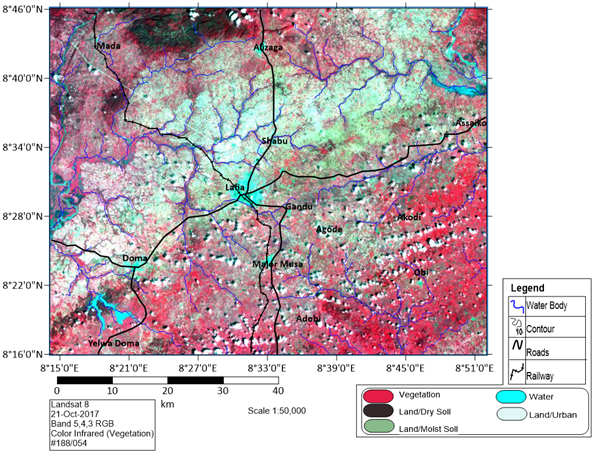
This research integrated easy-to-handle remote sensing data and geoinformatics techniques for erosion mapping and groundwater management in the River Amba watershed, central Nigeria. It is aimed at: (a) the determination of the erosion-prone areas and (b) the estimation of the groundwater potential contamination risk under current and future anthropogenic activities. Rainfall intensity was evaluated from monthly rainfall data (2001 - 2011) from the station located within the River Amba Watershed. Digital Elevation Model (DEM) for the terrain was created using the 3D Analyst tool (Surfer 14) and was used to determine the flow direction and lineament features in each raster cells. Remote sensing data (aerial photographs and LANDSAT imagery) were used to develop a land-use map, while geological mapping was used to determine the local geology of the watershed area. The contributions of the various factors to the erosion hazardous areas are: elevation 31.49 %, land use 21 %, slope 14 %, geology 12.52 %, rainfall intensity 10.5 % and flow accumulation 10.5 %. The combined influences of these factors to erosion susceptibility as either: very high, high, moderate, low, and very low with the south-western part characterized as high while other parts of the study area moderate to very low erosion vulnerability. The groundwater level is shallow (4.0 –28.5 m) and discharges through the Amba river and many springs. These springs along with boreholes and wells supply drinking water to Lafia and the environs.
Published
How to Cite
Issue
Section
Copyright (c) 2021 Journal of the Nigerian Society of Physical Sciences

This work is licensed under a Creative Commons Attribution 4.0 International License.
How to Cite
Similar Articles
- J. Andrawus, J. Y. Musa, S. Babuba, A. Yusuf, S. Qureshi, U. T. Mustapha, A. Oghenefejiro, I. S. Mamba, Modeling the dynamics of pertussis to assess the influence of timely awareness with optimal control analysis , Journal of the Nigerian Society of Physical Sciences: Volume 7, Issue 4, November 2025
- K. Ahmed, M. Y. Waziri, A. S. Halilu, I. A. R. Moghrab, H. Abdullahi, S. M. Ibrahim, Y. B. Musa, S. Murtala, A. M. Awwal, A. Sambas, A Dai-Kou-Type method with image de-blurring application , Journal of the Nigerian Society of Physical Sciences: Volume 7, Issue 3, August 2025
- Orlunta, Aloysius Ndubisi, Briggs-Kamara, Margaret Apaem, Sigalo, Friday Barikpe, Iyeneomie, Tamunobereton-Ari, Analysis of Indoor Radon Level and its Health Risks Parameters in Three Selected Towns in Port Harcourt, Rivers State, Nigeria , Journal of the Nigerian Society of Physical Sciences: Volume 3, Issue 3, August 2021
- Sherifdeen O. Bolarinwa, Eli Danladi, Andrew Ichoja, Muhammad Y. Onimisia, Christopher U. Achem, Synergistic Study of Reduced Graphene Oxide as Interfacial Buffer Layer in HTL-free Perovskite Solar Cells with Carbon Electrode , Journal of the Nigerian Society of Physical Sciences: Volume 4, Issue 3, August 2022
- Uthumporn Panitanarak, Aliyu Ismail Ishaq, Alfred Adewole Abiodun, Hanita Daud, Ahmad Abubakar Suleiman, A new Maxwell-Log logistic distribution and its applications for mortality rate data , Journal of the Nigerian Society of Physical Sciences: Volume 7, Issue 2, May 2025
- Shehu Magawata Shagari, Danlami Gabi, Nasiru Muhammad Dankolo, Noah Ndakotsu Gana, Countermeasure to Structured Query Language Injection Attack for Web Applications using Hybrid Logistic Regression Technique , Journal of the Nigerian Society of Physical Sciences: Volume 4, Issue 4, November 2022
- Olumide S. Adesina, Adedayo F. Adedotuun, Kayode S. Adekeye, Ogbu F. Imaga, Adeleke J. Adeyiga, Toluwalase J. Akingbade, On logistic regression versus support vectors machine using vaccination dataset , Journal of the Nigerian Society of Physical Sciences: Volume 6, Issue 1, February 2024
- Adeniyi F. Fagbamigbe, Gomolemo K. Basele, Boikanyo Makubate, Broderick O. Oluyede, Application of the Exponentiated Log-Logistic Weibull Distribution to Censored Data , Journal of the Nigerian Society of Physical Sciences: Volume 1, Issue 1, February 2019
You may also start an advanced similarity search for this article.