Field Strength Variability Mapping of Nigeria
Keywords:
Radio wave, Electromagnetic Propagation, Field Stregnth, Inter Tropical Discontinuity, Tropospheric RefractivityAbstract
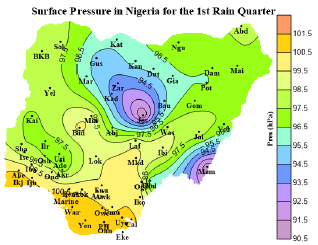
The analysis of the field strength variability using the meteorological parameters (temperature, pressure and relative humidity) retrieved from the archive of National Aeronautical and Space Administration (NASA) was conducted for 61 locations between 2016 and 2020 to check for the spatial and seasonal variation. The result shows a seasonal variation with higher field strength variability during the dry season and lower field strength variability during the wet season. The spatial variation shows a significant difference between stations in the drier locations up north and those in the coastal areas. This could be attributed to the moisture contents of the atmosphere. Further analysis of the Inter-Tropical Discontinuity (ITD) position during the study period has confirmed this assertion where we discovered the northward movement of the ITD brings along with it more moisture and consequently a weak field strength. The variation in the high grounds is not manifesting because of the fact that pressure has little influence on the field strength variability. A careful study of the pressure contour explains that. The mean field strength is found to be between 2.8 dB and 17.9 dB. This implies that the output of the receiving antenna should be less than 2.8 dB and can be as high as 17.9 dB.
References
N.K. Chaudhary, D.K. Trivedi & R. Gupta, “The impact of k-factor on Wireless Link in Indian Semi-Desert Terrain”, International Journal of Advanced Networking and Applications, 2 (2011) 776.
A. T. Adediji & M. O. Ajewole, “Vertical Profile of Radio Refractivity Gradient in Akure, South-West Nigeria”, Progress in Electromagnetic Research, C (2008) 157.
K. Saha, S. Raju & K. Parameswaran, “Neutral Atmospheric Refractivity on Microwave Propagation and its Implication on GPS Based Ranging System”, Proceedings of the XXVIIIth General Assembly, New Delhi (2005).
M. S. Tomar, “Measurement and Analysis of Radio Refractive Index over Patiala during Monsoon Season with Respect to its Diurnal and Monthly Characteristics”, Mausam, 63 (2012) 334.
M. Ajewole, A. Adediji, J. Ojo, S. Falodun, K. Adedayo, T. Ewetumo, A. Ashidi, S. Adebusola, K. Ogunjobi, A. Oluleye, A. Dada & O. Ojo, “Variation of Microwave Radio Refractivity Profiles with Temperature over Akure, Nigeria”, Global Journal of Computer Science and Technology: G Interdisciplinary, 20 (2020).
A. T. Adediji, M. O. Ajewole & S. E. Falodun, “Distribution of Radio Refractivity Gradient and effective Earth radius factor (k-factor) over Akure, South Western Nigeria”, Journal of Atmospheric and Solar Terrestrial Physics, 70 (2011) 2300.
M. M. Tanko, A. Akinbobola, S. Ojo & M. S. Liman, “Assessment of Tropospheric Variation of Radio Refractivity and Field Strength Variability over Some Selected Stations in Northern Nigeria”, Physical Science International Journal, 18 (2018) 1.
O. J. Abimbola, E. Bada, A. O. Falaiye, Y. M. Sukam, M. S. Otto & S. Muhammad, “Estimation of radio refractivity from satellite-derived meteorological data over a decade for West Africa”, Scientific African, 14 (2021) e01054.
A. T. Adediji & M. O. Ajewole, “Microwave Anomalous Propagation (AP) Measurement over Akure South-Western Nigeria”, Journal of Atmospheric and Terrestrial Physics, 72 (2010) 550.
R. B. Bean & E. J. Dutton, “Radio Meteorology”, National Bureau of Standards. U.S. (1966) pp 20.
NASA, “POWER Data” National Aeronautical and Space Administration, May 5 (2019) ttps://power.larc.nasa.gov/data-access-viewer/
E. K. Smith & S. Weintraub, “The COnstants in the Equation for Atmospheric Refractive Index at Radio Frequencies”, Proceedings of the I.R.E, 4 (1953) 1035.
K. Ogunjobi, D. Ragatoa, A. B. Nana, A. Okhimamhe & J. Eichie, “Change Comparison of Heat Wave Aspects in Climatic Zones of Nigeria”, Environmental Earth Sciences, (2019).
Published
How to Cite
Issue
Section
Copyright (c) 2022 M. M. Tanko, M. S. Liman, W. L. Lumbi, U. S. Aliyu, M. U. Sarki

This work is licensed under a Creative Commons Attribution 4.0 International License.