A study of growth of COVID-19 with super-spreaders using the modified SIR model including iceberg phenomenon
Keywords:
SIR model, COVID-19, Super-spreaders, Super Spreading Event, Iceberg phenomenon in epidemiology, Basic reproduction numberAbstract
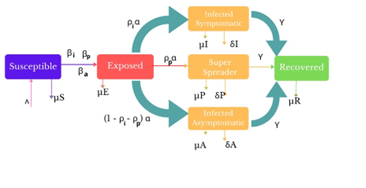
This paper explores the dynamics of COVID-19 transmission, particularly focusing on super-spreaders, through the lens of the SIR model. The model comprises six compartments representing susceptible, exposed, symptomatic infected, super-spreader, asymptomatic infected, and recovered individuals. Utilizing a set of non-linear, interdependent differential equations, we numerically solve for model parameters to examine the influence of super-spreaders on infection spread within the population. We calculate the basic reproduction number (R0) and discuss the stability of disease-free equilibrium. Our findings underscore the significant role played by super-spreaders and asymptomatic individuals in disease dissemination. Drawing on the epidemiological concept of the iceberg phenomenon, we offer insights into super-spreader events (SSEs) in India and their ramifications.
Published
How to Cite
Issue
Section
Copyright (c) 2024 Gurpreet Singh Tuteja, Tapshi Lal

This work is licensed under a Creative Commons Attribution 4.0 International License.
How to Cite
Similar Articles
- D. D. Bwede, R. A. Wuana, G. O. Egah, A. U. Itodo, E. Ogah, E. A. Yerima, A. I. Ibrahim, Characterization and Evaluation of Human Health Risk of Heavy Metals in Tin Mine Tailings in Selected Area of Plateau State, Nigeria , Journal of the Nigerian Society of Physical Sciences: Volume 3, Issue 4, November 2021
- A. S. Akingboye, Geohydraulic characteristics and groundwater vulnerability assessment of tropically weathered and fractured gneissic aquifers using combined georesistivity and geostatistical methods , Journal of the Nigerian Society of Physical Sciences: Volume 4, Issue 4, November 2022
- Godwin O. Olutona, Health Risk Assessment of Heavy Metals in Sediment of Tropical Freshwater Stream , Journal of the Nigerian Society of Physical Sciences: Volume 5, Issue 1, February 2023
- K. Nandhini, V. Vidhya, An Alleviation of Cloud Congestion Analysis of Fluid Retrial User on Matrix Analytic Method in IoT-based Application , Journal of the Nigerian Society of Physical Sciences: Volume 5, Issue 2, May 2023
- S. Adamu, O. O. Aduroja, A. S. Onanaye, M. R. Odekunle, Iterative method for the numerical solution of optimal control model for mosquito and insecticide , Journal of the Nigerian Society of Physical Sciences: Volume 6, Issue 2, May 2024
- John Tulirinya, Mathew Kinyanju, Samuel Mutua, Asaph Muhumuza, Optimizing initial chlorine dosage at an injection point along a water distribution pipe , Journal of the Nigerian Society of Physical Sciences: Volume 7, Issue 4, November 2025
- Philip Ajibola Bankole, Mabel Eruore Adeosun, Sunday Emmanuel Fadugba, Tolulope Fadina, Christopher Thron, Existence and uniqueness results for double jump fractional uncertain differential equations , Journal of the Nigerian Society of Physical Sciences: Volume 8, Issue 2, May 2026
- Priya Dahiya, Jasdev Bhatti, Pankaj Thakur, Weibull-based reliability and profitability analysis of an industrial multi-state repairable system , Journal of the Nigerian Society of Physical Sciences: Volume 8, Issue 3, August 2026
- C. A. Onate, M. C. Onyeaju, Entropic system in the relativistic Klein-Gordon Particle , Journal of the Nigerian Society of Physical Sciences: Volume 3, Issue 3, August 2021
- Aliyu Itari Abdullahi, Nuhu Degree Umar, Application of Remote Sensing and Geoinformatics Techniques in Erosion Mapping and Groundwater Management in the River Amba Watershed, Central Nigeria , Journal of the Nigerian Society of Physical Sciences: Volume 3, Issue 2, May 2021
You may also start an advanced similarity search for this article.