Development of internet of things-based petroleum pipeline topology leak monitoring and detection system using sensors
Keywords:
Internet of Things (IoT), Sensors, Petroleum, Pipeline topology, MonitoringAbstract
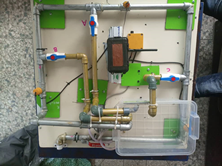
Transportation of crude oil by pipelines is the safest mode of oil transportation. In Nigeria, over 90\% of oil transported by federally regulated pipelines arrives safely every year. The flow starts from oil fields to flow stations to refineries and export tankers and finally, from refineries to depots. Notably, the transportation of oil by pipeline suffers challenges. The challenges range from natural disasters to attacks and activities carried out by vandals. These activities pose a serious threat to Flora and Fauna and have caused devastating effects on the environment, with remarkable destruction of vegetation cover, water bodies, and arable land. In this study, an Internet of Things (IoT)-Based Petroleum Pipeline Topology Leak Detection and Monitoring System (IoT-BPTLDMS) that is capable of monitoring, detecting, and reporting pipeline topology leakage and reports same to the control room before it graduates to spillage has been developed. This was done by strategically mounting pressure-change detecting sensors along the pipelines which are capable of detecting leakages through changes in fluid pressure and results transmitted with the aid of a Long-Range Wireless Area Network (LoRaWAN) module. The transmitted data captures the date, time, event, and geo-location of the leak site. This data is received in a computer and an Android phone. A prototype was used to study the setup's workings. The prototype controller was programmed using C++ with the Arduino Integrated Development Environment (IDE). The Android Application was assembled with Basic4Andriod. The captured result shows consistency with the area of leakage against the geo-location reported. This shows that this method would be effective in checking and detecting petroleum pipeline leakage, and as such, can solve the problem of quick response to pipeline vandalisation and oil spillage in Nigeria or generally.
References
[1] Y. Akinpelu, “2020 Budget: Senate pegs oil price benchmark at $28 per barrel”. [Online], 2020. https://www.premiumtimesng.com/news/top-news/395817-2020-budget-senate-peg.
[2] Reuters, “Rising oil boosts Nigeria’s 2021 budget but creates fuel price headache”. [Online], 2021. https://www.reuters.com/article/uk-nigeria-budget-idUSKBN2BE25F.
[3] G. U. Inyang, S. S. Udoh & O. C. Akinyokun, “Comparative analysis of neural network models for petroleum products pipeline monitoring”, Studies in Engineering and Technology 4 (2017) 53. https://doi.org/10.11114/set.v4i1.2340.
[4] M. A. Adegboye, W. F. Fung & A. Karnik, “Recent advances in pipeline monitoring and oil leakage detection technologies: Principles and approaches”, Sensors 19 (2019) 2548. https://doi.org/10.3390/s19112548.
[5] C. Gomez & D.R. Green, “Small unmanned airborne systems to sup-´ port oil and gas pipeline monitoring and mapping”, Arab Journal of Geoscience 10 (2017) 202. https://doi.org/10.1007/s12517-017-2989-x.
[6] R. Cramer, D. Shaw, R. Tulalian, P. Angelo & M. Van Stuijvenberg, “Detecting and correcting pipeline leaks before they become a big problem”, Mar. Technol. Soc. J 49 (2015) 31. http://dx.doi.org/10.2118/167874-MS.
[7] S. A. Aransiola, S. S. L. Zobeashia, A. A. Ikhumetse, O. I. Musa, O. P. Abioye, U. J. J. Ijah & N. R. Maddela, “Niger Delta mangrove ecosystem: Biodiversity, past and present pollution, threat and mitigation”, Regional Studies in Marine Science 75 (2024) 103568. https://doi.org/10.1016/j.rsma.2024.103568.
[8] R. A. Magris & T. Giarrizzo, “Mysterious oil spill in the Atlantic Ocean threatens marine biodiversity and local people in Brazil”, Marine Pollution Bulletin 153 (2020) 110961. https://doi.org/10.1016/j.marpolbul.2020.110961.
[9] G. Komolafe, "Guidelines for the design, construction and operation of oil and gas production facilities in Nigeria", Nigeria Upstream Petroleum Regulatory Commission, 2023. [Online]. https://www.nuprc.gov.ng/wp-content/uploads/2023/12/Guidelines-for-Design_Development_Operations-of-Oil-Gas-Production-Facilities_Ver-5_November-2023_Published.pdf.
[10] V. Conejo, L. Hernandez & H. Carre´ on, “Non-destructive evaluation of´ aging in welded pipeline X60 and X65 by thermoelectric power means”, International Journal of Pressure Vessels and Piping 207 (2024) 105103. https://doi.org/10.1016/j.ijpvp.2023.105103.
[11] A. B. Lukonge & X. Cao, “Leak detection system for long-distance onshore and offshore gas pipeline using acoustic emission technology: a review”, Trans Indian Inst Met 73 (2020) 1715.https://doi.org/10.1007/s12666-020-02002-x.
[12] S. A. M. Tajalli, M. Moattari, S. V. Naghavi & M. R. Salehizadeh, "A novel hybrid internal pipeline leak detection and location system based on modified real-time transient modelling", Modelling 5 (2024) 1135. https://doi.org/10.3390/modelling5030059.
[13] Y. Shi, C. Zhang, R. Li, M. Cai & G. Jia, “Theory and application of magnetic flux leakage pipeline detection”, Sensors 15 (2015) 31036. http://www.doi.org/10.3390/s151229845.
[14] D. Rifai, A. N. Abdalla, R. Razali, K. Ali & M.A. Faraj, “An eddy current testing platform system for pipe defect inspection based on an optimized eddy current technique probe design”, Sensors 17 (2017) 579.http://doi.org/10.3390/s17030579.
[15] K. Nanan, “Ultrasonic crack inspection: How to avoid pipeline failures”. [Online], 2020. https://www.corrosionpedia.com/ultrasonic-crack-inspection-how-to-avoid-pipeline-failures/2/7143.
[16] L. Beranek & T. Mellow, “Sound in enclosures”, in Acoustics: Sound fields and transducers (2nd Ed.), Academic Press, United Kingdom, 2012, pp. 449–479. https://doi.org/10.1016/B978-0-12-391421-7.00010-5
[17] Y. Wang, F. Song, Q. Feng, W. Qiao, S. Dong, Y. Jiang & Q. Ma. "Basic theory and applications of oil and gas pipeline non-destructive testing methods", Energies 17 (2024) 6366. https://doi.org/10.3390/en17246366
[18] E. G. Odor, M. S. Adekeye, I. B. Owunna, N. G. Agbonze, M. B. Salman, A. O. Salman, “Advanced non-destructive testing techniques for pipeline integrity assessment”, Path of Science: International Electronic Scientific Journal 10 (2024) 3332. https://doi.org/10.22178/pos.109-23.
[19] J. Briddon & B. Metcalfe, “Inspecting pipelines with discoveryTM, the World’s only subsea CT scanner”, Pipeline Technology Journal, 6 (2017) https://www.pipeline-journal.net/pdf/ptj-6-2017.pdf
[20] Q. Ma, G. Tian, Y. Zeng, R. Li, H. Song, Z. Wang, B. Gao & K. Zeng, “Pipeline in-line inspection method, instrumentation and data management”, Sensors 21 (2021) 3862. https://doi.org/10.3390/s21113862.
[21] M. Z. Abbas, K. A. Bakar, M. A. Arshad, M. Tayyab & M. H. Mohamed, “Scalable heterogeneous nodes deployment algorithm for monitoring of underwater pipeline”, Telkomnika 4 (2016) 1183. https://www.doi.org/10.12928/TELKOMNIKA.v14i3.3464.
[22] D. Chinedu, V. Neco & D. Mghele, “Energy efficient group based linear wireless sensor networks for application in pipeline monitoring”, International Journal of Sensors Wireless Communication and Control 11 (2021) 437. https://doi.org/10.2174/2210327910999200614002236.
[23] Z. Abbas, M. R. Anjum, M. U. Younus & B. S. Chowdhry, “Monitoring of gas distribution pipelines network using wireless sensor networks”, Wireless Personal Communications 117 (2021) 2575. https://doi.org/10.1007/s11277-020-07997-6.
[24] A. Hussein, A. El-Nakib & S. Kishk, “Energy-efficient linear wireless sensor networks applications in pipelines monitoring and control”, International Journal of Wireless Communications and Networking Technologies 6 (2017) 1. http://warse.org/IJWCNT/static/pdf/file/ijwcnt01622017.pdf.
[25] W. Han, X. Zhang, Y. Wang, L. Wang, X. Huang, J. Li, S. Wang, W. Chen, L. Li, R. Feng, R. Fan, X. Zhang & Y. Wang, “A survey of machine learning and deep learning in remote sensing of geological environment: Challenges, advances, and opportunities”, ISPRS Journal of Photogrammetry and Remote Sensing 202 (2023) 87. https://doi.org/10.1016/j.isprsjprs.2023.05.032.
[26] N. A. Bui, Y. Oh & I. Lee, “Oil spill detection and classification through deep learning and tailored data augmentation”, International Journal of Applied Earth Observation and Geoinformation 129 (2024) 103845. https://doi.org/10.1016/j.jag.2024.103845.
[27] I. H. Sarker, “Machine learning: Algorithms, real-world applications and research directions”, SN COMPUT. SCI 2 (2021) 160. https://doi.org/10.1007/s42979-021-00592-x.
[28] G. James, I. Umoren, A. Ekong, S. Inyang & O. Aloysius, “Analysis of support vector machine and random forest models for classification of the impact of technostress in covid and post-covid era”, Journal of the Nigerian Society of Physical Sciences 6 (2024) 2102. https://doi.org/10.46481/jnsps.2024.2102.
[29] L. Udeze, I.E. Eteng & E.I. Ayei, “Application of machine learning and resampling techniques to credit card fraud detection”, Journal of the Nigerian Society of Physical Sciences 4 (2022) 769 https://doi.org/10.46481/jnsps.2022.769.
[30] N. A. Gershenfeld, “When things start to think”, (1st Ed.). New York: Henry Holt & Co. (1999). https://archive.org/details/whenthingsstartt00neil/page/n243/mode/2up.
[31] R. Ahmad, J. Rajendran & W. Ismail, “Parallel-pipelined-memory Blowfish FPGA-based radio system with improved power-throughput for secured IoT network”, Ain Shams Engineering Journal 15 (2024) 102625. https://doi.org/10.1016/j.asej.2023.102625.
[32] K. Aminiyeganeh, R. W. L. Coutinho & A. Boukerche, “IoT video analytics for surveillance-based systems in smart cities”, Computer Communications 224 (2024) 95. https://doi.org/10.1016/j.comcom.2024.05.021.
[33] J. H. Dahooie, A. Mohammadian, A. R. Qorbani & T. Daim, “A portfolio selection of internet of things (IoTs) applications for the sustainable urban transportation: A novel hybrid multi criteria decision making approach”, Technology in Society 75 (2023) 102366, https://doi.org/10.1016/j.techsoc.2023.102366.
[34] A. Wakili & S. Bakkali, “Internet of Things in healthcare: An adaptive ethical framework for IoT in digital health”, Clinical eHealth 7 (2024) 92. https://doi.org/10.1016/j.ceh.2024.07.001.
[35] O. E. Ojo, M.K. Kareem, O. Samuel & C.O. Ugwunna, “An Internet-ofThings based Real-time monitoring system for smart classroom”, Journal of the Nigerian Society of Physical Sciences 4 (2022) 297. https://doi.org/10.46481/jnsps.2022.573.
[36] P. T. Bukie, E. U. Oyo-Ita, M. E. Ideba & J. Oboyi, “An enhanced sniffing tool for Network management”, IOSR Journal of Computer Engineering (IOSR-JCE) 21 (2019) 26. https://doi.org/10.9790/0661-2101032634.
[37] J. O. Esin, M. A. Agana, O. A. Ofem, P. Ana, B. I. Ele, P. T. Bukie, E. U. Oyo-Ita & S. I. Ele, “Imminent-threats of cloud computing technology in healthcare operation”, Journal of Educational Research and Technology 7 (2019) 29. https://unicross.edu.ng/staff/doc/267e9e3ca2ea09629d750a7e0c4d894f1662723690.pdf.
[38] A. Zhang, Z. Zhang, S. Cao, Z. Fan, Y. Yan, C. Liu, F. Zheng, C. Zhou, Y. Ma & K Niu, “A drainpipe leakage caused by under-deposit corrosion in a gas–steam turbine combined cycle power plant”, Journal of Failure Analysis and Prevention 21 (2021) 948. https://doi.org/10.1007/s11668-021-01140-8.
[39] O. Okoro, A.E. Edim, O.A. Ofem, E.E. Essien, O.O. Iwara & P.T. Bukie, “Improving security in a virtual local area network”, Journal of Theoretical and Applied Information Technology (JATIT) 100 (2022) 3385. http://www.jatit.org/volumes/Vol100No10/22Vol100No10.pdf.
[40] P. T. Bukie, I. U. Nkanu, S. I. Ele & B. I. Ele, “Techniques for enhancing Voice over Internet Protocol (VoIP) Quality of Service (QoS) Over Wireless LANs”, Scholars Journal of Engineering and Technology 5 (2017) 137. https://www.doi.org/10.21276/sjet.
[41] W. S. Oh, Y. Cheong, D. Lee & K. Kim, “Magnetostrictive guided wave technique verification for detection and monitoring defects in the pipe”, Materials (Basel), 12, (2017), 867, https://doi.org/10.3390/ma12060867.
[42] C. E. Acosta, F. Gil-Castiñeira, E. Costa-Montenegro & J. S. Silva, ``Reliable link level routing algorithm in pipeline monitoring using implicit acknowledgements'', Sensors 21 (2021) 968. https://doi.org/10.3390/s21030968.
[43] L. Lawand, O. Shiryayev, K.A. Handawi, N. Vahdati & P. Rostron, “Corrosivity sensor for exposed pipelines based on wireless energy transfer”, Sensors 17 (2017) 1238. https://doi.org/10.3390/s17061238.
[44] F. O. Okorodudu, P. O. Okorodudu & L. O. Atumah, “A monitoring system for petroleum pipeline vandalism in the Niger Delta region of Nigeria”, International Journal of Research-GRANTHAALAYAH 6 (2018) 139. https://doi.org/10.5281/zenodo.1301204.
[45] M. F. Monir, S. Das & P. Roychowdhury, “A study on wireless sensor network deployment and lifetime maximization of wireless sensor nodes in natural gas pipeline monitoring system”, Journal of Communication Engineering & Systems 6 (2016) 1. https://www.researchgate.net/profile/Sarjo-Das/publication/312056794_A_Study_on_Wireless_Sensor_Network_Deployment_and_Lifetime_Maximization_of_Wireless_Sensor_Nodes_in_Natural_Gas_Pipeline_Monitoring_System/links/586d499908aebf17d3a72358/A-Study-on-Wireless-Sensor-Network-Deployment-and-Lifetime-Maximization-of-Wireless-Sensor-Nodes-in-Natural-Gas-Pipeline-Monitoring-System.pdf.
[46] L. A. Ajao, E. A. Adedokun, C. P. Nwishieyi, M. A. Adegboye, J. Agajo & J. G. Kolo, “An anti-theft oil pipeline vandalism detection: Embedded system development”, International Journal of Engineering Science and Application 2 (2018) 41. http://dx.doi.org/10.13140/RG.2.2.35175.55203.
[47] P. A. Tomiwa & A. A. Bosede, “Intelligent pipeline monitoring system based on internet of things”, Scientific Research Journal (SCIRJ) 8 (2020) 44. http://dx.doi.org/10.31364/SCIRJ/v8.i8.2020.P0820793.
[48] A. I. Simeon, E. A. Edim, I. E. Eteng & C. Chimezie, “Design of a flood magnitude prediction model using algorithmic and mathematical approaches”, International Journal of Information Technology 13 (2021) 1569. https://doi.org/10.1007/s41870-021-00706-x.
[49] I. E. Eteng & S. O. Oladimeji, “Development of an online collaboration tool for research and innovation in the university”, Journal of Management Science and Business Intelligence 4 (2019) 25. https://doi.org/10.5281/zenodo.3269863.
[50] L. Nishizaki, “Cross-correlation of 2 matrices”, Observable. [Online], 2009. https://observablehq.com/@lemonnish/cross-correlation-of-2-matrices.
[51] J. J. A. Gubner, “Probability and random processes for electrical and computer engineers'', Cambridge University Press, United States of America, 2006. [Online]. https://doi.org/10.1017/CBO9780511813610.
[52] C. W. Therrien & M. Tummala, “Probability and random processes for electrical and computer engineers'', United States of America: CRC Press, 2011. [Online]. https://doi.org/10.1201/9781315115160.
Published
How to Cite
Issue
Section
Copyright (c) 2025 Paul Tawo Bukie, Idongesit E. Eteng, Eyo E. Essien (Author)

This work is licensed under a Creative Commons Attribution 4.0 International License.