Artificial potential field path length reduction using Kenneth-Nnanna-Saleh algorithm
Keywords:
Path planning, Artificial potential field, Obstacle avoidanceAbstract
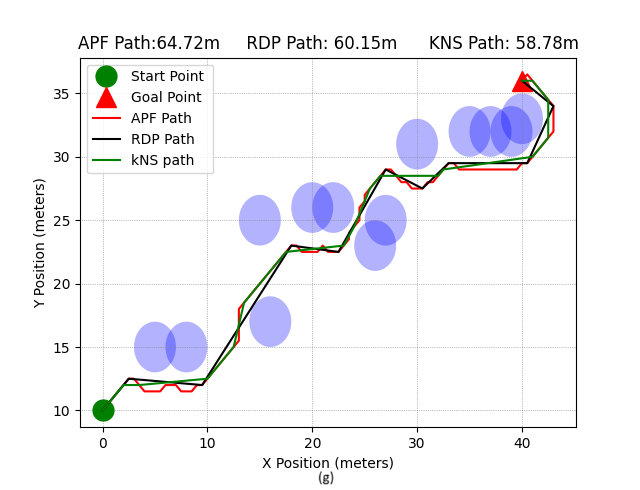
The artificial potential field (APF) is one of the famous path planning algorithms. It creates a virtual force field that attracts a robot to the goal or repels it from an obstacle, forcing it to move along the direction of the resultant forces toward the goal. The repulsive force pushes the robot away from the obstacle, causing a large displacement from the straight path, increasing the path length. This paper presents the Kenneth-Nnanna-Saleh (KNS) algorithm that can shorten the length of an APF path by reducing its waypoints. The algorithm takes an APF path that is generated from the problem domain as input, evaluates angles at each point, and compares the angle with a pre-defined threshold angle to remove or retain the point in the resultant KNS path. Simulation environments, each with varying complexity in obstacle arrangement, were designed for various simulations of the proposed algorithm. A Python-based computer simulation program was implemented and used to simulate the KNS, APF, and a similar waypoint reduction algorithm -Ramer-Douglas-Peucker (RDP) and the results were analyzed. The results show that KNS can yield a shorter path than APF and RDP and retain the obstacle avoidance feature of the path. The shortened path maintains the geometry of the APF path and leads to reduced energy cost for the deployment of robots.
Published
How to Cite
Issue
Section
Copyright (c) 2025 Kenneth Christopher Ugwoke, Nnanna Nwojo Agwu, Saleh Abdullahi

This work is licensed under a Creative Commons Attribution 4.0 International License.
How to Cite
Similar Articles
- E. E. Etim, Benchmark Studies on the Isomerization Enthalpies for Interstellar Molecular Species , Journal of the Nigerian Society of Physical Sciences: Volume 5, Issue 2, May 2023
- Misbaudeen Abdul-Hammed, Ibrahim Olaide Adedotun, Tolulope Irapada Afolabi Afolabi, Ubeydat Temitope Ismail, Praise Toluwalase Akande, Balqees Funmilayo Issa, Analysis of the Bioactive Compounds from Carica papaya in the Management of Psoriasis using Computational Techniques , Journal of the Nigerian Society of Physical Sciences: Volume 5, Issue 1, February 2023
- E. P. Onokare, L. O. Odokuma, F. D. Sikoki, B. M. Nziwu, P. O. Iniaghe, J. C. Ossai, Physicochemical Characteristics and Toxicity Studies of Crude Oil, Dispersant and Crude Oil-Dispersant Test Media to Marine Organisms , Journal of the Nigerian Society of Physical Sciences: Volume 4, Issue 1, February 2022
- A. B. Disu, S. O. Salawu, Thermal distribution of magneto-tangent hyperbolic flowing fluid over a porous moving sheet: A Lie group analysis , Journal of the Nigerian Society of Physical Sciences: Volume 5, Issue 1, February 2023
- N. Kure, I. H Daniel, N. M Hamidon, I. I Lakin, B. U Machu, E. J Adoyi, Effect of Time on the Syntheses of Carbon Nanotubes via Domestic Oven , Journal of the Nigerian Society of Physical Sciences: Volume 4, Issue 1, February 2022
- Stephen Olushola Oladosu, Alfred Sunday Alademomi , James Bolarinwa Olaleye, Joseph Olalekan Olusina, Tosin Julius Salami, Evaluation of ANFIS Predictive Ability Using Computed Sediment from Gullies and Dam , Journal of the Nigerian Society of Physical Sciences: Volume 5, Issue 2, May 2023
- A. S. Akingboye, Geohydraulic characteristics and groundwater vulnerability assessment of tropically weathered and fractured gneissic aquifers using combined georesistivity and geostatistical methods , Journal of the Nigerian Society of Physical Sciences: Volume 4, Issue 4, November 2022
- R. Kamali, S. Prema, Geometric admissibility of hypergeometric and integral operators for the synthesis of digital filters , Journal of the Nigerian Society of Physical Sciences: Volume 8, Issue 3, August 2026
- F. C. Ugbe, O. E. Ominigbo, A. O. Akano, Tectonic Setting of the Syenite Around Igarra, Southwestern Nigeria: Constraints from Geochemistry , Journal of the Nigerian Society of Physical Sciences: Volume 5, Issue 1, February 2023
- Benson Ade Eniola Afere, On the cluster of the families of hybrid polynomial kernels in kernel density estimation , Journal of the Nigerian Society of Physical Sciences: Volume 7, Issue 1, February 2025
You may also start an advanced similarity search for this article.