Effective tweets classification for disaster crisis based on ensemble of classifiers
Keywords:
Disaster Crisis Management, Social Media Analytics, Twitter, Machine Learning Classifiers, Ensemble Methods, Feature ExtractionAbstract
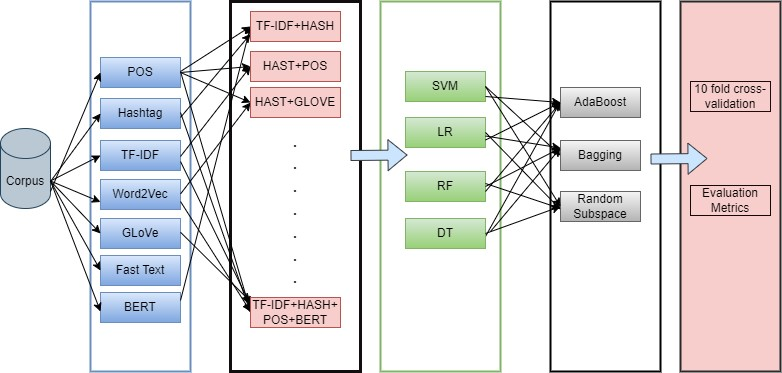
In the field of disaster management, social media analytics has gained significant recognition. Social media platforms, particularly Twitter, have become an invaluable source for disseminating information during disasters, offering real-time updates on events, crisis reports, and casualty information. However, the deluge of information on social media can also be overwhelming, with a substantial amount of irrelevant content. To address this challenge, researchers leverage machine learning (ML) classifiers to automatically categorize disaster-related tweets. However, ML classifiers, while being effective, also face issues such as overfitting and class imbalance. This study proposes an ensemble-based approach that integrates a variety of linguistic and word embedding features, including Parts-Of-Speech (POS), hashtags, Term Frequency-Inverse Document Frequency (TF-IDF), GloVe, Word2Vec, and BERT. A range of supervised learning algorithms like Decision Trees, Logistic Regression, Support Vector Machines, and Random Forests, were evaluated individually and as part of ensemble methods like AdaBoost, Bagging, and Random Subspace. The results show that combining TF-IDF with word embeddings and using the AdaBoost ensemble model yields superior performance, achieving a classification accuracy of 98.92%. This represents a notable improvement over the conventional standalone classifiers and highlights the advantage of ensemble methods in enhancing model robustness and minimizing overfitting. The proposed approach demonstrates not only high predictive capacity but also scalability for real-time tweet filtering during emergencies. In addition to demonstrating the efficacy of ensemble methods in disaster tweet classification, this study also provides valuable insights for improving social media-based crisis response. It also establishes a foundation for future research, particularly in multi-lingual and multi-disaster scenarios.
Published
How to Cite
Issue
Section
Copyright (c) 2025 Christopher Ifeanyi Eke, Kholoud Maswadi, Musa Phiri, Mulenga Mwege, Mohammad Imran, Dekera Kenneth Kwaghtyo, Akeremale Olusola Collins

This work is licensed under a Creative Commons Attribution 4.0 International License.
How to Cite
Similar Articles
- O. M. Ogunlaran, M. A. Kehinde, M. A. Akanbi, E. I. AKINOLA, A Chebyshev polynomial based block integrator for the direct numerical solution of fourth order ordinary differential equations , Journal of the Nigerian Society of Physical Sciences: Volume 6, Issue 2, May 2024
- John Tulirinya, Mathew Kinyanju, Samuel Mutua, Asaph Muhumuza, Optimizing initial chlorine dosage at an injection point along a water distribution pipe , Journal of the Nigerian Society of Physical Sciences: Volume 7, Issue 4, November 2025
- Emmanuel P. Agbo, Golden C. Offorson, Abubakar S. Yusuf, John O. Bassey, Moses A. Okono, Ugochukwu Nkajoe, Patrick O. Ushie, Innovative trend analysis of precipitation changes over Nigeria: A case study of locations across the Niger and Benue Rivers , Journal of the Nigerian Society of Physical Sciences: Volume 7, Issue 1, February 2025
- Misbaudeen Abdul-Hammed, Ibrahim Olaide Adedotun, Tolulope Irapada Afolabi Afolabi, Ubeydat Temitope Ismail, Praise Toluwalase Akande, Balqees Funmilayo Issa, Analysis of the Bioactive Compounds from Carica papaya in the Management of Psoriasis using Computational Techniques , Journal of the Nigerian Society of Physical Sciences: Volume 5, Issue 1, February 2023
- Adeyemi Olukayode Binuyo, Eigenvalue Elasticity and Sensitivity Analyses of the Transmission Dynamic Model of Corruption , Journal of the Nigerian Society of Physical Sciences: Volume 1, Issue 1, February 2019
- M. Kida, S. Adamu, O. O Aduroja, P. T Pantuvo, Numerical Solution of Stiff and Oscillatory Problems using Third Derivative Trigonometrically Fitted Block Method , Journal of the Nigerian Society of Physical Sciences: Volume 4, Issue 1, February 2022
- Kazeem A. Tijani, Chinwendu E. Madubueze, Reuben I. Gweryina, Terhemen Aboiyar, Mathematical modelling and optimal-control strategies of schistosomiasis–typhoid fever co-infection: using the demographic setting of Makurdi, Benue State, Nigeria , Journal of the Nigerian Society of Physical Sciences: Volume 8, Issue 3, August 2026 (In Progress)
- V. Ramanjini, G. Gopi Krishna, Mani Ramanuja, Hari Kamala Sree, S. R. Mishra, Unsteady Prandtl nanofluidic flow through stretching sheet due to mixed convection, first-order slip, and chemical reaction , Journal of the Nigerian Society of Physical Sciences: Volume 5, Issue 4, November 2023
- Charles Otobrise, Godwin Eferurhobo, Prediction of the acentric factor of some halogenated hydrocarbons via group contribution techniques , Journal of the Nigerian Society of Physical Sciences: Volume 6, Issue 4, November 2024
- J. O. Coker, H. H. Akpan, A. O. Atilade, O. F. Ojo, Seasonal Comparison of Potential Groundwater Aquifer in Ijebu-Ife, South-West, Nigeria, using Dipole-Dipole Array and Electromagnetic Methods , Journal of the Nigerian Society of Physical Sciences: Volume 2, Issue 4, November 2020
You may also start an advanced similarity search for this article.
Most read articles by the same author(s)
- Dekera Kenneth Kwaghtyo, Christopher Ifeanyi Eke, Timothy Moses, CropGAN: A conditional GAN framework for synthetic tabular data augmentation in crop recommendation systems , Journal of the Nigerian Society of Physical Sciences: Volume 8, Issue 3, August 2026 (In Progress)