Effective tweets classification for disaster crisis based on ensemble of classifiers
Keywords:
Disaster Crisis Management, Social Media Analytics, Twitter, Machine Learning Classifiers, Ensemble Methods, Feature ExtractionAbstract
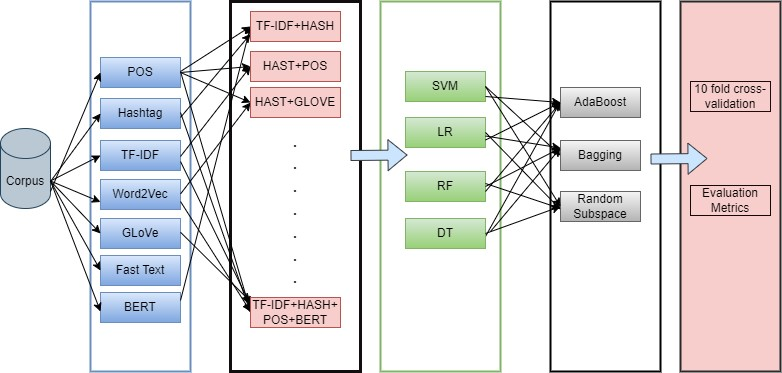
In the field of disaster management, social media analytics has gained significant recognition. Social media platforms, particularly Twitter, have become an invaluable source for disseminating information during disasters, offering real-time updates on events, crisis reports, and casualty information. However, the deluge of information on social media can also be overwhelming, with a substantial amount of irrelevant content. To address this challenge, researchers leverage machine learning (ML) classifiers to automatically categorize disaster-related tweets. However, ML classifiers, while being effective, also face issues such as overfitting and class imbalance. This study proposes an ensemble-based approach that integrates a variety of linguistic and word embedding features, including Parts-Of-Speech (POS), hashtags, Term Frequency-Inverse Document Frequency (TF-IDF), GloVe, Word2Vec, and BERT. A range of supervised learning algorithms like Decision Trees, Logistic Regression, Support Vector Machines, and Random Forests, were evaluated individually and as part of ensemble methods like AdaBoost, Bagging, and Random Subspace. The results show that combining TF-IDF with word embeddings and using the AdaBoost ensemble model yields superior performance, achieving a classification accuracy of 98.92%. This represents a notable improvement over the conventional standalone classifiers and highlights the advantage of ensemble methods in enhancing model robustness and minimizing overfitting. The proposed approach demonstrates not only high predictive capacity but also scalability for real-time tweet filtering during emergencies. In addition to demonstrating the efficacy of ensemble methods in disaster tweet classification, this study also provides valuable insights for improving social media-based crisis response. It also establishes a foundation for future research, particularly in multi-lingual and multi-disaster scenarios.
Published
How to Cite
Issue
Section
Copyright (c) 2025 Christopher Ifeanyi Eke, Kholoud Maswadi, Musa Phiri, Mulenga Mwege, Mohammad Imran, Dekera Kenneth Kwaghtyo, Akeremale Olusola Collins

This work is licensed under a Creative Commons Attribution 4.0 International License.
How to Cite
Similar Articles
- Nneka Ernestina Richard-Nnabu, Chinagolum Ituma, Henry Friday Nweke, Convolutional neural networks method for folded naira currency denominations recognition and analysis , Journal of the Nigerian Society of Physical Sciences: Volume 6, Issue 4, November 2024
- Chinnarao Menda, Ch. Ramakrishna, V D N Kumar Abbaraju, Analysis of industrial solid waste for secure and eco-friendly disposal by incineration practices , Journal of the Nigerian Society of Physical Sciences: Volume 7, Issue 3, August 2025
- Atiek Iriany, Wigbertus Ngabu, Henny Pramoedyo, Amarifai, Geographically weighted regression random forest for modeling soil particles , Journal of the Nigerian Society of Physical Sciences: Volume 8, Issue 2, May 2026
- E. P. Onokare, L. O. Odokuma, F. D. Sikoki, B. M. Nziwu, P. O. Iniaghe, J. C. Ossai, Physicochemical Characteristics and Toxicity Studies of Crude Oil, Dispersant and Crude Oil-Dispersant Test Media to Marine Organisms , Journal of the Nigerian Society of Physical Sciences: Volume 4, Issue 1, February 2022
- Sunday Samuel Bako, Norhaslinda Ali, Jayanthi Arasan, Assessing model selection techniques for distributions use in hydrological extremes in the presence of trimming and subsampling , Journal of the Nigerian Society of Physical Sciences: Volume 6, Issue 4, November 2024
- S. Adamu, O. O. Aduroja, A. S. Onanaye, M. R. Odekunle, Iterative method for the numerical solution of optimal control model for mosquito and insecticide , Journal of the Nigerian Society of Physical Sciences: Volume 6, Issue 2, May 2024
- Rachid El chaal, Hamid Dalhi, Otmane Darbal, Omar Boughaleb, Analytical resolution of nonlinear fractional equations using the GERDFM method: Application to nonlinear Schrödinger and truncated Boussinesq-Burgers equations , Journal of the Nigerian Society of Physical Sciences: Volume 7, Issue 4, November 2025
- K. M. Omatolaa, A. D. Onojah, A. N. Amah, I. Ahemen, Synthesis and characterization of silica xerogel and aerogel from rice husk ash and pulverized beach sand via sol-gel route , Journal of the Nigerian Society of Physical Sciences: Volume 5, Issue 4, November 2023
- Wilson Nwankwo, Kingsley Ukhurebor, Investigating the Performance of Point to Multipoint Microwave Connectivity across Undulating Landscape during Rainfall , Journal of the Nigerian Society of Physical Sciences: Volume 1, Issue 3, August 2019
- O. E. Osafile, O. N. Nenuwe, Lattice Dynamics and thermodynamic Responses of XNbSn Half-Heusler Semiconductors: A First-Principles Approach , Journal of the Nigerian Society of Physical Sciences: Volume 3, Issue 2, May 2021
You may also start an advanced similarity search for this article.
Most read articles by the same author(s)
- Dekera Kenneth Kwaghtyo, Christopher Ifeanyi Eke, Timothy Moses, CropGAN: A conditional GAN framework for synthetic tabular data augmentation in crop recommendation systems , Journal of the Nigerian Society of Physical Sciences: Volume 8, Issue 3, August 2026 (In Progress)