Hybrid deep belief network and fuzzy clustering approach for geothermal prospectivity mapping in northeastern Nigeria using magnetic and landsat data
Keywords:
Geothermal mapping, DBN, FCM, Unsupervised learningAbstract
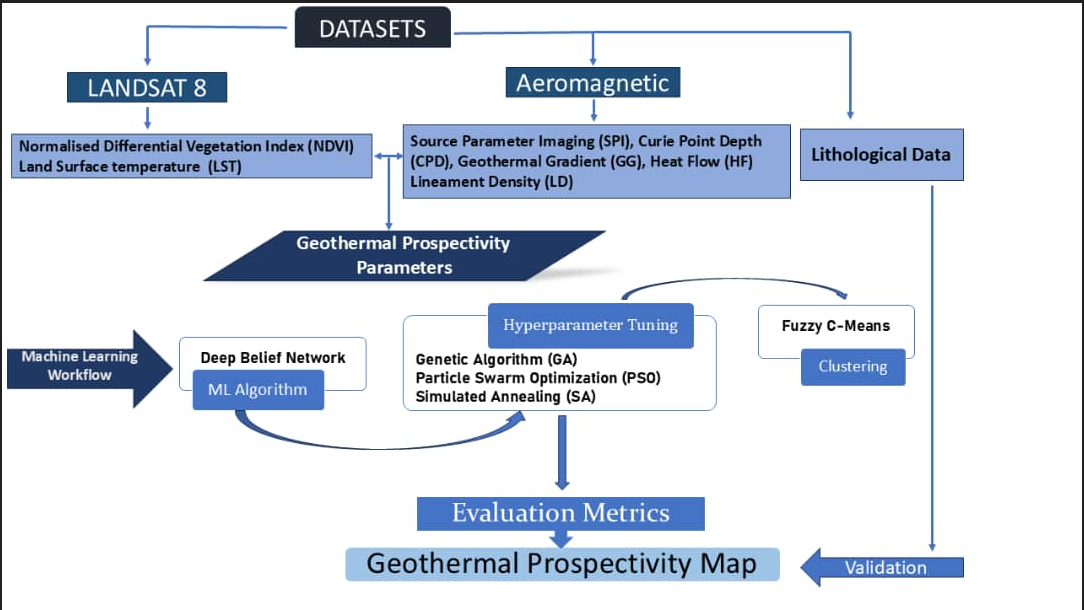
Nigeria faces persistent energy supply challenges, particularly in its northeastern region, where grid access is limited and dependence on fossil fuels undermines sustainability goals. Although the National Renewable Energy Action Plan (NREAP 2015–2030) outlines ambitious targets for renewable energy integration, it notably lacks specific strategies for geothermal development—leaving a critical gap in policy and resource utilization. This study addresses that gap by developing a scalable, cost-effective geothermal prospectivity mapping framework using remote sensing and aeromagnetic data integrated through a hybrid machine learning model. A novel combination of Deep Belief Networks (DBN) for feature extraction and Fuzzy C-Means (FCM) clustering for spatial classification was employed, with optimization achieved using three metaheuristic algorithms: Genetic Algorithm (GA), Particle Swarm Optimization (PSO), and Simulated Annealing (SA). Among these, the DBN-SA model achieved the best internal validity, with superior Silhouette Score, Davies–Bouldin Index, and cluster compactness, ensuring robust and interpretable prospectivity results. Key geothermal indicators—including land surface temperature, vegetation stress, Curie depth, heat flow, and magnetic source depth—were derived from Landsat and airborne magnetic datasets. The resulting map classifies the study area into low, moderate, and high geothermal potential zones, with validation supported by geological correlation and the presence of known thermal features like the Wikki Warm Spring. Approximately one-third of the area was identified as high-potential, particularly over basement terrains with high heat production and structural permeability. This approach offers both scientific insight and practical direction for decentralized, low-carbon energy deployment in northeastern Nigeria, aligning with broader national renewable energy goals and filling a crucial gap in geothermal resource planning.
Published
How to Cite
Issue
Section
Copyright (c) 2025 A. K. Usman, Y. A. Hassan, A. A. Bery, A. A. Sunny, M. D. Dick, A. B. Mohammed, R. O. Aderoju (Author)

This work is licensed under a Creative Commons Attribution 4.0 International License.
How to Cite
Similar Articles
- Muhammad Dahiru Liman, Salamatu Ibrahim Osanga, Esther Samuel Alu, Sa'adu Zakariya, Regularization Effects in Deep Learning Architecture , Journal of the Nigerian Society of Physical Sciences: Volume 6, Issue 2, May 2024
- Nahid Salma, Majid Khan Majahar Ali, Raja Aqib Shamim, Machine learning-based feature selection for ultra-high-dimensional survival data: a computational approach , Journal of the Nigerian Society of Physical Sciences: Volume 7, Issue 3, August 2025
- P. O. Odion, M. N. Musa, S. U. Shuaibu, Age Prediction from Sclera Images using Deep Learning , Journal of the Nigerian Society of Physical Sciences: Volume 4, Issue 3, August 2022
- Gabriel James, Ifeoma Ohaeri, David Egete, John Odey, Samuel Oyong, Enefiok Etuk, Imeh Umoren, Ubong Etuk, Aloysius Akpanobong, Anietie Ekong, Saviour Inyang, Chikodili Orazulume, A fuzzy-optimized multi-level random forest (FOMRF) model for the classification of the impact of technostress , Journal of the Nigerian Society of Physical Sciences: Volume 7, Issue 3, August 2025
- O. Oderinde, C. L. Mgbechidinma, A. O. Agbeja, A. A. Ajayi, A. O. Ogundiran, O. O. Olaide, O. A. Orelaja, C. A. Mgbechidimma, C. O. Ajanaku, K. D. Oyeyemi, Appraising raw exhaust pollutant gases emissions from industrial generators using statistics and machine learning approaches , Journal of the Nigerian Society of Physical Sciences: Volume 7, Issue 4, November 2025
- Shaymaa Mohammed Ahmed, Majid Khan Majahar Ali, Raja Aqib Shamim, Integrating robust feature selection with deep learning for ultra-high-dimensional survival analysis in renal cell carcinoma , Journal of the Nigerian Society of Physical Sciences: Volume 7, Issue 4, November 2025
- Timothy Kayode Samson, Francis Olatunbosun Aweda, Wind speed prediction in some major cities in Africa using Linear Regression and Random Forest algorithms , Journal of the Nigerian Society of Physical Sciences: Volume 6, Issue 4, November 2024
- Raphael Ozighor Enihe, Rajesh Prasad, Francisca Nonyelum Ogwueleka, Fatimah Binta Abdullahi, The effect of imbalance data mitigation techniques on cardiovascular disease prediction , Journal of the Nigerian Society of Physical Sciences: Volume 7, Issue 2, May 2025
- Chinedu L. Udeze, Idongesit E. Eteng, Ayei E. Ibor, Application of Machine Learning and Resampling Techniques to Credit Card Fraud Detection , Journal of the Nigerian Society of Physical Sciences: Volume 4, Issue 3, August 2022
- Unyime Ufok Ibekwe, Uche M. Mbanaso, Nwojo Agwu Nnanna, Umar Adam Ibrahim, A machine learning sentiment classification of factors that shape trust in smart contracts , Journal of the Nigerian Society of Physical Sciences: Volume 7, Issue 1, February 2025
You may also start an advanced similarity search for this article.