Deep convolutional neural network based synthetic minority over sampling technique: a forfending model for fraudulent credit card transactions in financial institution
Keywords:
Data Augmentation Techniques,, Deep Learning, Credit Card FraudAbstract
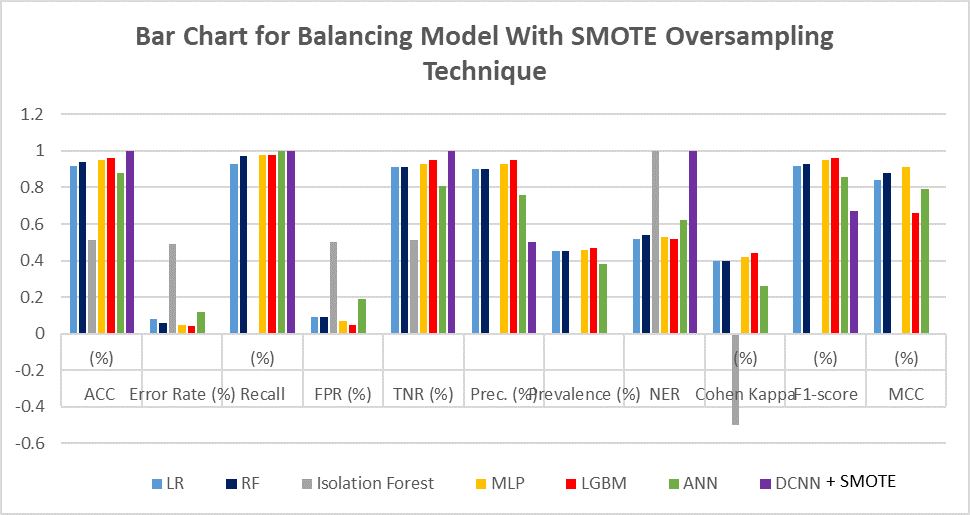
Fraudulent credit card transactions are committed by unauthorized individuals and organizations employing methods such as phishing and social engineering fraud tactics. Researchers propose several Machine Learning (ML) techniques to deter the challenges of credit card fraud. However, the ML approaches are endorsed with some challenges, which makes the detection of credit card fraud extremely difficult. This study proposes a Deep Convolutional Neural Network (DCNN) with Synthetic Minority Oversampling Techniques (SMOTE) as an ideal solution. Kaggle datasets with 284,807 records and 31 features were exploited. Implementation was performed on the Google Colab cloud-based platform, embedding a Jupyter notebook setting with Graphical Processing Units (GPUs). Two experiments were conducted; the first was probed to determine suitable models among baseline models: Logistic Regression (LR), Random Forest (RF), Isolation Forest, and a single Deep Learning (DL) model of Multiple Layer Perceptron (MLP). The baseline models yielded an overfitting accuracy score, with recall, specificity, precision, and F1-score all presenting 1.00% respectively. This outcome is not sufficient in establishing findings on imbalanced data distribution as it's biased. This led to the construction of a new ML model incorporating Light Gradient Boosting Machine (LGBM), with Artificial Neural Network (ANN) and the proposed DCNN+SMOTE for the second experimental phase alongside baseline models. Experimental results via simulation show the proposed DCNN+SMOTE yielded awesome superclass performance across the board, displaying 1.00% results respectively. Its Error Rate (ER) and Null Error Rate (NER) are 0.00% distinctly. Meanwhile, the False Positive Rate (FPR) yields a 0.001% result, lesser and better than the baseline models.
Published
How to Cite
Issue
Section
Copyright (c) 2024 L. G. Salaudeen, D. GABI, M. Garba, H. U. Suru

This work is licensed under a Creative Commons Attribution 4.0 International License.
How to Cite
Similar Articles
- Chinedu L. Udeze, Idongesit E. Eteng, Ayei E. Ibor, Application of Machine Learning and Resampling Techniques to Credit Card Fraud Detection , Journal of the Nigerian Society of Physical Sciences: Volume 4, Issue 3, August 2022
- Ogochukwu C. Okeke, Ike J. Mgbeafulike, Anthony I. Adigwe, Chidiogo C. Nwokedi, Nwadiogo E. G. Mmaduakonam, Calista U. Okpala, Chinonso J. Okonkwo, Nnamdi C. Ezenwegbu, SAE-IF: A hybrid sparse autoencoder–isolation forest framework for real-time credit-card fraud detection and sustainable digital-economy protection , Journal of the Nigerian Society of Physical Sciences: Volume 8, Issue 3, August 2026
- Sherifdeen O. Bolarinwa, Eli Danladi, Andrew Ichoja, Muhammad Y. Onimisia, Christopher U. Achem, Synergistic Study of Reduced Graphene Oxide as Interfacial Buffer Layer in HTL-free Perovskite Solar Cells with Carbon Electrode , Journal of the Nigerian Society of Physical Sciences: Volume 4, Issue 3, August 2022
- Muhammad Dahiru Liman, Salamatu Ibrahim Osanga, Esther Samuel Alu, Sa'adu Zakariya, Regularization Effects in Deep Learning Architecture , Journal of the Nigerian Society of Physical Sciences: Volume 6, Issue 2, May 2024
- V Umarani, A Julian, J Deepa, Sentiment Analysis using various Machine Learning and Deep Learning Techniques , Journal of the Nigerian Society of Physical Sciences: Volume 3, Issue 4, November 2021
- Idongesit E. Eteng, Udeze L. Chinedu, Ayei E. Ibor, A stacked ensemble approach with resampling techniques for highly effective fraud detection in imbalanced datasets , Journal of the Nigerian Society of Physical Sciences: Volume 7, Issue 1, February 2025
- Dekera Kenneth Kwaghtyo, Christopher Ifeanyi Eke, Timothy Moses, CropGAN: A conditional GAN framework for synthetic tabular data augmentation in crop recommendation systems , Journal of the Nigerian Society of Physical Sciences: Volume 8, Issue 3, August 2026
- George Muddu, Shefiu Olusegun Ganiyu, Adekunle Olugbenga Ejidokun, Yusuf Abass Aleshinloye, Integrated data-driven credit default prediction in Uganda using machine learning models , Journal of the Nigerian Society of Physical Sciences: Volume 8, Issue 1, February 2026
- S. I. Ele, U. R. Alo, H. F. Nweke, A. H. Okemiri, E. O. Uche-Nwachi, Deep convolutional neural network (DCNN)-based model for pneumonia detection using chest x-ray images , Journal of the Nigerian Society of Physical Sciences: Volume 7, Issue 2, May 2025
- S. N. Enemuo, O. N. Akande, M. O. Lawrence, I. C. Saidu, Optimized aspect level sentiment analysis of tweet data using deep learning and rule-based techniques , Journal of the Nigerian Society of Physical Sciences: Volume 7, Issue 2, May 2025
You may also start an advanced similarity search for this article.