Sustainable photocatalytic degradation of methylene blue dye induced through biogenic synthesis of metal oxide nanoparticles mediated orange peel extract

Authors

  • Oyesolape Basirat Akinsipo (Oyelaja)
    Department of Chemical Sciences, College of Science and Information Technology, Ijagun, PMB 2118, Tai Solarin University of Education, Ijebu-Ode, Ogun State, Nigeria.
  • Abosede Adejoke Badeji
    Department of Chemical Sciences, College of Science and Information Technology, Ijagun, PMB 2118, Tai Solarin University of Education, Ijebu-Ode, Ogun State, Nigeria.
  • Victor Olamilekan Folorunsho
    Department of Chemical Sciences, College of Science and Information Technology, Ijagun, PMB 2118, Tai Solarin University of Education, Ijebu-Ode, Ogun State, Nigeria.
  • Abiola Kareem Asunmo
    Department of Chemical Sciences, College of Science and Information Technology, Ijagun, PMB 2118, Tai Solarin University of Education, Ijebu-Ode, Ogun State, Nigeria.
  • Olamilekan Emmanuel Agboola
    Department of Chemical Sciences, College of Science and Information Technology, Ijagun, PMB 2118, Tai Solarin University of Education, Ijebu-Ode, Ogun State, Nigeria.

Keywords:

Green synthesis, Zinc oxide nanoparticles, Photocatalytic degradation, Orange peel, Methylene blue dye

Abstract

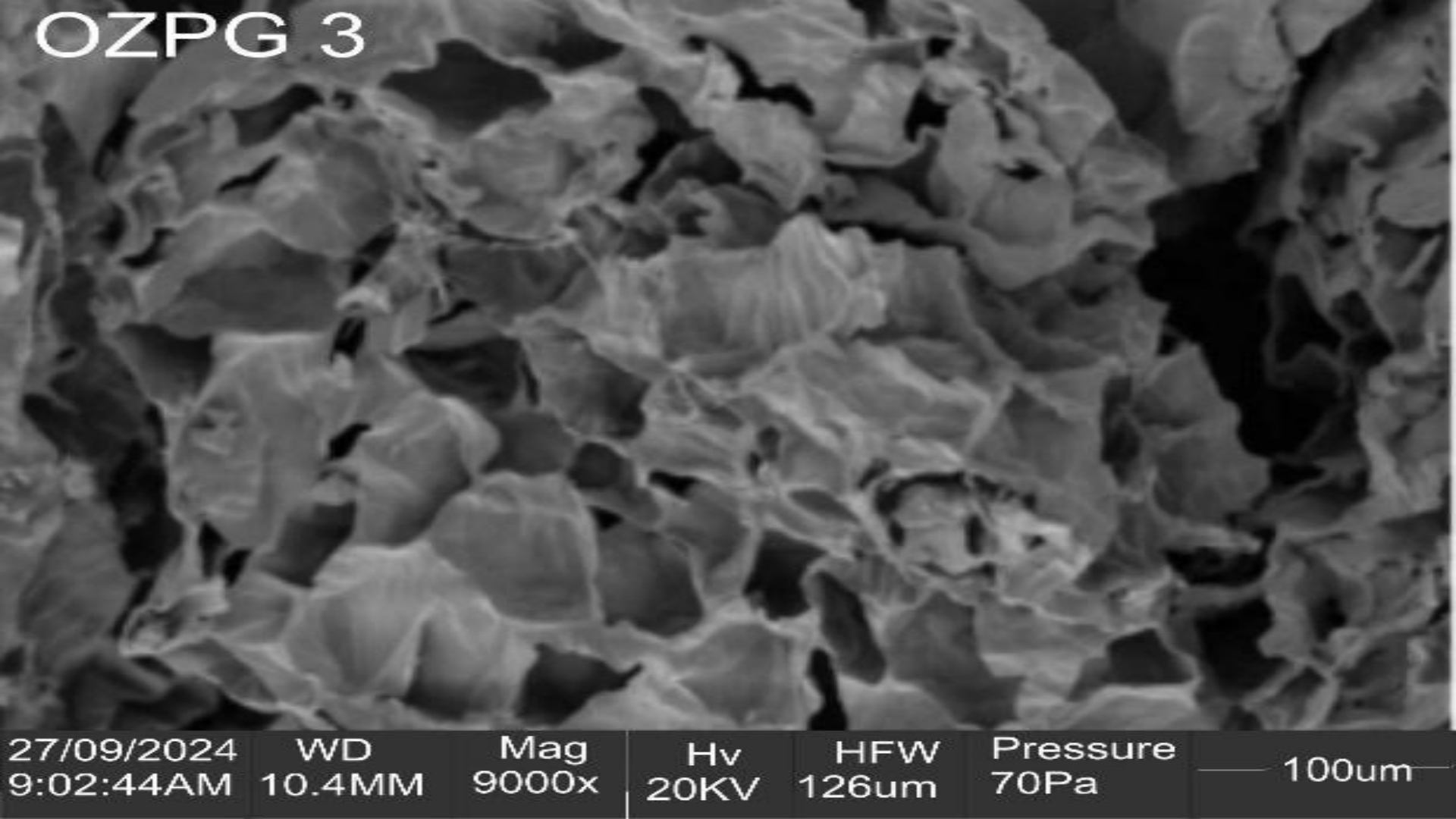
Synthetic azo dyes, widely used in various industries, pose serious environmental and health risks due to their toxic, non-biodegradable, and carcinogenic nature when released into aquatic ecosystems. This research focuses on synthesizing and evaluating orange peel-green synthesized zinc oxide nanoparticles (OZONp) as an efficient photocatalytic nanomaterial for the degradation of methylene blue (MB) dye. OZONp were prepared at different concentrations (0.01-0.1 M) of zinc acetate dihydrate and characterised through UV-VIS spectrophotometer, Fourier Transform Infrared (FT-IR) and Scanning Electron Microscope (SEM). The molecular insight into the geometry of phytochemicals of orange peel extract in the activity of OZONp was studied using density functional theory computations. The morphology variations driven by the precursor concentration using SEM analysis were not regular as it changed to irregular spheres and nanoflowers. UV-Vis spectra proved the formation of OZONp with an absorption band within 250-320 nm. FTIR spectra signals the presence of phytochemicals that mediate reduction and stabilization. Photocatalytic degradation experiments of various MB concentrations (5-50 mg/L), revealed that the higher the Zinc salt concentration, the higher the MB degraded, especially under 0.1 M and 5 mgL-1 of the dye MB. Pseudo- first-order reaction behavior was followed by kinetic modelling with R2 values greater than or equal to 0.99. Computational studies revealed that orange peel extract has ferulic acid, hesperidin and narirutin which have desirable electronic properties, which makes them good candidates in the formation of OZONp. The properties are probably beneficial to the process of photocatalytic degradation of methylene blue dye, especially when light is present
Dimensions

[1] D. Bhatia, N. R. Sharma, J. Singh & R. S. Kanwar, “Biological methods for textile dye removal from wastewater: a review”, Critical Reviews in Environmental Science and Technology 47 (2017) 183. https://doi.org/10.1080/10643389.2017.1393263.

[2] P. Dutta, M. R. Rabbi, M. A. Sufian & S. Mahjebin, “Effects of textile dyeing effluent on the environment and its treatment: a review”, Engineering and Applied Science Letters 5 (2022) 1. https://doi.org/10.30538/psrp-easl2022.0080.

[3] O. Akinsipo, A. Osinubi & B. Adebayo,“Green synthesis and characterization of zinc oxide nanoparticles using euphorbia lateriflora leaf extract: evaluation of antimicrobial and antioxidant activities”, FUDMA Journal of Sciences 10 (2026) 45. https://doi.org/10.33003/fjs-2026-1002-4456.

[4] R. Sangamnere, T. Misra, H. Bherwani, A. Kapley & R. Kumar, “A critical review of conventional and emerging wastewater treatment technologies”, Sustainable Water Resources Management 9 (2023) 58. https://doi.org/10.1007/s40899-023-00829-y.

[5] A. Mojiri, “Treatment of water and wastewater: challenges and solutions”, Separations 10 (2023) 385. https://doi.org/10.3390/separations10070385.

[6] A. Ayub, A. K. Wani, C. Chopra, D. K. Sharma, O. Amin, A. W. Wani, A. Singh, S. Manzoor & R. Singh, “Advancing dye degradation: integrating microbial metabolism, photocatalysis, and nanotechnology for eco-friendly solutions”, Bacteria 4 (2025) 15. https://doi.org/10.3390/bacteria4010015.

[7] D. Kirubakaran, J. B. Abdul Wahid, N. Karmegam, R. Jeevika, L. Sellapillai, M. Rajkumar & K. J. SenthilKumar, “A comprehensive review on the green synthesis of nanoparticles: advancements in biomedical and environmental applications”, Biomedical Materials & Devices 4 (2025) 388. https://doi.org/10.1007/s44174-025-00295-4.

[8] S. O. Alayande, A. A. Akinsiku, O. B. Akinsipo (Oyelaja), E. O. Ogunjinmi & E. O. Dare, Green synthesized silver nanoparticles and their therapeutic applications. In S. K. Verma & A. K. Das (Eds.), Comprehensive analytical chemistry, Elsevier 94 2021 585. https://doi.org/10.5772/intechopen.1002203.

[9] M. M. Abomughaid, “Bio-fabrication of bio-inspired silica nanomaterials from orange peels in combating oxidative stress”, Nanomaterials 12 (2022) 3236. https://doi.org/10.3390/nano12183236.

[10] Y. Zhao & D. G. Truhlar, “The M06 suite of density functionals for main group thermochemistry, thermochemical kinetics, noncovalent interactions, excited states, and transition elements”, Theoretical Chemistry Accounts 120 (2008) 215. https://doi.org/10.1007/s00214-007-0310-x.

[11] F. Weigend,“Accurate Coulomb-fitting basis sets for H to Rn”, Physical Chemistry Chemical Physics 8 (2006) 1057. https://doi.org/10.1039/b515623h.

[12] R. Dennington, T. Keith, J. Millam, K. Eppinnett, W. Hovell & R. Gilliland, GaussView, version 6, Semichem Inc., Shawnee Mission, KS, USA, 2016.

[13] Chemcraft - graphical software for visualization of quantum chemistry computations, Version 1.8, build 682. https://www.chemcraftprog.com.

[14] M. Miar, A. Shiroudi, K. Pourshamsian, A. R. Oliaey & F. Hatamjafari, “Theoretical investigations on the HOMO–LUMO gap and global reactivity descriptor studies, natural bond orbital, and nucleus independent chemical shifts analyses of 3-phenylbenzo[d]thiazole-2(3H)-imine and its para-substituted derivatives: Solvent and substituent effects”, Journal of Chemical Research 45 (2021) 147. https://doi.org/10.1177/1747519820932091.

[15] K. Fukui, T. Yonezawa & H. Shingu, “A molecular orbital theory of reactivity in aromatic hydrocarbons”, Journal of Chemical Physics 20 (1952) 722. https://doi.org/10.1063/1.1700523.

[16] A. A. Ogunlana, J. Zou & X. Bao, “insights into the mechanisms and chemoselectivities of carbamates and amides in reactions involving rh(ii)-azavinylcarbene: a computational study”, The Journal of Organic Chemistry 84 (2019) 8151. https://doi.org/10.1021/acs.joc.9b01070.

[17] A. A. Badeji, M. T. Omoniyi, T. B. Ogunbayo, S. D. Oladipo & I. A. Akinbulu, “quantum chemical investigation of the degradation of acid orange 7 by different oxidants”, Discover Chemistry 1 (2024) 55. https://doi.org/10.1007/s44371-024-00059-x.

[18] A. Asghar, M. M. Bello, A. A. A. Raman, W. M. A. W. Daud, A. Ramalingam & S. B. M. Zain, “predicting the degradation potential of acid blue 113 by different oxidants using quantum chemical analysis”, Heliyon 5 (2019) e02396. https://doi.org/10.1016/j.heliyon.2019.e02396.

[19] M. Karelson, V. S. Lobanov & A. R. Katritzky, “quantum-chemical descriptors in qsar/qspr studies”, Chemical Reviews 96 (1996) 1027. https://doi.org/10.1021/cr950202r.

[20] C. G. Zhan, J. A. Nichols & D. A. Dixon, “ionization potential, electron affinity, electronegativity, hardness, and electron excitation energy: molecular properties from density functional theory orbital energies”, The Journal of Physical Chemistry A 107 (2003) 4184. https://doi.org/10.1021/jp0225774.

[21] R. G. Parr, L. v. Szentpa´ly & S. Liu, “electrophilicity index”, Journal of the American Chemical Society 121 (1999) 1922. https://doi.org/10.1021/ja983494x.

[22] S. D. Oladipo, S. J. Zamisa, A. A. Badeji, M. A. Ejalonibu, A. A. Adeleke, I. A. Lawal, A. Henni & M. M. Lawal, “Ni2+ and Cu2+ complexes of N-(2,6-dichlorophenyl)-N-mesityl formamidine dithiocarbamate structural and functional properties as CYP3A4 potential substrate”, Scientific Reports 13 (2023) 13414. https://doi.org/10.1038/s41598-023-39502-x.

[23] L. Liu, J. Feng, Y. Liu, Y. Wu & S. Liu, “Molecular electrostatic potential: A new tool to predict the lithiation process of organic battery materials”, The Journal of Physical Chemistry Letters 9 (2018) 3573. https://doi.org/10.1021/acs.jpclett.8b01123.

[24] G. Na´ray-Szabo´, “Preferred channels for nucleophilic and electrophilic attack from simple molecular potential maps”, Acta Physica Academiae Scientiarum Hungaricae 51 (1981) 65. https://doi.org/10.1007/BF03155565.

[25] C. H. Suresh, G. S. Remya & P. K. Anjalikrishna, “Molecular electrostatic potential analysis: A powerful tool to interpret and predict chemical reactivity”, Wiley Interdisciplinary Reviews: Computational Molecular Science 12 (2022) e1601. https://doi.org/10.1002/wcms.1601.

[26] V. B. Sumithranand, M. S. Roxy & G. Vaishnavi, “Green synthesis of ZnO nanoparticles using sweet orange peels as a mediating agent and their antibacterial properties”, Oriental Journal of Chemistry 40 (2024) 221. https://doi.org/10.13005/ojc/400221.

[27] A. Anik, M. A. Alam, M. Alam, D. Sarker & N. Sultana, “Photocatalytic degradation of methylene blue dye using bio-green synthesis of ZnO nanoparticles from Justicia adhatoda leaves extract”, SSRN (2024). https://doi.org/10.2139/ssrn.5260651.

[28] I. Khan, K. Saeed & I. Khan, “Nanoparticles: Properties, applications and toxicities”, Arabian Journal of Chemistry 12 (2019) 908. https://doi.org/10.1016/j.arabjc.2017.05.011.

[29] E. I. Oikeh, F. E. Oviasogie & E. S. Omoregie, “Quantitative phytochemical analysis and antimicrobial activities of fresh and dry ethanol extracts of Citrus sinensis (L.) Osbeck (sweet Orange) peels”, Clinical Phytoscience 6 (2020) 46. https://doi.org/10.1186/s40816-020-00193-w.

[30] M. Bayat, M. Zargar, T. Astarkhanova, E. Pakina, S. Ladan, M. Lyashko & S. I. Shkurkin, “Facile biogenic synthesis and characterization of seven metal-based nanoparticles conjugated with phytochemical bioactives using fragaria ananassa leaf extract”, Molecules 26 (2021) 3025. https://doi.org/10.3390/molecules26103025.

[31] K. R. S. Murthy, G. K. Raghu & P. Binnal, “Zinc oxide nanostructured material for sensor application”, Journal of Biotechnology and Bioengineering 5 (2021) 25. https://doi.org/10.22259/2637-5362.0501004.

[32] A. Rashid Salah, I. Ibraheem, J. Khalil, A. Naser & S. Mohammad Salim, “Sustainable-green synthesis and characterization of zno nanoparticles and evaluation of their antibacterial and antioxidant activities”, Journal of Nanostructures 15 (2025) 180. https://doi.org/10.22052/JNS.2025.01.017.

[33] H. Xu, H. Wang, Y. Zhang, W. He, M. Zhu, B. Wang & H. Yan, “Hydrothermal synthesis of zinc oxide powders with controllable morphology”, Ceramics International 30 (2004) 93. https://doi.org/10.1016/S0272-8842(03)00069-5.

[34] S. Jayswal & R. S. Moirangthem, “Fabrication of hierarchical hybrid zno/au micro-/nanostructures for efficient dye degradation: role of gold nanostructures in photophysical process”, Colloids and Surfaces A: Physicochemical and Engineering Aspects 630 (2021) 127555. https://doi.org/10.1016/j.colsurfa.2021.127555.

[35] N. Talebian, S. M. Amininezhad & M. Doudi, “Controllable synthesis of ZnO nanoparticles and their morphology-dependent antibacterial and optical properties”, Journal of Photochemistry and Photobiology B: Biology 120 (2013) 66. https://doi.org/10.1016/j.jphotobiol.2013.01.004.

[36] E. S. Hadi & K. K. Jasim, “Responsive uv-light photocatalytic of Ag/ZnO nanocomposites for removal of brilliant blue dye: as a model for advanced chemical studies”, Advanced Journal of Chemistry—Section A 8 (2025) 604. https://doi.org/10.48309/ajca.2025.474706.1654.

[37] L. N.S. J. Lee, H. J. Jung, R. Koutavarapu, S. H. Lee, M. Arumugam, J.H. Kim & M. Y. Choi, “ZnO supported Au/Pd bimetallic nanocomposites for plasmon improved photocatalytic activity for methylene blue degradation under visible light irradiation”, Applied Surface Science 496 (2019) 143665. https://doi.org/10.1016/j.apsusc.2019.143665.

[38] N. J. I. Groeneveld, M. Kanelli, F. Ariese & M. R. van Bommel, “Parameters that affect the photodegradation of dyes and pigments in solution and on substrate—an overview”, Dyes and Pigments 210 (2023) 110999. https://doi.org/10.1016/j.dyepig.2022.110999.

[39] S. Jayswal & R. S. Moirangthem, “Fabrication of hierarchical hybrid zno/au micro-/nanostructures for efficient dye degradation: role of gold nanostructures in photophysical process”, Colloids and Surfaces A: Physicochemical and Engineering Aspects 630 (2021) 127555. https://doi.org/10.1016/j.colsurfa.2021.127555.

[40] E. S. Hadi & K. K. Jasim, “Responsive UV-light photocatalytic of Ag/ZnO nanocomposites for removal of brilliant blue dye: as a model for advanced chemical studies”, Advanced Journal of Chemistry, Section A 8 (2025) 604. https://doi.org/10.48309/AJCA.2025.474706.1654.

[41] P. Singla, O. P. Pandey & K. Singh, “Study of photocatalytic degradation of environmentally harmful phthalate esters using Ni-doped TiO2 nanoparticles”, International Journal of Environmental Science and Technology 13 (2016) 849. https://doi.org/10.1007/s13762-015-0909-8.

[42] A. Anik, M. A. Alam, M. Alam, D. Sarker & N. Sultana, “Photocatalytic degradation of methylene blue dye using bio-green synthesis of ZnO nanoparticles from justicia adhatoda leaves extract”, SSRN (2024). https://doi.org/10.2139/ssrn.5262386.

[43] A. S. Rashid, I. K. Ibraheem, J. A. Naser & S. S. Mohammad, “Sustainable-green synthesis and characterization of zno nanoparticles and evaluation of their antibacterial and antioxidant activities”, Journal of Nanostructures 15 (2025) 180. https://doi.org/10.22052/JNS.2025.01.017.

[44] S. J. Lee, H. J. Jung, R. Koutavarapu, S. H. Lee, M. Arumugam, J. H. Kim & M. Y. Choi, “ZnO supported Au/Pd bimetallic nanocomposites for plasmon improved photocatalytic activity for methylene blue degradation under visible light irradiation”, Applied Surface Science 496 (2019) 143665. https://doi.org/10.1016/j.apsusc.2019.143665.

[45] I. Groeneveld, M. Kanelli, F. Ariese & M. R. van Bommel, “Parameters that affect the photodegradation of dyes and pigments in solution and on substrate – an overview”, Dyes and Pigments 210 (2023) 110999. https://doi.org/10.1016/j.dyepig.2022.110999.

[46] K. M. Lee, C. W. Lai, K. S. Ngai & J. C. Juan, “Recent developments of zinc oxide based photocatalyst in water treatment technology: A review”, Water Research 88 (2016) 428. https://doi.org/10.1016/j.watres.2015.09.045.

Published

2026-04-11

How to Cite

Sustainable photocatalytic degradation of methylene blue dye induced through biogenic synthesis of metal oxide nanoparticles mediated orange peel extract. (2026). Journal of the Nigerian Society of Physical Sciences, 8(2), 3078. https://doi.org/10.46481/jnsps.2026.3078

How to Cite

Sustainable photocatalytic degradation of methylene blue dye induced through biogenic synthesis of metal oxide nanoparticles mediated orange peel extract. (2026). Journal of the Nigerian Society of Physical Sciences, 8(2), 3078. https://doi.org/10.46481/jnsps.2026.3078

Similar Articles

41-50 of 77

You may also start an advanced similarity search for this article.