Geohydraulic characteristics and groundwater vulnerability assessment of tropically weathered and fractured gneissic aquifers using combined georesistivity and geostatistical methods
Keywords:
ERT, Schlumberger VES, geoelectrohydraulic method, regression analysis, groundwater vulnerability, gneissic aquiferAbstract
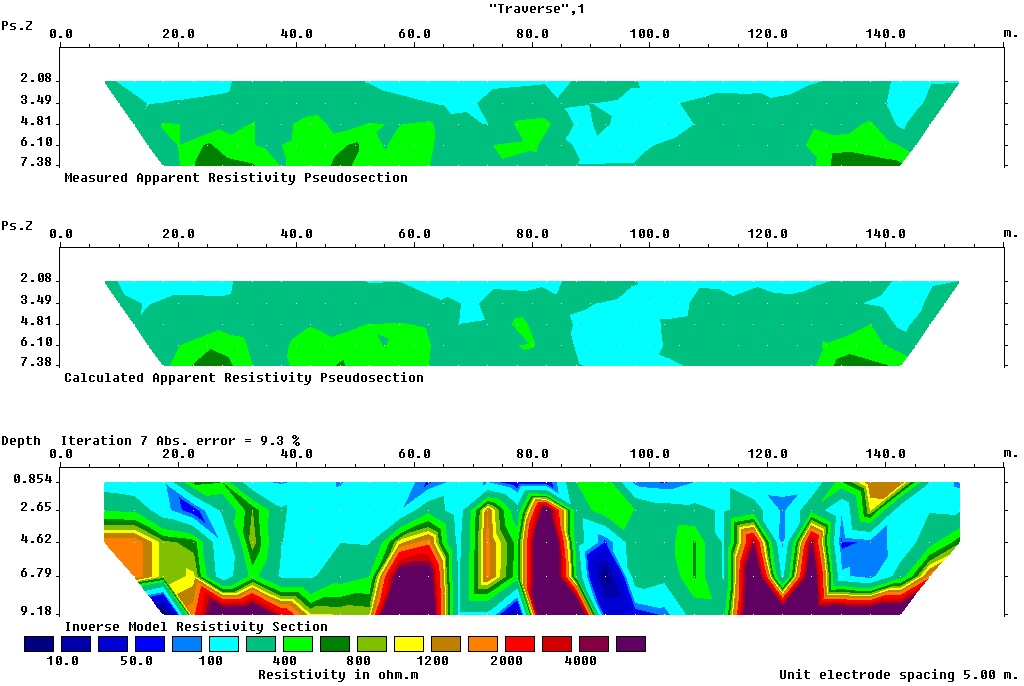
Sustainable groundwater yield in aquifers depends on the protective capacity of the subsurface lithologies and conduit systems. Electrical resistivity tomography (ERT) and its Schlumberger vertical electrical sounding (VES) technique were employed to assess the groundwater yield of aquifer units and their vulnerability to contaminants in Araromi (Akungba-Akoko), southwestern Nigeria. Geohydraulic parameters: aquifer resistivity (\rho0), hydraulic conductivity (K), transmissivity (T), permeability (\Psi), hydraulic resistance (KR), and longitudinal conductance (S) were also evaluated. In addition, regression analysis was utilized to establish the empirical relationships between the K and other geohydraulic parameters, with their percentage contributions to posing vulnerability risk. The georesistivity results revealed four distinct layers: topsoil, weathered layer, partially weathered/fractured bedrock unit, and fresh bedrock. The K model regression-assisted analysis showed that the \rho, T, \Psi, and S contributed about 97.8%, 14%, 99.9%, and 11.5%, respectively, to the estimated aquifers’ K values for the study area. Except for T and S, the regression results had moderate to strong positive correlations with K; hence, this illuminates the essentiality of K in assessing groundwater potential and vulnerability. The aquifer units have low to moderate groundwater yield based on T values (1.67-17.57 m/day) caused by the generally thin overburden (<4 m). However, the deep-weathered and fractured aquifer units with depths ranging from 39-55 m could supply high groundwater yield for sustainable abstraction. The estimated S values (0.0226-0.1926 mhos) for aquifer protective capacity ratings rated the aquifer units in the area as poor to weak. Based on the estimated low logarithm of KR (log KR) values of 0.79-2.25 years, these aquifers have extremely high to moderate aquifer vulnerability index. As a result, prospective wells/boreholes in the study area and settings with similar geohydraulic and vulnerability characteristics should be developed adequately to prevent the infiltration of surface contaminants for potable groundwater abstraction.
Published
How to Cite
Issue
Section
Copyright (c) 2022 A. S. Akingboye

This work is licensed under a Creative Commons Attribution 4.0 International License.
How to Cite
Similar Articles
- Abdelhak Erraji, Abderrahim Maizate, Mohamed Ouzzif, An integral approach for complete migration from a relational database to MongoDB , Journal of the Nigerian Society of Physical Sciences: Volume 5, Issue 2, May 2023
- Pushap Lata Sharma, Mohini Kapalta, Ashok Kumar, Deepak Bains, Sumit Gupta, Pankaj Thakur, Electrohydro dynamics convection in dielectric rotating Oldroydian nanofluid in porous medium , Journal of the Nigerian Society of Physical Sciences: Volume 5, Issue 2, May 2023
- Lamees K. Alzaki, Hassan Kamil Jassim, Time-Fractional Differential Equations with an Approximate Solution , Journal of the Nigerian Society of Physical Sciences: Volume 4, Issue 3, August 2022
- M. M. Tanko, M. S. Liman, W. L. Lumbi, U. S. Aliyu, M. U. Sarki, Field Strength Variability Mapping of Nigeria , Journal of the Nigerian Society of Physical Sciences: Volume 4, Issue 3, August 2022
- Tertsea Igbawua, Martha Hembafan Gbanger, Fanan Ujoh, Suitability Analysis for Yam Production in Nigeria using Satellite and Observation Data , Journal of the Nigerian Society of Physical Sciences: Volume 4, Issue 4, November 2022
- L. Adamu, N. Hussaini, An Epidemic Model of Zoonotic Visceral Leishmaniasis with Time Delay , Journal of the Nigerian Society of Physical Sciences: Volume 1, Issue 1, February 2019
- Segun Oladipo, Adesola A. Adeleke, Abosede A. Badeji, Katherine I. Babalola, Ayomide H. Labulo, Ibrahim Hassan, Sadiq T. Yussuf, Samuel O. Olalekan, Computational investigation and biological activity of selected Schiff bases , Journal of the Nigerian Society of Physical Sciences: Volume 6, Issue 3, August 2024
- O. A. Uwaheren, A. F. Adebisi, O. A. Taiwo, Perturbed Collocation Method For Solving Singular Multi-order Fractional Differential Equations of Lane-Emden Type , Journal of the Nigerian Society of Physical Sciences: Volume 2, Issue 3, August 2020
- Paul Tawo Bukie, Idongesit E. Eteng, Eyo E. Essien, Development of internet of things-based petroleum pipeline topology leak monitoring and detection system using sensors , Journal of the Nigerian Society of Physical Sciences: Volume 7, Issue 4, November 2025
- C. A. Oyelami, W. Akande, T. O. Kolawole, A Preliminary Geotechnical Assessment of Residual Tropical Soils around Osogbo Metropolis as Materials for Road Subgrade , Journal of the Nigerian Society of Physical Sciences: Volume 4, Issue 2, May 2022
You may also start an advanced similarity search for this article.