Geohydraulic characteristics and groundwater vulnerability assessment of tropically weathered and fractured gneissic aquifers using combined georesistivity and geostatistical methods
Keywords:
ERT, Schlumberger VES, geoelectrohydraulic method, regression analysis, groundwater vulnerability, gneissic aquiferAbstract
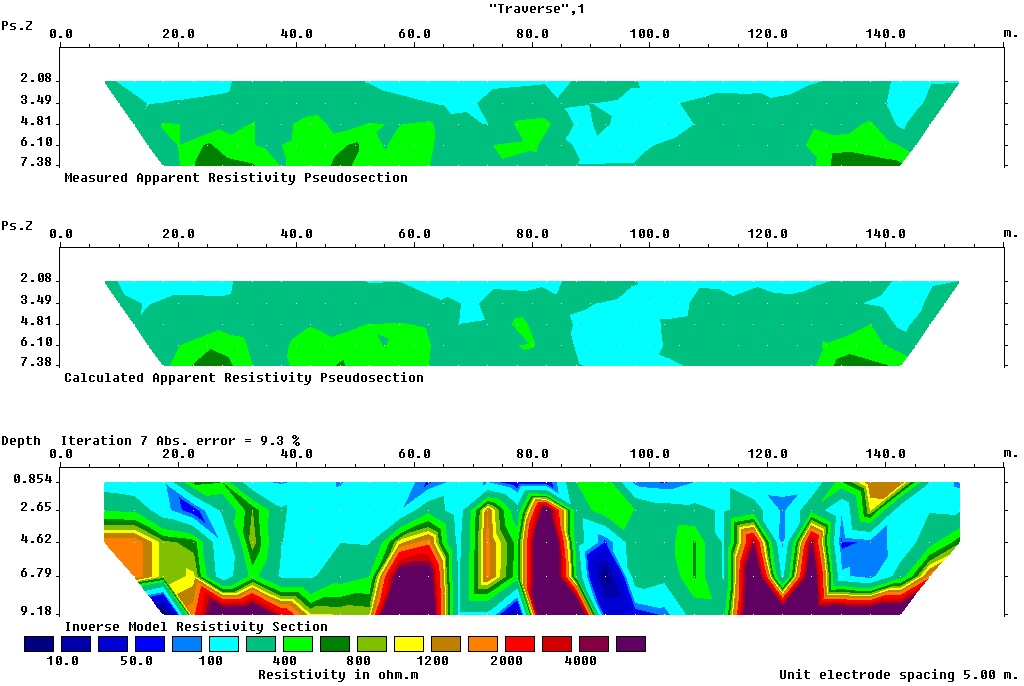
Sustainable groundwater yield in aquifers depends on the protective capacity of the subsurface lithologies and conduit systems. Electrical resistivity tomography (ERT) and its Schlumberger vertical electrical sounding (VES) technique were employed to assess the groundwater yield of aquifer units and their vulnerability to contaminants in Araromi (Akungba-Akoko), southwestern Nigeria. Geohydraulic parameters: aquifer resistivity (\rho0), hydraulic conductivity (K), transmissivity (T), permeability (\Psi), hydraulic resistance (KR), and longitudinal conductance (S) were also evaluated. In addition, regression analysis was utilized to establish the empirical relationships between the K and other geohydraulic parameters, with their percentage contributions to posing vulnerability risk. The georesistivity results revealed four distinct layers: topsoil, weathered layer, partially weathered/fractured bedrock unit, and fresh bedrock. The K model regression-assisted analysis showed that the \rho, T, \Psi, and S contributed about 97.8%, 14%, 99.9%, and 11.5%, respectively, to the estimated aquifers’ K values for the study area. Except for T and S, the regression results had moderate to strong positive correlations with K; hence, this illuminates the essentiality of K in assessing groundwater potential and vulnerability. The aquifer units have low to moderate groundwater yield based on T values (1.67-17.57 m/day) caused by the generally thin overburden (<4 m). However, the deep-weathered and fractured aquifer units with depths ranging from 39-55 m could supply high groundwater yield for sustainable abstraction. The estimated S values (0.0226-0.1926 mhos) for aquifer protective capacity ratings rated the aquifer units in the area as poor to weak. Based on the estimated low logarithm of KR (log KR) values of 0.79-2.25 years, these aquifers have extremely high to moderate aquifer vulnerability index. As a result, prospective wells/boreholes in the study area and settings with similar geohydraulic and vulnerability characteristics should be developed adequately to prevent the infiltration of surface contaminants for potable groundwater abstraction.
Published
How to Cite
Issue
Section
Copyright (c) 2022 A. S. Akingboye

This work is licensed under a Creative Commons Attribution 4.0 International License.
How to Cite
Similar Articles
- Abiola T. Owolabi, Kayode Ayinde, Taiwo J. Adejumo, Wakeel A. Kasali, Emmanuel T. Adewuyi, Comparative Analysis of the Implication of Periods Before and During Vaccination of COVID-19 Infection in Some Regional Leading African Countries , Journal of the Nigerian Society of Physical Sciences: Volume 4, Issue 2, May 2022
- Boukary Damiba, Christian Zoundi, Abdoul Kader Segda, Dynamics of the Earth’s magnetopause’s subsolar location during solar cycle 24 in relation to the phases of geomagnetic storms of CME origin , Journal of the Nigerian Society of Physical Sciences: Volume 8, Issue 1, February 2026
- Benson Ade Eniola Afere, On the fourth-order hybrid beta polynomial kernels in kernel density estimation , Journal of the Nigerian Society of Physical Sciences: Volume 6, Issue 1, February 2024
- Eli Danladi, Jamila Tasiu, Lucky Endas, Preparation and Characterization of High Performance Dye Sensitized Solar Cells with Silver Nanoparticles in nanocomposite Photoanode , Journal of the Nigerian Society of Physical Sciences: Volume 2, Issue 1, February 2020
- Sathish Kumar Kannaiyan, Rengaraj R, Venkata krishnan G R, Gayathri P K, Lavanya G, Hemapriya D, Antimicrobial activity of green synthesized tri-metallic oxide Ni/Cr/Cu nanoparticles , Journal of the Nigerian Society of Physical Sciences: Volume 3, Issue 3, August 2021
- S. Iyakwari, H. J. Glass, G. K. Rollinson, A. A. Umbugadu, O. D. Opaluwa, B. O. Frankie, Validation of Near InfraRed preconcentration strategies for ore sorting , Journal of the Nigerian Society of Physical Sciences: Volume 4, Issue 1, February 2022
- C. A. Onate, M. O. Oluwayemi, I. B. Okon, Dirac Equation for Energy-Dependent Potential With Energy-dependent Tensor Interaction , Journal of the Nigerian Society of Physical Sciences: Volume 5, Issue 1, February 2023
- Pooja Satwani, Sudhir Kumar Mishra, An empirical evaluation of mathematical, machine learning, and hybrid modeling approaches for COVID-19 forecasting , Journal of the Nigerian Society of Physical Sciences: Volume 8, Issue 4, November 2026 (in progress)
- Pushap Lata Sharma, Deepak Bains, Pankaj Thakur, Throughflow effect on bi-disperse convection in Rivlin-Ericksen fluid , Journal of the Nigerian Society of Physical Sciences: Volume 6, Issue 3, August 2024
- J. A. Adebisi, O. M. Babatunde, Green Information and Communication Technologies Implementation in Textile Industry Using Multicriteria Method , Journal of the Nigerian Society of Physical Sciences: Volume 4, Issue 2, May 2022
You may also start an advanced similarity search for this article.