Geohydraulic characteristics and groundwater vulnerability assessment of tropically weathered and fractured gneissic aquifers using combined georesistivity and geostatistical methods
Keywords:
ERT, Schlumberger VES, geoelectrohydraulic method, regression analysis, groundwater vulnerability, gneissic aquiferAbstract
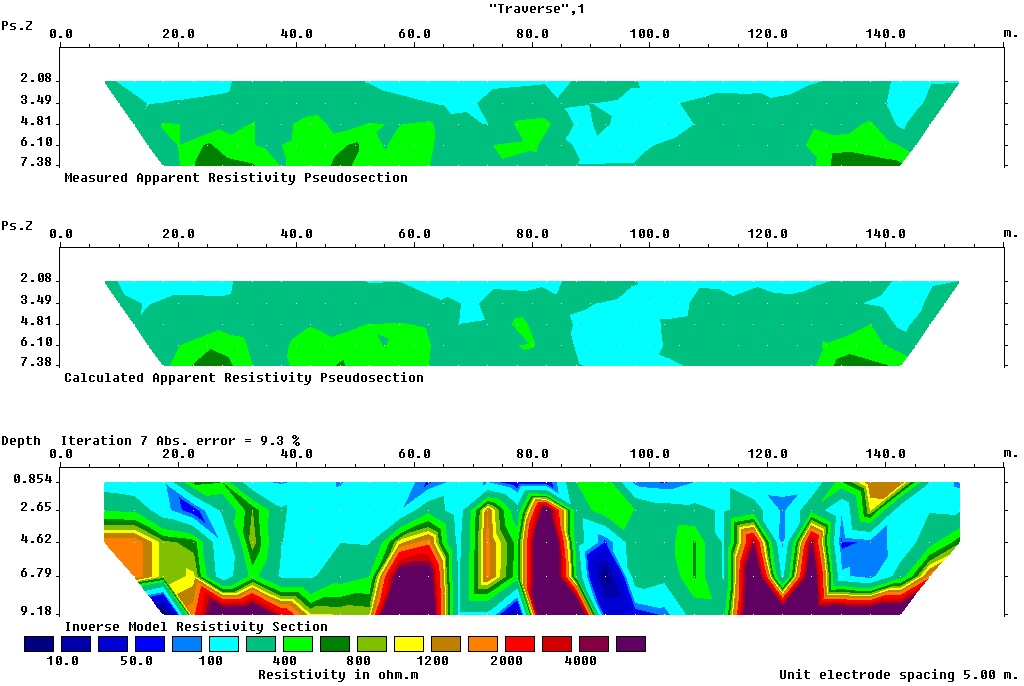
Sustainable groundwater yield in aquifers depends on the protective capacity of the subsurface lithologies and conduit systems. Electrical resistivity tomography (ERT) and its Schlumberger vertical electrical sounding (VES) technique were employed to assess the groundwater yield of aquifer units and their vulnerability to contaminants in Araromi (Akungba-Akoko), southwestern Nigeria. Geohydraulic parameters: aquifer resistivity (\rho0), hydraulic conductivity (K), transmissivity (T), permeability (\Psi), hydraulic resistance (KR), and longitudinal conductance (S) were also evaluated. In addition, regression analysis was utilized to establish the empirical relationships between the K and other geohydraulic parameters, with their percentage contributions to posing vulnerability risk. The georesistivity results revealed four distinct layers: topsoil, weathered layer, partially weathered/fractured bedrock unit, and fresh bedrock. The K model regression-assisted analysis showed that the \rho, T, \Psi, and S contributed about 97.8%, 14%, 99.9%, and 11.5%, respectively, to the estimated aquifers’ K values for the study area. Except for T and S, the regression results had moderate to strong positive correlations with K; hence, this illuminates the essentiality of K in assessing groundwater potential and vulnerability. The aquifer units have low to moderate groundwater yield based on T values (1.67-17.57 m/day) caused by the generally thin overburden (<4 m). However, the deep-weathered and fractured aquifer units with depths ranging from 39-55 m could supply high groundwater yield for sustainable abstraction. The estimated S values (0.0226-0.1926 mhos) for aquifer protective capacity ratings rated the aquifer units in the area as poor to weak. Based on the estimated low logarithm of KR (log KR) values of 0.79-2.25 years, these aquifers have extremely high to moderate aquifer vulnerability index. As a result, prospective wells/boreholes in the study area and settings with similar geohydraulic and vulnerability characteristics should be developed adequately to prevent the infiltration of surface contaminants for potable groundwater abstraction.
Published
How to Cite
Issue
Section
Copyright (c) 2022 A. S. Akingboye

This work is licensed under a Creative Commons Attribution 4.0 International License.
How to Cite
Similar Articles
- Suha Ibrahim Salih Al-Ali, Zaidun Naji Abudi, Mohammed Nsaif Abbas, Modelling and Simulation for the use of Natural Waste to Purified Contaminated Heavy Metals , Journal of the Nigerian Society of Physical Sciences: Volume 5, Issue 1, February 2023
- Ghada A. Ahmed, Fractional-order modeling of visceral leishmaniasis disease transmission dynamics : strategies in eastern Sudan , Journal of the Nigerian Society of Physical Sciences: Volume 5, Issue 4, November 2023
- M. O. Ogunniran, A Class of Block Multi-derivative Numerical Techniques for Singular Advection Equations , Journal of the Nigerian Society of Physical Sciences: Volume 1, Issue 2, May 2019
- Philemon Uten Emmoh, Christopher Ifeanyi Eke, Timothy Moses, A feature selection and scoring scheme for dimensionality reduction in a machine learning task , Journal of the Nigerian Society of Physical Sciences: Volume 7, Issue 1, February 2025
- L. O. Animasahun, B. A. Taleatu, S. A. Adewinbi, H. S. Bolarinwa, A. Y. Fasasi, Synthesis of SnO2/CuO/SnO2 Multi-layered Structure for Photoabsorption: Compositional and Some Interfacial Structural Studies , Journal of the Nigerian Society of Physical Sciences: Volume 3, Issue 2, May 2021
- Kabiru Lere Najib, Adamu Shitu Hassan, Food and environmental degradation as causative agents of honey bee colonies decline: Mathematical model approach , Journal of the Nigerian Society of Physical Sciences: Volume 3, Issue 4, November 2021
- U. Rilwan, M. I. Sayyed, K. A. Mahmoud, S. Muhammad, A. Alkasim, S. I. Ikpughul, S. J. Iwa, Jibrin Ahmed Guto, O. A. Adeyeba, M. W. Marashdeh, Evaluation of radiation shielding and mechanical properties of palm nut shell ash modernized concrete: a comparative analysis , Journal of the Nigerian Society of Physical Sciences: Volume 8, Issue 1, February 2026
- Gabriel O. Odekina, Adedayo F. Adedotun, Ogbu F. Imaga, Modeling and Forecasting the Third wave of Covid-19 Incidence Rate in Nigeria Using Vector Autoregressive Model Approach , Journal of the Nigerian Society of Physical Sciences: Volume 4, Issue 1, February 2022
- Muhammad Farman, Noreen Asghar, Muhammad Umer Saleem, Nezihal Gokbulut, Evren Hincal, Aseel Smerat, Mohamed Hafez, Optimal control of smoking-induced asthma and cardiovascular disorders with medical and public health interventions , Journal of the Nigerian Society of Physical Sciences: Volume 8, Issue 3, August 2026
- A. B. Disu, S. O. Salawu, Thermal distribution of magneto-tangent hyperbolic flowing fluid over a porous moving sheet: A Lie group analysis , Journal of the Nigerian Society of Physical Sciences: Volume 5, Issue 1, February 2023
You may also start an advanced similarity search for this article.