Characterisation of Singular Domains in Threshold-Dependent Biological Networks
Keywords:
Discontinuous System, Singular Domain, Threshold-Dependent Network, Biological System, Piecewise Linear ModelsAbstract
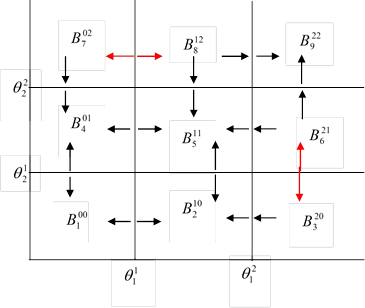
Threshold-dependent networks behave like piecewise smooth system which belongs to a class of systems with discontinuous right hand side. It can be studied with piecewise linear differential equations. At threshold values and their intersections, known as switching boundaries and surfaces, the state of such networks is not defined because of singularity at such points. These states are termed singular states or domains of the network. This study is to characterise, in terms of number, singular domains of any order in a network and the total number of such domains. It shall also propose new definitions for walls which are switching domains of order one. The new definition, which derives from Fillipov’s First Order Theory on characterisation of (sliding) wall, shall be shown to prove better than existing ones as it can reveal intrinsic behaviours in such networks.
Published
How to Cite
Issue
Section
Copyright (c) 2022 Benitho Ngwu, Godwin C. E. Mbah, Chika O. Mmaduakor, Sunday Isienyi, Oghenekevwe R. Ajewole, Felix D. Ajibade

This work is licensed under a Creative Commons Attribution 4.0 International License.
How to Cite
Similar Articles
- S. E. Ogunfeyitimi, M. N. O Ikhile, P. O. Olatunji, High order boundary value linear multistep method for the numerical solution of IVPs in ODEs , Journal of the Nigerian Society of Physical Sciences: Volume 7, Issue 4, November 2025
- K. Lekhana, K. T. Shivaram, Applications of quadrilateral finite element meshes with four-node, eight-node, and twelve-node for efficient microwave energy transfer in curved waveguides , Journal of the Nigerian Society of Physical Sciences: Volume 8, Issue 3, August 2026
- Osowomuabe Njama-Abang, Denis U. Ashishie, Paul T. Bukie, Addressing class imbalance in lassa fever epidemic data, using machine learning: a case study with SMOTE and random forest , Journal of the Nigerian Society of Physical Sciences: Volume 7, Issue 3, August 2025
- U. B. Amadi, M. Ogwuegbu, C. K. Enenebeaku, G. onyedika, Design, synthesis and studies on thermodynamic and biological activities of lanthanide III complexes of hydrazinecarbothioamide ligands , Journal of the Nigerian Society of Physical Sciences: Volume 7, Issue 2, May 2025
- Adefemi Adeniran, A. A. Sodipo, C. G. Udomboso, A Modifed Forced Randomized Response Model , Journal of the Nigerian Society of Physical Sciences: Volume 2, Issue 1, February 2020
- M. Kida, S. Adamu, O. O Aduroja, P. T Pantuvo, Numerical Solution of Stiff and Oscillatory Problems using Third Derivative Trigonometrically Fitted Block Method , Journal of the Nigerian Society of Physical Sciences: Volume 4, Issue 1, February 2022
- Wilson Nwankwo, Kingsley Ukhurebor, Investigating the Performance of Point to Multipoint Microwave Connectivity across Undulating Landscape during Rainfall , Journal of the Nigerian Society of Physical Sciences: Volume 1, Issue 3, August 2019
- Idris Babaji Muhammad, Salisu Usaini, Dynamics of Toxoplasmosis Disease in Cats population with vaccination , Journal of the Nigerian Society of Physical Sciences: Volume 3, Issue 1, February 2021
- Majid Khan Bin Majahar Ali, Shahida Shahnawaz, An inverse physics-informed neural network (I-PINN) framework for parameter estimation in mixed convection and melting effects , Journal of the Nigerian Society of Physical Sciences: Volume 8, Issue 2, May 2026
- Essodossomondom Anate, N’Detigma Kata, Hodo-Abalo Samah, Amadou Seidou Maiga, Study of the passivation of defects in the perovskite cell: application to Sahelian climate conditions , Journal of the Nigerian Society of Physical Sciences: Volume 5, Issue 2, May 2023
You may also start an advanced similarity search for this article.