
An inverse physics-informed neural network (I-PINN) framework for parameter estimation in mixed convection and melting effects
Keywords:
Inverse PINN, Hybrid Nanofluids, Melting Effects, Mixed ConvectionAbstract
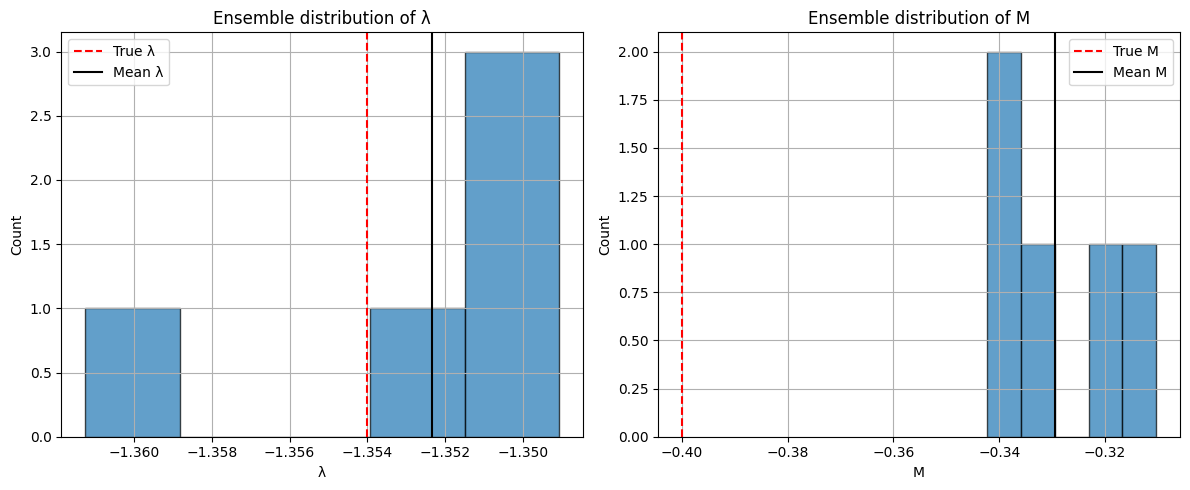
An inverse physics-informed neural network (I-PINN) framework is developed for joint parameter estimation and field reconstruction in steady mixed convection with melting in a porous medium. Focusing on the laminar boundary layer of an Al2 O3 –Cu/water hybrid nanofluid over a vertical melting surface, the approach treats the mixed-convection parameter ? and the melting parameter M as trainable variables and fits sparse, noisy temperature measurements while satisfying the coupled similarity ODEs and boundary conditions. A robust training strategy combining data-guided curriculum learning, self-adaptive loss weighting, gradient clipping, and a hybrid Adam–L-BFGS optimization achieves accurate recovery and robust uncertainty quantification on synthetic benchmark data. The dominant parameter lambda is identified with below 0.5% relative error even with as few as eight sensors. The reconstructed temperature and velocity fields remain smooth and physically consistent across unmeasured regions. Notably, the method remains stable in the challenging opposing-flow regime near separation (lambda = -1.354, M = -0.4), demonstrating the promise of I-PINNs for parameter discovery, model calibration, and digital-twin development under limited data.
References
[1] M. Raissi, P. Perdikaris & G. E. Karniadakis, “Physics-informed neural networks: a deep learning frame-work for solving forward and inverse problems involving nonlinear partial differential equations”, Journal of Computational Physics 378 (2019) 686. https://doi.org/10.1016/j.jcp.2018.10.045.
[2] J. D. Toscano, V. Oommen, A. J. Varghese, Z. Zou, N. A. Daryakenari, C. Wu & G. E. Karniadakis, “From PINNs to PIKANs: recent advances in physics-informed machine learning”, Machine Learning for Computational Science and Engineering 1 (2025) 15. https://doi.org/10.1007/s44379-025-00015-1.
[3] A. Farea, O. Yli-Harja & F. Emmert-Streib, “Understanding physics-informed neural networks: techniques, applications, trends, and challenges”, AI 5 (2024) 1534. https://doi.org/10.3390/ai5030074
[4] S. Ganga & Z. Uddin, “Exploring physics-informed neural networks: From fundamentals to applications in complex systems”, arXiv preprint arXiv:2410.00422 (2024). https://arxiv.org/abs/2410.00422.
[5] D. Kim & J. Lee, “A review of physics informed neural networks for multiscale analysis and inverse problems”, Multiscale Science and Engineering 6 (2024) 1. https://doi.org/10.1007/s42493-024-00106-w.
[6] M. Berardi, F. V. Difonzo & M. Icardi, “Inverse physics-informed neural networks for transport models in porous materials”, Computer Methods in Applied Mechanics and Engineering 435 (2025) 117628. https://doi.org/10.1016/j.cma.2024.117628.
[7] Y. Xia & Y. Meng, “Physics-informed neural network (PINN) for solving frictional contact temperature and inversely evaluating relevant input parameters”, Lubricants 12 (2024) 62. https://doi.org/10.3390/lubricants12020062.
[8] M. J. Colaço, H. R. B. Orlande & G. S. Dulikravich, “Inverse and optimization problems in heat transfer”, Journal of the Brazilian Society of Mechanical Sciences and Engineering 28 (2006) 1. https://doi.org/10.1590/S1678-58782006000100001.
[9] P. Sajadi, M. R. Dehaghani, Y. Tang & G. G. Wang, “Physics-informed online learning for temperature prediction in metal AM”, Materials 17 (2024) 3306. https://doi.org/10.3390/ma17133306.
[10] S. Szenási & I. Felde, “Database for research projects to solve the inverse heat conduction problem”, Data 4 (2019) 90. https://doi.org/10.3390/data4030090.
[11] S. A. Jumana, M. G. Murtaza, M. Ferdows, O. D. Makinde & K. Zaimi, “Dual solutions analysis of melting phenomenon with mixed convection in a nanofluid flow and heat transfer past a permeable stretching/shrinking sheet”, Journal of Nanofluids 9 (2020) 313. https://doi.org/10.1166/jon.2020.1761
[12] B. E. Madir, F. Luddens, C. Lothode & I. Danaila, “Physics informed neural networks for heat conduction with phase change”, International Journal of Heat and Mass Transfer 252 (2025) 127430. https://doi.org/10.1016/j.ijheatmasstransfer.2025.127430.
[13] Q. Yuan, P. Yao, W. Zhao & B. Zhang, “Optimization of sparse sensor layouts and data-driven reconstruction methods for steady-state and transient thermal field inverse problems”, Sensors 25 (2025) 4984. https://doi.org/10.3390/s25164984.
[14] L. Yang, X. Meng & G. E. Karniadakis, “B-PINNs: Bayesian physics-informed neural networks for forward and inverse PDE problems with noisy data”, Journal of Computational Physics 425 (2021) 109913. https://doi.org/10.1016/j.jcp.2020.109913.
[15] H. Bararnia & M. Esmaeilpour, “On the application of physics informed neural networks (PINN) to solve boundary layer thermal?fluid problems”, International Communications in Heat and Mass Transfer 132 (2022) 105890. https://doi.org/10.1016/j.icheatmasstransfer.2022.105890.
[16] K. Cong, G. Li, Y. Sun et al., “Using physics-informed derivative networks to solve the forward problem of a free-convective boundary layer problem”, Scientific Reports 15 (2025) 18766. https://doi.org/10.1038/s41598-025-03918-4.
[17] A. Raina, S. Badireddi & S. Natesan, “Application of PINN to obtain solution of boundary layer problems arising in fluid dynamics”, Meccanica 10 (2026) 89. https://doi.org/10.3934/mfc.2025024.
[18] A. D. Jagtap, K. Kawaguchi & G. E. Karniadakis, “Adaptive activation functions accelerate convergence in deep and physics-informed neural networks”, Journal of Computational Physics 404 (2020) 109136. https://doi.org/10.1016/j.jcp.2019.109136.
[19] S. Wang, Y. Teng & P. Perdikaris, “When and why PINNs fail to solve PDEs: a gradient pathology perspective”, Journal of Computational Physics 449 (2022) 110768. https://doi.org/10.1016/j.jcp.2021.110768.
[20] B. Madir, F. Luddens, C. Lothode & I. Danaila, “Physics-informed neural networks for heat conduction with phase change”, International Journal of Heat and Mass Transfer 252 (2025) 127430. https://doi.org/10.1016/j.ijheatmasstransfer.2025.127430.
[21] S. Ahmad & I. Pop, “Melting effect on mixed convection boundary layer flow about a vertical surface embedded in a porous medium: Opposing flows case”, Transport in Porous Media 102 (2014) 317. https://doi.org/10.1007/s11242-014-0291-x.
[22] P. Sharma, W. T. Chung, B. Akoush & M. Ihme, “A review of physics-informed machine learning in fluid mechanics”, Energies 16 (2023) 2343. https://doi.org/10.3390/en16052343.
[23] Z. Haddad, H. F. Oztop, E. Abu-Nada & A. Mataoui, “A review on natural convective heat transfer of nanofluids”, Renewable and Sustainable Energy Reviews 16 (2012) 5363. https://doi.org/10.1016/j.rser.2012.04.003.
[24] T. Hayat, S. Naz, A. Alsaedi & S. Momani, “Melting and dissipative effects about entropy induced Darcy-Forchheimer flow involving ternary-hybrid nanofluids”, Case Studies in Thermal Engineering 55 (2024) 104097. https://doi.org/10.1016/j.csite.2024.104097.
Published
How to Cite
Issue
Section
Copyright (c) 2026 Majid Khan Bin Majahar Ali, Shahida Shahnawaz (Author)

This work is licensed under a Creative Commons Attribution 4.0 International License.







