Model Fitness and Predictive Accuracy in Linear Mixed-Effects Models with Latent Clusters
Keywords:
Clustered data, Primal and dual clusters, Linear mixed-effects models, Model fitness, Predictive accuracyAbstract
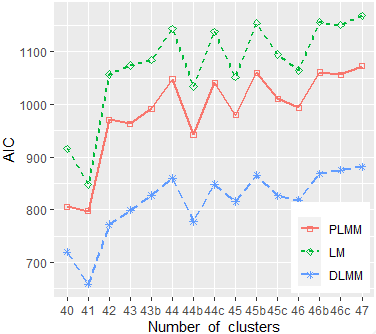
In clustered data, observations within a cluster show similarity between themselves because they share common features different from observations in the other clusters. In a given population, different clustering may surface because correlation may occur across more than one dimension. The existing multilevel analysis techniques of the primal linear mixed-effect models are limited to natural clusters which are often not realistic to capture in real-life situations. Therefore, this paper proposes dual linear mixed models (DLMMs) for modeling unobserved latent clusters when such are present in data sets to yield appreciable gains in model fitness and predictive accuracy. The methodology explored the development and analysis of the dual linear mixed models (DLMMs) based on the derived latent clusters from the natural clusters using multivariate cluster analysis. A published data set on political analysis was used to demonstrate the efficiency of the proposed models. The proposed DLMMs have yielded minimum values of the models' assessment criteria (Akaike information criterion, Bayesian information criterion, and root mean squared error), and hence, outperformed the classical PLMMs in terms of model fitness and predictive accuracy.
Published
How to Cite
Issue
Section
Copyright (c) 2023 Yusuf Bello, Waheed Yahya, B., Professor

This work is licensed under a Creative Commons Attribution 4.0 International License.
How to Cite
Similar Articles
- Obiora Cornelius Collins, Mathematical model analysis for maize yield under co-infection of maize streak virus and maize stripe virus diseases with control measures , Journal of the Nigerian Society of Physical Sciences: Volume 8, Issue 2, May 2026
- Saheed Ajao, Isaac Olopade, Titilayo Akinwumi, Sunday Adewale, Adelani Adesanya, Understanding the Transmission Dynamics and Control of HIV Infection: A Mathematical Model Approach , Journal of the Nigerian Society of Physical Sciences: Volume 5, Issue 2, May 2023
- Bolarinwa Bolaji, Abdullahi Ibrahim, Favour Ani, Benjamin Omede, Godwin Acheneje, A model for the control of transmission dynamics of human monkeypox disease in Sub-Saharan Africa , Journal of the Nigerian Society of Physical Sciences: Volume 6, Issue 2, May 2024
- Shah Zeb, Awais Ahmad, Rizwana Kausar, Siti Ainor Mohd Yatim, Nurulhuda Ramli, Muhammad Rafiq, Evaluating lung cancer control through a time-delay mathematical model with detailed sensitivity analysis , Journal of the Nigerian Society of Physical Sciences: Volume 8, Issue 3, August 2026
- E. A. Nwaibeh, M. K. M. Ali, M. O. Adewole, The dynamics of hybrid-immune and immunodeficient susceptible individuals and the three stages of COVID-19 vaccination , Journal of the Nigerian Society of Physical Sciences: Volume 6, Issue 3, August 2024
- Muhammad Farman, Kottakkaran Sooppy Nisar, Modeling and stability analysis of a fractional-order tuberculosisvmodel with different exposed populations progressing to infection , Journal of the Nigerian Society of Physical Sciences: Volume 8, Issue 3, August 2026
- J. Sunday, G. M. Kumleng, N. M. Kamoh, J. A. Kwanamu, Y. Skwame, O. Sarjiyus, Implicit Four-Point Hybrid Block Integrator for the Simulations of Stiff Models , Journal of the Nigerian Society of Physical Sciences: Volume 4, Issue 2, May 2022
- Adeniyi F. Fagbamigbe, Gomolemo K. Basele, Boikanyo Makubate, Broderick O. Oluyede, Application of the Exponentiated Log-Logistic Weibull Distribution to Censored Data , Journal of the Nigerian Society of Physical Sciences: Volume 1, Issue 1, February 2019
- Adefemi Adeniran, A. A. Sodipo, C. G. Udomboso, A Modifed Forced Randomized Response Model , Journal of the Nigerian Society of Physical Sciences: Volume 2, Issue 1, February 2020
- G. A. Shewa, F. I. Ugwuowo, Combating the Multicollinearity in Bell Regression Model: Simulation and Application , Journal of the Nigerian Society of Physical Sciences: Volume 4, Issue 3, August 2022
You may also start an advanced similarity search for this article.