Analysis of a fractional order climate model due to excessive emission and accumulation of carbon dioxide in the atmosphere
Keywords:
Climate change, Fractional order, Carbon dioxide, Excessive emissionAbstract
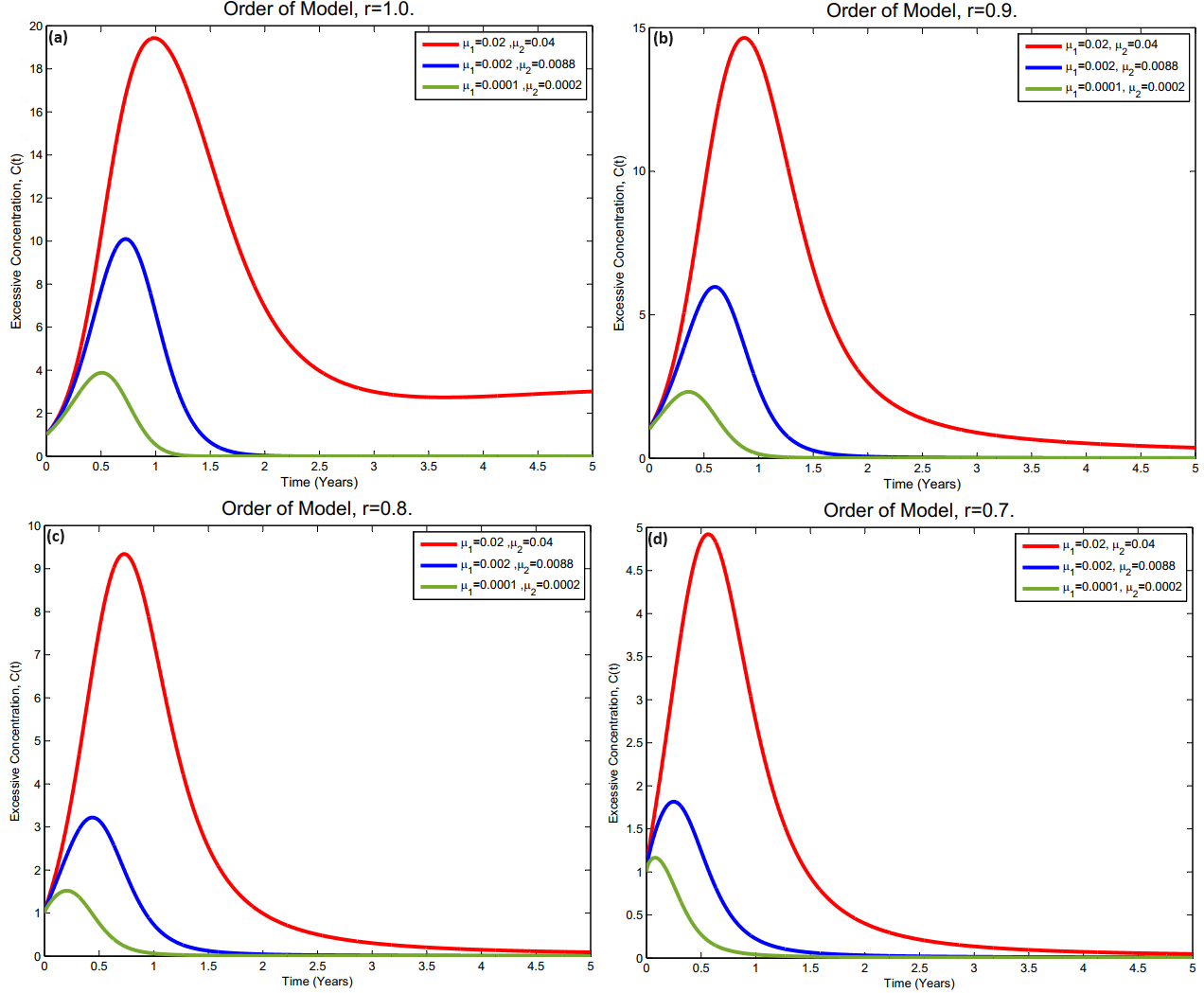
The devastating consequences of climate change on our planet cannot be taken lightly. Greenhouse gas emissions due to the various activities of the increasing human population are solely responsible for this change. The chief and most significant of these gases is carbon dioxide. A fractional-order model of five compartments is considered. The uniqueness and existence, the positivity, and the boundedness of the model solution are established. The equilibrium points of the model are given. By formulating different Lyapunov functions, the global stability of the four equilibrium points was determined. The numerical simulation of the model was done using the Predict-Evaluate-Correct-Evaluate method of Adam-Bashforth-Moulton by considering four different orders of 0.7, 0.8, 0.9, and 1.0. According to the results, excessive concentrations of carbon dioxide in the atmosphere can be reduced by the joint employment of mitigation measures.
Published
How to Cite
Issue
Section
Copyright (c) 2023 Peter Urane Achimugwu, Mathew Ngugi Kinyanjui, David Mumo Malonza

This work is licensed under a Creative Commons Attribution 4.0 International License.
How to Cite
Similar Articles
- N. Kure, I. H Daniel, N. M Hamidon, I. I Lakin, B. U Machu, E. J Adoyi, Effect of Time on the Syntheses of Carbon Nanotubes via Domestic Oven , Journal of the Nigerian Society of Physical Sciences: Volume 4, Issue 1, February 2022
- Emmanuel P. Agbo, Golden C. Offorson, Abubakar S. Yusuf, John O. Bassey, Moses A. Okono, Ugochukwu Nkajoe, Patrick O. Ushie, Innovative trend analysis of precipitation changes over Nigeria: A case study of locations across the Niger and Benue Rivers , Journal of the Nigerian Society of Physical Sciences: Volume 7, Issue 1, February 2025
- M. Basim, N. Senu, A. Ahmadian, Z. B. Ibrahim, S. Salahshour, Solving fractional variable-order differential equations of the non-singular derivative using Jacobi operational matrix , Journal of the Nigerian Society of Physical Sciences: Volume 5, Issue 2, May 2023
- Tertsea Igbawua, Martha Hembafan Gbanger, Fanan Ujoh, Suitability Analysis for Yam Production in Nigeria using Satellite and Observation Data , Journal of the Nigerian Society of Physical Sciences: Volume 4, Issue 4, November 2022
- Ghada A. Ahmed, Fractional-order modeling of visceral leishmaniasis disease transmission dynamics : strategies in eastern Sudan , Journal of the Nigerian Society of Physical Sciences: Volume 5, Issue 4, November 2023
- M. A. Lala, O. A. Adesina, O. J. Odejobi, J. A. Sonibare, Theoretical Air Requirement and Combustion Flue Gases Analysis for Indigenous Biomass Combustion , Journal of the Nigerian Society of Physical Sciences: Volume 4, Issue 4, November 2022
- B. C. Asogwa, O. M. Mac-kalunta, J. I. Iheanyichukwu, I. E. Otuokere, K. Nnochirionye, Sonochemical synthesis, characterization, and ADMET studies of Fe (II) and Cu (II) nano-sized complexes of trimethoprim , Journal of the Nigerian Society of Physical Sciences: Volume 6, Issue 3, August 2024
- A. F. Adedotun, T. Latunde, O. A. Odusanya, Modelling and Forecasting Climate Time Series with State-Space Model , Journal of the Nigerian Society of Physical Sciences: Volume 2, Issue 3, August 2020
- A. Shamsudeen, Shuaibu S., S.G. Abdu, M. S. Abubakar, Abdullahi lawal, First-principles calculations of Fluorine-doped Titanium dioxide: A prospective material for solar cells application , Journal of the Nigerian Society of Physical Sciences: Volume 1, Issue 4, November 2019
- K. O. Sodeinde, S. A. Animashaun, H. O. Adubiaro, Methods for the Detection and Remediation of Ammonia from Aquaculture Effluent: A Review , Journal of the Nigerian Society of Physical Sciences: Volume 5, Issue 1, February 2023
You may also start an advanced similarity search for this article.