A study of growth of COVID-19 with super-spreaders using the modified SIR model including iceberg phenomenon
Keywords:
SIR model, COVID-19, Super-spreaders, Super Spreading Event, Iceberg phenomenon in epidemiology, Basic reproduction numberAbstract
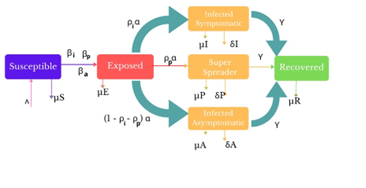
This paper explores the dynamics of COVID-19 transmission, particularly focusing on super-spreaders, through the lens of the SIR model. The model comprises six compartments representing susceptible, exposed, symptomatic infected, super-spreader, asymptomatic infected, and recovered individuals. Utilizing a set of non-linear, interdependent differential equations, we numerically solve for model parameters to examine the influence of super-spreaders on infection spread within the population. We calculate the basic reproduction number (R0) and discuss the stability of disease-free equilibrium. Our findings underscore the significant role played by super-spreaders and asymptomatic individuals in disease dissemination. Drawing on the epidemiological concept of the iceberg phenomenon, we offer insights into super-spreader events (SSEs) in India and their ramifications.
Published
How to Cite
Issue
Section
Copyright (c) 2024 Gurpreet Singh Tuteja, Tapshi Lal

This work is licensed under a Creative Commons Attribution 4.0 International License.
How to Cite
Similar Articles
- Raed Hatamleh, Diana Amin Mohammad Mahmoud, Haitham Qawaqneh, Hind Y. Saleh, Alaa M. Abd El-latif, Eman Almuhur, Aqeedat Hussain, Arif Mehmood, Cris L. Armada, Complex triple-valued neutrosophic soft sets and their topological framework with AI-driven signal-template analysis , Journal of the Nigerian Society of Physical Sciences: Volume 8, Issue 3, August 2026
- Shehu Magawata Shagari, Danlami Gabi, Nasiru Muhammad Dankolo, Noah Ndakotsu Gana, Countermeasure to Structured Query Language Injection Attack for Web Applications using Hybrid Logistic Regression Technique , Journal of the Nigerian Society of Physical Sciences: Volume 4, Issue 4, November 2022
- Joshua Sunday, Joel N. Ndam, Lydia J. Kwari, An Accuracy-preserving Block Hybrid Algorithm for the Integration of Second-order Physical Systems with Oscillatory Solutions , Journal of the Nigerian Society of Physical Sciences: Volume 5, Issue 1, February 2023
- S. E. Ogunfeyitimi, M. N. O Ikhile, P. O. Olatunji, High order boundary value linear multistep method for the numerical solution of IVPs in ODEs , Journal of the Nigerian Society of Physical Sciences: Volume 7, Issue 4, November 2025
- J. O. Coker, H. H. Akpan, A. O. Atilade, O. F. Ojo, Seasonal Comparison of Potential Groundwater Aquifer in Ijebu-Ife, South-West, Nigeria, using Dipole-Dipole Array and Electromagnetic Methods , Journal of the Nigerian Society of Physical Sciences: Volume 2, Issue 4, November 2020
- Chinedu L. Udeze, Idongesit E. Eteng, Ayei E. Ibor, Application of Machine Learning and Resampling Techniques to Credit Card Fraud Detection , Journal of the Nigerian Society of Physical Sciences: Volume 4, Issue 3, August 2022
- C. J. Ajaelu, O. Oyedele, A. A. Ikotun, E. O. Faboro, Safranin O dye removal using Senna fistula activated biomass: Kinetic, equilibrium and thermodynamic studies , Journal of the Nigerian Society of Physical Sciences: Volume 5, Issue 1, February 2023
- Kehinde Sanni, Adeshola Dauda Adediran, Aliu Olaniyi Tajudeen, Numerical investigation of nonlinear radiative flux of non-Newtonian MHD fluid induced by nonlinear driven multi-physical curved mechanism with variable magnetic field , Journal of the Nigerian Society of Physical Sciences: Volume 5, Issue 3, August 2023
- Solomon Nehemiah Yusuf, Williams Midala Wakili, Geological mapping and structural analysis from satellite imagery of a section of the Adamawa Massif: Implications for mineralization , Journal of the Nigerian Society of Physical Sciences: Volume 7, Issue 3, August 2025
- K. Lekhana, K. T. Shivaram, Applications of quadrilateral finite element meshes with four-node, eight-node, and twelve-node for efficient microwave energy transfer in curved waveguides , Journal of the Nigerian Society of Physical Sciences: Volume 8, Issue 3, August 2026
You may also start an advanced similarity search for this article.