A study of growth of COVID-19 with super-spreaders using the modified SIR model including iceberg phenomenon
Keywords:
SIR model, COVID-19, Super-spreaders, Super Spreading Event, Iceberg phenomenon in epidemiology, Basic reproduction numberAbstract
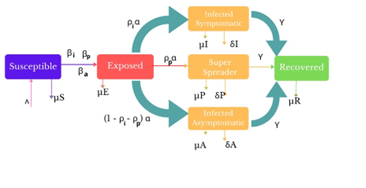
This paper explores the dynamics of COVID-19 transmission, particularly focusing on super-spreaders, through the lens of the SIR model. The model comprises six compartments representing susceptible, exposed, symptomatic infected, super-spreader, asymptomatic infected, and recovered individuals. Utilizing a set of non-linear, interdependent differential equations, we numerically solve for model parameters to examine the influence of super-spreaders on infection spread within the population. We calculate the basic reproduction number (R0) and discuss the stability of disease-free equilibrium. Our findings underscore the significant role played by super-spreaders and asymptomatic individuals in disease dissemination. Drawing on the epidemiological concept of the iceberg phenomenon, we offer insights into super-spreader events (SSEs) in India and their ramifications.
Published
How to Cite
Issue
Section
Copyright (c) 2024 Gurpreet Singh Tuteja, Tapshi Lal

This work is licensed under a Creative Commons Attribution 4.0 International License.
How to Cite
Similar Articles
- Abbas Ja'afaru Badakaya, Bilyaminu Muhammad, A Purusit Differential Game Problem on a Closed Convex Subset of a Hilbert Space , Journal of the Nigerian Society of Physical Sciences: Volume 2, Issue 3, August 2020
- C. O. Lawani, G. J. Ibeh, O. O. Ige, Eli Danladi, J. O. Emmanuel, A. J. Ukwenya, P. O. Oyedare, Corrigendum to "Numerical Simulation of Copper Indium Gallium Diselenide Solar Cells Using One Dimensional SCAPS Software [J. Nig. Soc. Phys. Sci. 3 (2021) 48–58, https://doi.org/10.46481/jnsps.2021.133]" , Journal of the Nigerian Society of Physical Sciences: Volume 3, Issue 3, August 2021
- Mariya Helen, Prabhakar V, Computational investigation of free convection flow inside inclined square cavities , Journal of the Nigerian Society of Physical Sciences: Volume 4, Issue 2, May 2022
- E. P. Inyang, E. O. Obisung, P. C. Iwuji, J. E. Ntibi, J. Amajama, E. S. William, Masses and thermal properties of a Charmonium and Bottomonium Mesons , Journal of the Nigerian Society of Physical Sciences: Volume 4, Issue 3, August 2022
- Y. B. Lawal, E. T. Omotoso, Investigation of Point Refractivity Gradient and Geoclimatic Factor at 70 m Altitude in Yenagoa, Nigeria , Journal of the Nigerian Society of Physical Sciences: Volume 5, Issue 1, February 2023
- A. Murali, K. Muthunagai, Some theorems on fixed points in bi-complex valued metric spaces with an application to integral equations , Journal of the Nigerian Society of Physical Sciences: Volume 6, Issue 2, May 2024
- Benson Ade Eniola Afere, On the cluster of the families of hybrid polynomial kernels in kernel density estimation , Journal of the Nigerian Society of Physical Sciences: Volume 7, Issue 1, February 2025
- Raphael Ozighor Enihe, Rajesh Prasad, Francisca Nonyelum Ogwueleka, Fatimah Binta Abdullahi, The effect of imbalance data mitigation techniques on cardiovascular disease prediction , Journal of the Nigerian Society of Physical Sciences: Volume 7, Issue 2, May 2025
- Raed Hatamleh, Diana Amin Mohammad Mahmoud, Haitham Qawaqneh, Hind Y. Saleh, Alaa M. Abd El-latif, Eman Almuhur, Aqeedat Hussain, Arif Mehmood, Cris L. Armada, Complex triple-valued neutrosophic soft sets and their topological framework with AI-driven signal-template analysis , Journal of the Nigerian Society of Physical Sciences: Volume 8, Issue 3, August 2026
- Shehu Magawata Shagari, Danlami Gabi, Nasiru Muhammad Dankolo, Noah Ndakotsu Gana, Countermeasure to Structured Query Language Injection Attack for Web Applications using Hybrid Logistic Regression Technique , Journal of the Nigerian Society of Physical Sciences: Volume 4, Issue 4, November 2022
You may also start an advanced similarity search for this article.