A study of growth of COVID-19 with super-spreaders using the modified SIR model including iceberg phenomenon
Keywords:
SIR model, COVID-19, Super-spreaders, Super Spreading Event, Iceberg phenomenon in epidemiology, Basic reproduction numberAbstract
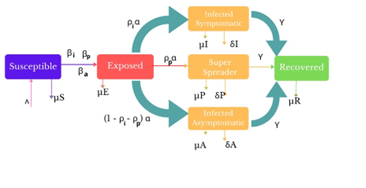
This paper explores the dynamics of COVID-19 transmission, particularly focusing on super-spreaders, through the lens of the SIR model. The model comprises six compartments representing susceptible, exposed, symptomatic infected, super-spreader, asymptomatic infected, and recovered individuals. Utilizing a set of non-linear, interdependent differential equations, we numerically solve for model parameters to examine the influence of super-spreaders on infection spread within the population. We calculate the basic reproduction number (R0) and discuss the stability of disease-free equilibrium. Our findings underscore the significant role played by super-spreaders and asymptomatic individuals in disease dissemination. Drawing on the epidemiological concept of the iceberg phenomenon, we offer insights into super-spreader events (SSEs) in India and their ramifications.
Published
How to Cite
Issue
Section
Copyright (c) 2024 Gurpreet Singh Tuteja, Tapshi Lal

This work is licensed under a Creative Commons Attribution 4.0 International License.
How to Cite
Similar Articles
- E. Omugbe, E. P. Inyang, A. Jahanshir, C. A. Onate, C. N. Isonguyo, E. S. Eyube, U. S. Okorie, R. Horchani, A. N. Ikot, Expectation values and Fisher information theoretic measures of heavy flavoured mesons , Journal of the Nigerian Society of Physical Sciences: Volume 7, Issue 1, February 2025
- Osowomuabe Njama-Abang, Denis U. Ashishie, Paul T. Bukie, Addressing class imbalance in lassa fever epidemic data, using machine learning: a case study with SMOTE and random forest , Journal of the Nigerian Society of Physical Sciences: Volume 7, Issue 3, August 2025
- Aliyu Itari Abdullahi, Nuhu Degree Umar, Application of Remote Sensing and Geoinformatics Techniques in Erosion Mapping and Groundwater Management in the River Amba Watershed, Central Nigeria , Journal of the Nigerian Society of Physical Sciences: Volume 3, Issue 2, May 2021
- F. O. Akinpelu, R. A. Oderinu, A. D. Ohaegbue, Analysis of Hydromagnetic Double Exothermic Chemical Reactive Flow with Convective Cooling through a Porous Medium under Bimolecular Kinetics , Journal of the Nigerian Society of Physical Sciences: Volume 4, Issue 1, February 2022
- F. O. Aweda, J. A. Akinpelu, T. K. Samson, M. Sanni, B. S. Olatinwo, Modeling and Forecasting Selected Meteorological Parameters for the Environmental Awareness in Sub-Sahel West Africa Stations , Journal of the Nigerian Society of Physical Sciences: Volume 4, Issue 3, August 2022
- A. E. Ibor, E. B. Edim, A. A. Ojugo, Secure Health Information System with Blockchain Technology , Journal of the Nigerian Society of Physical Sciences: Volume 5, Issue 2, May 2023
- A. Y. Fasasi, E. Ajenifuja, E. Osagie, L. O. Animasaun, A. E. Adeoye, E. I. Obiajunwa, Optical, Dielectric and Optoelectronic Properties of Spray Deposited Cu-doped Fe2O3 Thin Films , Journal of the Nigerian Society of Physical Sciences: Volume 5, Issue 3, August 2023
- Fathelrhman EL Guma, Ossama M. Badawy, Mohammed Berir, Mohamed A. Abdoon, Numerical Analysis of Fractional-Order Dynamic Dengue Disease Epidemic in Sudan , Journal of the Nigerian Society of Physical Sciences: Volume 5, Issue 2, May 2023
- S. N. Enemuo, O. N. Akande, M. O. Lawrence, I. C. Saidu, Optimized aspect level sentiment analysis of tweet data using deep learning and rule-based techniques , Journal of the Nigerian Society of Physical Sciences: Volume 7, Issue 2, May 2025
- Raja Aqib Shamim, Majid Khan Majahar Ali, Mohamed Farouk Haashir bin Hamdullah, Computational optimization of auctioneer revenue in modified discrete Dutch auctions with cara risk preferences , Journal of the Nigerian Society of Physical Sciences: Volume 8, Issue 1, February 2026
You may also start an advanced similarity search for this article.