Complex triple-valued neutrosophic soft sets and their topological framework with AI-driven signal-template analysis
Keywords:
Complex triple-valued neutrosophic soft sets, Complex triple-valued neutrosophic soft topology, Cotangent similarity measures, Data visualization techniquesAbstract
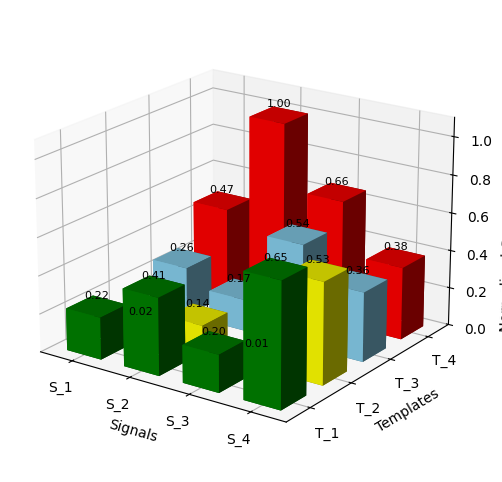
This research proposes basic operations on complex triple-valued neutrosophic soft sets (CTVNSs) and defines complex triple-valued neutrosophic soft topological spaces (CTVNSTSs) with interior and closure operators. The study also presents an application to signal-template matching using cotangent similarity. Visual comparisons of four signals (S1--S4) and four templates (T1--T4) show that T4 is the most similar template, T2 is the least similar, and T1 and T3 are moderately similar. Normalization affects dominance and makes T1 relevant in some comparisons. Correlation analysis and clustering using principal component analysis and K-means (K=2) identify one cluster (S1, S2 , and S3) and one outlier (S4). These results indicate that cotangent similarity, together with data visualization and normalization, can effectively support the analysis of complex data.
References
[1] L. A. Zadeh, ``Fuzzy sets'', Information and Control 8 (1965) 338. https://doi.org/10.1016/S0019-9958(65)90241-X.
[2] I. B. Turksen, ``Interval valued fuzzy sets based on normal forms'', Fuzzy Sets Syst. 20 (1986) 191. https://doi.org/10.1016/0165-0114(86)90077-1.
[3] K. Atanassov, ``Intuitionistic fuzzy sets'', Fuzzy Sets Syst. 20 (1986) 87. https://doi.org/10.1016/S0165-0114(86)80034-3.
[4] K. Atanassov & G. Gargov, ``Interval-valued intuitionistic fuzzy sets'', Fuzzy Sets Syst. 31 (1989) 343. https://doi.org/10.1016/0165-0114(89)90205-4.
[5] F. Smarandache, A unifying field in logics: Neutrosophy and neutrosophic logic, American Research Press, Rehoboth, NM, USA, 1998. https://doi.org/10.5281/zenodo.49174.
[6] F. G. Lupianez, ``On neutrosophic topology'', Kybernetes 37 (2008) 797. https://doi.org/10.1108/03684920810876990.
[7] H. Wang, F. Smarandache, Y. Zhang & R. Sunderraman, ``Single-valued neutrosophic sets'', Multispace & Multistructure. Neutrosophic Transdisciplinarity 4 (2010) 410. Available online: https://fs.unm.edu/SingleValuedNeutrosophicSets.pdf.
[8] H. Wang, F. Smarandache, Y. Q. Zhang & R. Sunderraman, Interval neutrosophic sets and logic: Theory and applications in computing, Hexis, Phoenix, AZ, USA, 2005. https://doi.org/10.5281/zenodo.8818.
[9] S. Broumi & F. Smarandache, ``Cosine similarity measure of interval valued neutrosophic sets'', Neutrosophic Sets and Systems 5 (2014) 15. https://doi.org/10.6084/M9.FIGSHARE.1502645.
[10] S. Broumi & F. Smarandache, ``New distance and similarity measures of interval neutrosophic sets'', 17th International Conference on Information Fusion, Salamanca, Spain, 2014, p. 249. Available online: https://digitalrepository.unm.edu/math_fsp/487.
[11] J. Ye, ``Similarity measures between interval neutrosophic sets and their applications in multicriteria decision-making'', J. Intell. Fuzzy Syst. 26 (2014) 165. https://doi.org/10.3233/IFS-120724.
[12] S. Broumi & F. Smarandache, ``Correlation coefficient of interval neutrosophic set'', Int. Conf. ICMERA, Bucharest, Romania, 2013. https://doi.org/10.5281/zenodo.48908.
[13] P. Majumdar & S. K. Samanta, ``On similarity and entropy of neutrosophic sets'', J. Intell. Fuzzy Syst. 26 (2014) 1245. https://doi.org/10.3233/IFS-130810.
[14] S. M. Chen, ``A new approach to handling fuzzy decision making problems'', IEEE Trans. Syst., Man, Cybern. 18 (1988) 1012. https://doi.org/10.1109/21.23100.
[15] S. M. Chen, S. M. Yeh & P. H. Hsiao, ``A comparison of similarity measures of fuzzy values'', Fuzzy Sets Syst. 72 (1995) 79. https://doi.org/10.1016/0165-0114(94)00284-E.
[16] D. Molodtsov, ``Soft set theory: First results'', Comput. Math. Appl. 37 (1999) 19. https://doi.org/10.1016/S0898-1221(99)00056-5.
[17] H. Aktas & N. Cagman, ``Soft sets and soft groups'', Inf. Sci. 177 (2007) 2726. https://doi.org/10.1016/j.ins.2006.12.008.
[18] K. V. Babitha & J. J. Sunil, ``Soft set relations and functions'', Comput. Math. Appl. 60 (2010) 1840. https://doi.org/10.1016/j.camwa.2010.07.014.
[19] D. Chen, E. C. C. Tsang & D. S. Yeung, ``Some notes on the parameterization reduction of soft sets'', Int. Conf. Mach. Learn. Cybern., 2003, p. 1442. https://doi.org/10.1109/ICMLC.2003.1259720.
[20] D. Chen, E. C. C. Tsang, D. S. Yeung & X. Wang, ``The parameterization reduction of soft sets and its applications'', Comput. Math. Appl. 49 (2005) 757. https://doi.org/10.1016/j.camwa.2004.10.036.
[21] N. Cagman & S. Enginoglu, ``Soft set theory and uni-int decision making'', Eur. J. Oper. Res. 207 (2010) 848. https://doi.org/10.1016/j.ejor.2010.05.004.
[22] F. Feng, Y. B. Jun, X. Liu & L. Li, ``An adjustable approach to fuzzy soft set based decision making'', J. Comput. Appl. Math. 234 (2010) 10. https://doi.org/10.1016/j.cam.2009.11.055.
[23] A. R. Roy & P. K. Maji, ``A fuzzy soft set theoretic approach to decision making problems'', J. Comput. Appl. Math. 203 (2007) 412. https://doi.org/10.1016/j.cam.2006.04.008.
[24] K. N. Singh & J. K. Mantri, ``A clinical decision support system using rough set theory and machine learning for disease prediction'', Intelligent Medicine 4 (2024) 200. https://doi.org/10.1016/j.imed.2023.08.002.
[25] B. Ahmad & A. Kharal, ``On fuzzy soft sets'', Adv. Fuzzy Syst. 2009 (2009) 586507. https://doi.org/10.1155/2009/586507.
[26] B. K. Tripathy, R. K. Mohanty & T. R. Sooraj, ``On intuitionistic fuzzy soft set and its application in group decision making'', Proc. 2016 Int. Conf. Emerging Trends in Engineering, Technology and Science (ICETETS), Pudukkottai, 2016, p. 1. https://doi.org/10.1109/ICETETS.2016.7603002.
[27] P. K. Maji, R. Biswas & A. R. Roy, ``Soft set theory'', Comput. Math. Appl. 45 (2003) 555. https://doi.org/10.1016/S0898-1221(03)00016-6.
[28] N. Cagman & I. Deli, ``Means of FP-soft sets and its applications'', Hacet. J. Math. Stat. 41 (2012) 615. Available online: https://dergipark.org.tr/tr/download/article-file/86337.
[29] N. Cagman & I. Deli, ``Product of FP-soft sets and its applications'', Hacet. J. Math. Stat. 41 (2012) 365.
[30] I. Deli, ``Interval-valued neutrosophic soft sets and its decision making'', arXiv:1402.3130 (2014). https://doi.org/10.48550/arXiv.1402.3130.
[31] P. Majumdar & S. K. Samanta, ``Similarity measure of soft sets'', New Math. Nat. Comput. 4 (2008) 1. https://doi.org/10.1142/S1793005708000908.
[32] A. Kharal, ``Distance and similarity measures for soft sets'', New Math. Nat. Comput. 6 (2010) 321. https://doi.org/10.1142/S1793005710001724.
[33] P. Grzegorzewski, ``Distances between intuitionistic fuzzy sets and/or interval-valued fuzzy sets based on the Hausdorff metric'', Fuzzy Sets Syst. 148 (2004) 319. https://doi.org/10.1016/j.fss.2003.08.005.
[34] M. Arora, R. Biswas & U. S. Pandy, ``Neutrosophic relational database decomposition'', Int. J. Adv. Comput. Sci. Appl. 2 (2011) 121. https://doi.org/10.14569/IJACSA.2011.020822.
[35] M. Arora & R. Biswas, ``Deployment of neutrosophic technology to retrieve answers for queries posed in natural language'', 3rd IEEE Int. Conf. Comput. Sci. Inf. Technol. (ICCSIT), Chengdu, China, 2010, p. 435. https://doi.org/10.1109/ICCSIT.2010.5564125.
[36] S. Aggarwal, R. Biswas & A. Q. Ansari, ``Neutrosophic modeling and control'', IEEE Int. Conf., 2010, p. 718. https://doi.org/10.1109/ICCCT.2010.5640435.
[37] H. D. Cheng & Y. Guo, ``A new neutrosophic approach to image thresholding'', New Math. Nat. Comput. 4 (2008) 291. https://doi.org/10.1142/S1793005708001082.
[38] Y. Guo & H. D. Cheng, ``New neutrosophic approach to image segmentation'', Pattern Recognit. 42 (2009) 587. https://doi.org/10.1016/j.patcog.2008.10.002.
[39] M. Zhang, L. Zhang & H. D. Cheng, ``A neutrosophic approach to image segmentation based on watershed method'', Signal Process. 90 (2010) 1510. https://doi.org/10.1016/j.sigpro.2009.10.021.
[40] A. Q. Ansari, R. Biswas & S. Aggarwal, ``Proposal for applicability of neutrosophic set theory in medical AI'', Int. J. Comput. Appl. 27 (2011) 5. https://doi.org/10.5120/3299-4505.
[41] M. I. Ali, F. Feng, X. Liu, W. K. Min & M. Shabir, ``On some new operations in soft set theory'', Comput. Math. Appl. 57 (2009) 1547. https://doi.org/10.1016/j.camwa.2008.11.009.
[42] M. I. Ali, ``A note on soft sets, rough soft sets and fuzzy soft sets'', Appl. Soft Comput. 11 (2011) 3329. https://doi.org/10.1016/j.asoc.2011.01.003.
[43] U. Acar, F. Koyuncu & B. Tanay, ``Soft sets and soft rings'', Comput. Math. Appl. 59 (2010) 3458. https://doi.org/10.1016/j.camwa.2010.03.034.
[44] Y. Jiang, Y. Tang, Q. Chen, H. Liu & J. Tang, ``Interval-valued intuitionistic fuzzy soft sets and their properties'', Comput. Math. Appl. 60 (2010) 906. https://doi.org/10.1016/j.camwa.2010.05.036.
[45] N. Cagman, ``Similarity measures of intuitionistic fuzzy soft sets and their decision making'', arXiv:1301.0456 (2013). https://doi.org/10.48550/arXiv.1301.0456.
[46] S. Broumi, ``Generalized neutrosophic soft set'', Int. J. Comput. Sci., Eng. Inf. Technol. 3 (2013) 17. https://doi.org/10.5121/ijcseit.2013.3202.
[47] S. Broumi & F. Smarandache, ``Several similarity measures of neutrosophic sets'', Neutrosophic Sets Syst. 1 (2013) 54. Available online: https://digitalrepository.unm.edu/nss_journal/vol1/iss1/10.
[48] T. Bera & N. K. Mahapatra, ``Introduction to neutrosophic soft topological space'', Opsearch 54 (2017) 841. https://doi.org/10.1007/s12597-017-0308-7.
[49] P. K. Maji, ``Neutrosophic soft set'', Ann. Fuzzy Math. Inform. 5 (2013) 157. Available online: http://www.afmi.or.kr/papers/2013/Vol-05_No-01/PDF/AFMI-5-1(157-168)-J-111216R1.pdf.
[50] I. Deli & S. Broumi, ``Neutrosophic soft relations and some properties'', Ann. Fuzzy Math. Inform. 9 (2015) 169. https://doi.org/10.5281/zenodo.23153.
[51] F. Smarandache, {it Neutrosophic set - a generalization of the intuitionistic fuzzy set}, 2006 IEEE International Conference on Granular Computing, Atlanta, GA, USA, 2006, p. 38. https://doi.org/10.1109/GRC.2006.1635754.
[52] C. D. Manning, P. Raghavan & H. Schutze, Introduction to information retrieval, Cambridge University Press, Cambridge, United Kingdom, 2008. https://doi.org/10.1017/CBO9780511809071.
[53] L. Wilkinson, The grammar of graphics, Springer, New York, NY, USA, 2005. https://doi.org/10.1007/0-387-28695-0.
[54] J. Han, M. Kamber & J. Pei, Data mining: Concepts and techniques, 3rd ed., Elsevier, Amsterdam, Netherlands, 2011. https://doi.org/10.1016/C2009-0-61819-5.
[55] E. R. Tufte, The visual display of quantitative information, Graphics Press, Cheshire, CT, USA, 2001.
[56] K. Pearson, ``On lines and planes of closest fit to systems of points in space'', Philosophical Magazine 2 (1901) 559. https://doi.org/10.1080/14786440109462720.
[57] C. de Boor, A practical guide to splines, Springer, New York, NY, USA, 1978. https://doi.org/10.2307/2006241.
[58] MathWorks, ``MATLAB documentation'', The MathWorks, Inc., Natick, MA, USA. Accessed 20 June 2026. Available online: https://www.mathworks.com/help/matlab/.
[59] S. Lloyd, ``Least squares quantization in PCM'', IEEE Transactions on Information Theory 28 (1982) 129. https://doi.org/10.1109/TIT.1982.1056489.
[60] R. A. Fisher, ``The use of multiple measurements in taxonomic problems'', Annals of Eugenics 7 (1936) 179. https://doi.org/10.1111/j.1469-1809.1936.tb02137.x.
[61] M. M. Saeed, R. Hatamleh, A. M. Abd El-latif, A. Alhusban, H. M. Attaalfadeel, T. Fujita, K. A. Aldwoah & A. Mehmood, ``A breakthrough approach to quadri-partitioned neutrosophic soft topological spaces'', Eur. J. Pure Appl. Math. 18 (2025) 5845. https://doi.org/10.29020/nybg.ejpam.v18i2.5845.
[62] A. A. Abubaker, R. Hatamleh, K. Matarneh & A. Al-Husban, ``On the numerical solutions for some neutrosophic singular boundary value problems by using (LPM) polynomials'', International Journal of Neutrosophic Science 25 (2024) 197. https://doi.org/10.54216/IJNS.250217.
[63] A. A. Abubaker, R. Hatamleh, K. Matarneh & A. Al-Husban, ``On the irreversible k-threshold conversion number for some graph products and neutrosophic graphs'', International Journal of Neutrosophic Science 25 (2025) 183. https://doi.org/10.54216/IJNS.250216.
[64] R. Hatamleh, A. Al-Husban, K. Sundareswari, G. Balaj & M. Palanikumar, ``Complex tangent trigonometric approach applied to ($gamma$, $tau$)-rung fuzzy set using weighted averaging, geometric operators and its extension'', Communications on Applied Nonlinear Analysis 32 (2025) 133. https://doi.org/10.52783/cana.v32.2978.
[65] R. Hatamleh & A. Hazaymeh, ``On some topological spaces based on symbolic n-plithogenic intervals'', International Journal of Neutrosophic Science 25 (2025) 23. https://doi.org/10.54216/IJNS.250102.
[66] H. Qawaqneh, ``Fractional analytic solutions and fixed point results with some applications'', Advances in Fixed Point Theory 14 (2024) 1. https://doi.org/10.28919/afpt/8279.
[67] H. Qawaqneh, M. S. Noorani, W. Shatanawi & H. Aydi, ``On fixed point results in partial b-metric spaces'', Journal of Function Spaces 2021 (2021) 8769190. https://doi.org/10.1155/2021/8769190.
[68] H. Qawaqneh, M. S. Noorani & H. Aydi, ``Some new characterizations and results for fuzzy contractions in fuzzy b-metric spaces and applications'', AIMS Mathematics 8 (2023) 6682. https://doi.org/10.3934/math.2023338.
[69] H. Qawaqneh, J. Manafian, M. Alharthi & Y. Alrashedi, ``Stability analysis, modulation instability, and beta-time fractional exact soliton solutions to the van der Waals equation'', Mathematics 12 (2024) 2257. https://doi.org/10.3390/math12142257.
[70] M. Elbes, A. Alkhateeb, T. Kanan, A. Al-Momani & M. Alia, ``COVID-19 detection platform from X-ray images using deep learning'', International Journal of Advances in Soft Computing and its Applications 14 (2022) 197. https://doi.org/10.15849/IJASCA.220328.13.
[71] T. Kanan, M. Elbes, K. Abu Maria & M. Alia, ``Exploring the potential of IoT-based learning environments in education'', International Journal of Advances in Soft Computing and its Applications 15 (2023) 167. https://www.i-csrs.org/Volumes/ijasca/IJASCA.230720.11.pdf.
[72] I. M. Batiha, S. A. Njadat, R. M. Batyha, A. Zraiqat, A. Dababneh & S. Momani, ``Design fractional-order PID controllers for single-joint robot arm model'', International Journal of Advances in Soft Computing and its Applications 14 (2022) 96. https://doi.org/10.15849/IJASCA.220720.07.
[73] A. M. Abd El-latif & M. H. Alqahtani, ``Novel categories of supra soft continuous maps via new soft operators'', AIMS Mathematics 9 (2024) 7449. https://doi.org/10.3934/math.2024361.
[74] A. M. Abd El-latif, M. H. Alqahtani & F. A. Gharib, ``Strictly wider class of soft sets via supra soft $delta$-closure operator'', International Journal of Analysis and Applications 22 (2024) 47. https://doi.org/10.28924/2291-8639-22-2024-47.
[75] A. Al-Omari & M. H. Alqahtani, ``Some operators in soft primal spaces'', AIMS Mathematics 9 (2024) 10756. https://doi.org/10.3934/math.2024525.
[76] A. M. Abd El-latif, A. A. Azzam, A. Al-Omari & M. H. Alqahtani, ``New versions of maps and connected spaces via supra soft sd-operators'', PLOS ONE 19 (2024) e0304042. https://doi.org/10.1371/journal.pone.0304042.
[77] A. M. Abd El-latif, A. Al-Omari & M. H. Alqahtani, ``Applications on soft somewhere dense sets'', Journal of Interdisciplinary Mathematics 27 (2024) 1679. https://doi.org/10.47974/JIM-2007.
[78] M. H. Alqahtani, ``Neutrosophic primal structure with closure and proximity operators'', AIMS Mathematics 11 (2026) 644. https://doi.org/10.3934/math.2026028.
[79] M. H. Alqahtani, ``Operators and separation axioms within the framework of diving topological spaces'', AIMS Mathematics 10 (2025) 25253. https://doi.org/10.3934/math.20251118.
[80] I. Ibedou, S. E. Abbas & M. H. Alqahtani, ``Defining new structures on a universal set: Diving structures and floating structures'', Mathematics 13 (2025) 1859. https://doi.org/10.3390/math13111859.
[81] M. H. Alqahtani & M. Tkachenko, ``Normality and N-factorizable topological groups'', Topology and its Applications 373 (2025) 109497. https://doi.org/10.1016/j.topol.2025.109497.
[82] S. A. El-Sheikh & A. M. Abd El-latif, ``Decompositions of some types of supra soft sets and soft continuity'', International Journal of Mathematics Trends and Technology 9 (2014) 37. https://doi.org/10.14445/22315373/IJMTT-V9P504.
[83] A. M. Abd El-latif, ``Specific types of Lindel"{o}fness and compactness based on novel supra soft operator'', AIMS Mathematics 10 (2025) 8144. https://doi.org/10.3934/math.2025374.
[84] A. M. Abd El-latif & M. H. Alqahtani, ``New soft operators related to supra soft $delta_i$-open sets and applications'', AIMS Mathematics 9 (2024) 3076. https://doi.org/10.3934/math.2024150.
[85] M. H. Alqahtani & A. M. Abd El-latif, ``Separation axioms via novel operators in topological spaces and applications'', AIMS Mathematics 9 (2024) 14213. https://doi.org/10.3934/math.2024690.
Published
How to Cite
Issue
Section
Copyright (c) 2026 Raed Hatamleh, Diana Amin Mohammad Mahmoud, Haitham Qawaqneh, Hind Y. Saleh, Alaa M. Abd El-latif, Eman Almuhur, Aqeedat Hussain, Arif Mehmood, Cris L. Armada (Author)

This work is licensed under a Creative Commons Attribution 4.0 International License.