Iterative method for the numerical solution of optimal control model for mosquito and insecticide
Keywords:
Malaria, mosquito, insecti, First Boubaker polynomials, optimal control problems, mathematical modelsAbstract
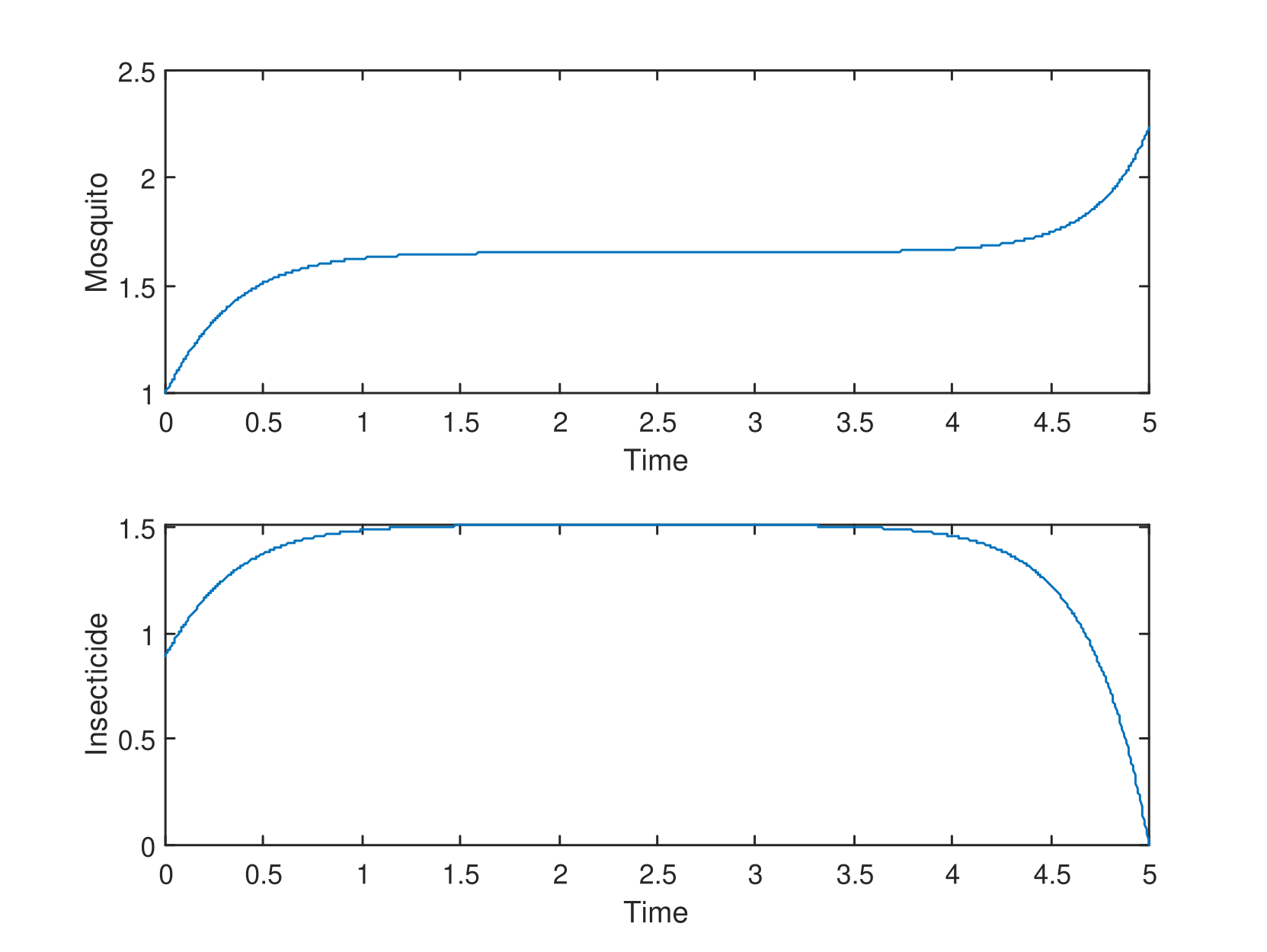
A linear multistep method is transformed into an iterative method based on Patade and Bhalekar's technique for the numerical solution of the optimal control problem modeled for mosquito and insecticide management using forward-backward sweep methods via Pontryagin's principle. Stability and convergence analysis of the iterative method are carried out, and it is found to be stable, convergent, and of order four. Results obtained by the method clearly show that the population of mosquitoes can be minimized to a large extent using the new iterative method while reducing the harmful effects of the insecticide, subsequently reducing the spread of malaria.
Published
How to Cite
Issue
Section
Copyright (c) 2024 S. Adamu, O. O. Aduroja, A. S. Onanaye, M. R. Odekunle

This work is licensed under a Creative Commons Attribution 4.0 International License.
How to Cite
Similar Articles
- Friday Obarhua, Oluwasemire John Adegboro, An Order Four Continuous Numerical Method for Solving General Second Order Ordinary Differential Equations , Journal of the Nigerian Society of Physical Sciences: Volume 3, Issue 1, February 2021
- Dalal Khalid Almutairi, Mohamed A. Abdoon, Salih Yousuf Mohamed Salih, Shahinaz A.Elsamani, Fathelrhman EL Guma, Mohammed Berir, Modeling and Analysis of a Fractional Visceral Leishmaniosis with Caputo and Caputo–Fabrizio derivatives , Journal of the Nigerian Society of Physical Sciences: Volume 5, Issue 3, August 2023
- Nahid Salma, Majid Khan Majahar Ali, Raja Aqib Shamim, Machine learning-based feature selection for ultra-high-dimensional survival data: a computational approach , Journal of the Nigerian Society of Physical Sciences: Volume 7, Issue 3, August 2025
- Saheed Ajao, Isaac Olopade, Titilayo Akinwumi, Sunday Adewale, Adelani Adesanya, Understanding the Transmission Dynamics and Control of HIV Infection: A Mathematical Model Approach , Journal of the Nigerian Society of Physical Sciences: Volume 5, Issue 2, May 2023
- Olumide Sunday Adesina, Bayesian Multilevel Models for Count Data , Journal of the Nigerian Society of Physical Sciences: Volume 3, Issue 3, August 2021
- Abdulaziz G. Ahmad, Nnamdi F. Okechi, David U. Uche, Abdulwasiu O. Salaudeen, Numerical Simulation of Nonlinear and Non-Isothermal Liquid Chromatography for Studying Thermal Variations in Columns Packed with Core-Shell Particles , Journal of the Nigerian Society of Physical Sciences: Volume 5, Issue 2, May 2023
- James Andrawus, Kayode Isaac Omotoso, Agada Apeh Andrew, Felix Yakubu Eguda, Sunday Babuba, Kabiru Garba Ibrahim, Mathematical model analysis on the significance of surveillance and awareness on the transmission dynamics of diphtheria , Journal of the Nigerian Society of Physical Sciences: Volume 7, Issue 4, November 2025
- Chinwendu Emilian Madubueze, Kazeem A. Tijani, Elijah Iji Ajogi, Madumelu H. C. Madubueze, A mathematical model of cybercrime contagion: impact ofemployment on youth offending , Journal of the Nigerian Society of Physical Sciences: Volume 8, Issue 3, August 2026
- Ezra Abba, Zaccheus Shehu, Wilson Lamayi Danbature, Kennedy Poloma Yoriyo, Rifkatu Dogara Kambel , Charles Nsor Ayuk, A Novel developments of ZnO/SiO2 nanocomposite: a nanotechnological approach towards insect vector control , Journal of the Nigerian Society of Physical Sciences: Volume 3, Issue 3, August 2021
- Muhammad Farman, Kottakkaran Sooppy Nisar, Modeling and stability analysis of a fractional-order tuberculosisvmodel with different exposed populations progressing to infection , Journal of the Nigerian Society of Physical Sciences: Volume 8, Issue 3, August 2026
You may also start an advanced similarity search for this article.
Most read articles by the same author(s)
- M. Kida, S. Adamu, O. O Aduroja, P. T Pantuvo, Numerical Solution of Stiff and Oscillatory Problems using Third Derivative Trigonometrically Fitted Block Method , Journal of the Nigerian Society of Physical Sciences: Volume 4, Issue 1, February 2022