Deep convolutional neural network based synthetic minority over sampling technique: a forfending model for fraudulent credit card transactions in financial institution
Keywords:
Data Augmentation Techniques,, Deep Learning, Credit Card FraudAbstract
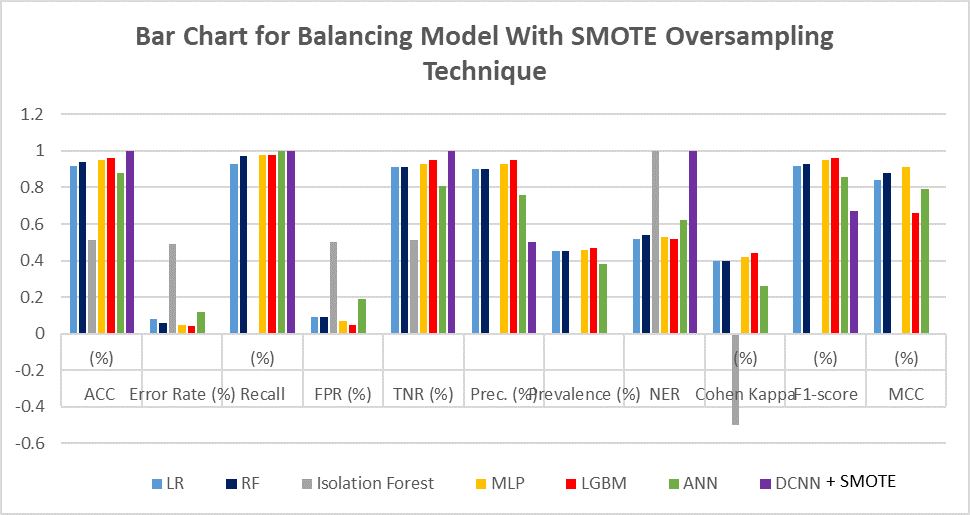
Fraudulent credit card transactions are committed by unauthorized individuals and organizations employing methods such as phishing and social engineering fraud tactics. Researchers propose several Machine Learning (ML) techniques to deter the challenges of credit card fraud. However, the ML approaches are endorsed with some challenges, which makes the detection of credit card fraud extremely difficult. This study proposes a Deep Convolutional Neural Network (DCNN) with Synthetic Minority Oversampling Techniques (SMOTE) as an ideal solution. Kaggle datasets with 284,807 records and 31 features were exploited. Implementation was performed on the Google Colab cloud-based platform, embedding a Jupyter notebook setting with Graphical Processing Units (GPUs). Two experiments were conducted; the first was probed to determine suitable models among baseline models: Logistic Regression (LR), Random Forest (RF), Isolation Forest, and a single Deep Learning (DL) model of Multiple Layer Perceptron (MLP). The baseline models yielded an overfitting accuracy score, with recall, specificity, precision, and F1-score all presenting 1.00% respectively. This outcome is not sufficient in establishing findings on imbalanced data distribution as it's biased. This led to the construction of a new ML model incorporating Light Gradient Boosting Machine (LGBM), with Artificial Neural Network (ANN) and the proposed DCNN+SMOTE for the second experimental phase alongside baseline models. Experimental results via simulation show the proposed DCNN+SMOTE yielded awesome superclass performance across the board, displaying 1.00% results respectively. Its Error Rate (ER) and Null Error Rate (NER) are 0.00% distinctly. Meanwhile, the False Positive Rate (FPR) yields a 0.001% result, lesser and better than the baseline models.
Published
How to Cite
Issue
Section
Copyright (c) 2024 L. G. Salaudeen, D. GABI, M. Garba, H. U. Suru

This work is licensed under a Creative Commons Attribution 4.0 International License.
How to Cite
Similar Articles
- O. J. Ibidoja, F. P. Shan, Mukhtar, J. Sulaiman, M. K. M. Ali, Robust M-estimators and Machine Learning Algorithms for Improving the Predictive Accuracy of Seaweed Contaminated Big Data , Journal of the Nigerian Society of Physical Sciences: Volume 5, Issue 1, February 2023
- A. A. Willoughby, M. E. Sanyaolu, M. O. Osinowo, A. O. Soge, O. F. Dairo, Estimation of some Radio Propagation Parameters using Measurements of Surface Meteorological Variables in Ede, Southwest Nigeria , Journal of the Nigerian Society of Physical Sciences: Volume 5, Issue 1, February 2023
- Umaru Hassan, Mohd Tahir Ismail, Improving forecasting accuracy using quantile regression neural network combined with unrestricted mixed data sampling , Journal of the Nigerian Society of Physical Sciences: Volume 5, Issue 4, November 2023
- Mahesh Kumar Singh, Arun Kumar Singh, Pushpa Choudhary, Akhilesh Kumar Singh, Lalit Kumar Tyagi, A practical deep learning framework for multi-class skin cancer detection using U-Net segmentation and ResNet50 transfer learning , Journal of the Nigerian Society of Physical Sciences: Volume 8, Issue 3, August 2026
- Timothy Kayode Samson, Francis Olatunbosun Aweda, Wind speed prediction in some major cities in Africa using Linear Regression and Random Forest algorithms , Journal of the Nigerian Society of Physical Sciences: Volume 6, Issue 4, November 2024
- Philemon Uten Emmoh, Christopher Ifeanyi Eke, Timothy Moses, A feature selection and scoring scheme for dimensionality reduction in a machine learning task , Journal of the Nigerian Society of Physical Sciences: Volume 7, Issue 1, February 2025
- P. O. Odion, M. N. Musa, S. U. Shuaibu, Age Prediction from Sclera Images using Deep Learning , Journal of the Nigerian Society of Physical Sciences: Volume 4, Issue 3, August 2022
- Gerard Shu Fuhnwi, Janet O. Agbaje, Kayode Oshinubi, Olumuyiwa James Peter, An Empirical Study on Anomaly Detection Using Density-based and Representative-based Clustering Algorithms , Journal of the Nigerian Society of Physical Sciences: Volume 5, Issue 2, May 2023
- K. Nandhini, V. Vidhya, An Alleviation of Cloud Congestion Analysis of Fluid Retrial User on Matrix Analytic Method in IoT-based Application , Journal of the Nigerian Society of Physical Sciences: Volume 5, Issue 2, May 2023
- Osowomuabe Njama-Abang, Denis U. Ashishie, Paul T. Bukie, Addressing class imbalance in lassa fever epidemic data, using machine learning: a case study with SMOTE and random forest , Journal of the Nigerian Society of Physical Sciences: Volume 7, Issue 3, August 2025
You may also start an advanced similarity search for this article.