Deep convolutional neural network based synthetic minority over sampling technique: a forfending model for fraudulent credit card transactions in financial institution
Keywords:
Data Augmentation Techniques,, Deep Learning, Credit Card FraudAbstract
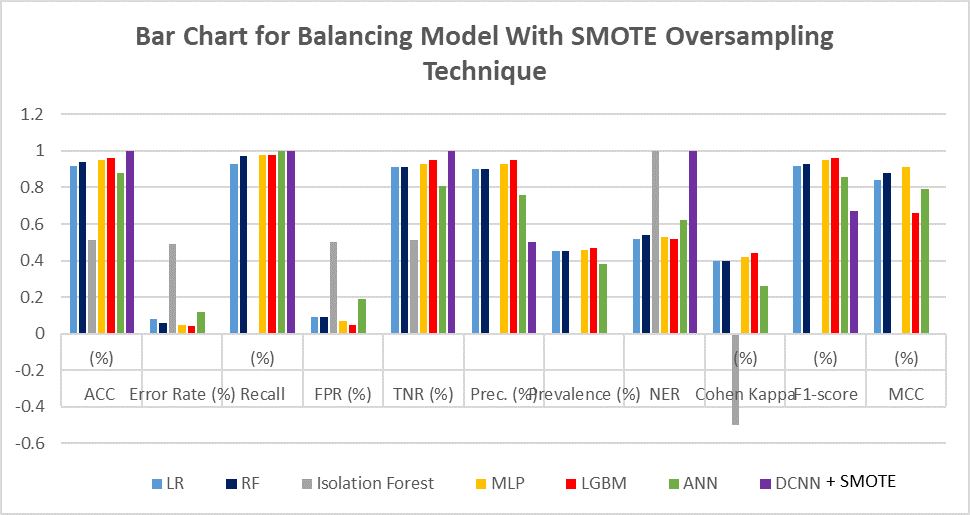
Fraudulent credit card transactions are committed by unauthorized individuals and organizations employing methods such as phishing and social engineering fraud tactics. Researchers propose several Machine Learning (ML) techniques to deter the challenges of credit card fraud. However, the ML approaches are endorsed with some challenges, which makes the detection of credit card fraud extremely difficult. This study proposes a Deep Convolutional Neural Network (DCNN) with Synthetic Minority Oversampling Techniques (SMOTE) as an ideal solution. Kaggle datasets with 284,807 records and 31 features were exploited. Implementation was performed on the Google Colab cloud-based platform, embedding a Jupyter notebook setting with Graphical Processing Units (GPUs). Two experiments were conducted; the first was probed to determine suitable models among baseline models: Logistic Regression (LR), Random Forest (RF), Isolation Forest, and a single Deep Learning (DL) model of Multiple Layer Perceptron (MLP). The baseline models yielded an overfitting accuracy score, with recall, specificity, precision, and F1-score all presenting 1.00% respectively. This outcome is not sufficient in establishing findings on imbalanced data distribution as it's biased. This led to the construction of a new ML model incorporating Light Gradient Boosting Machine (LGBM), with Artificial Neural Network (ANN) and the proposed DCNN+SMOTE for the second experimental phase alongside baseline models. Experimental results via simulation show the proposed DCNN+SMOTE yielded awesome superclass performance across the board, displaying 1.00% results respectively. Its Error Rate (ER) and Null Error Rate (NER) are 0.00% distinctly. Meanwhile, the False Positive Rate (FPR) yields a 0.001% result, lesser and better than the baseline models.
Published
How to Cite
Issue
Section
Copyright (c) 2024 L. G. Salaudeen, D. GABI, M. Garba, H. U. Suru

This work is licensed under a Creative Commons Attribution 4.0 International License.
How to Cite
Similar Articles
- Gabriel James, Ifeoma Ohaeri, David Egete, John Odey, Samuel Oyong, Enefiok Etuk, Imeh Umoren, Ubong Etuk, Aloysius Akpanobong, Anietie Ekong, Saviour Inyang, Chikodili Orazulume, A fuzzy-optimized multi-level random forest (FOMRF) model for the classification of the impact of technostress , Journal of the Nigerian Society of Physical Sciences: Volume 7, Issue 3, August 2025
- Olumide S. Adesina, Adedayo F. Adedotuun, Kayode S. Adekeye, Ogbu F. Imaga, Adeleke J. Adeyiga, Toluwalase J. Akingbade, On logistic regression versus support vectors machine using vaccination dataset , Journal of the Nigerian Society of Physical Sciences: Volume 6, Issue 1, February 2024
- Christian N. Nwaeme, Adewale F. Lukman, Robust hybrid algorithms for regularization and variable selection in QSAR studies , Journal of the Nigerian Society of Physical Sciences: Volume 5, Issue 4, November 2023
- F. U. Salifu, O. A. Oladipo, E. O. Ebock, B. Nava, Deep neural network model for vertical total electron content prediction at a single low latitude station , Journal of the Nigerian Society of Physical Sciences: Volume 7, Issue 4, November 2025
- David Opeoluwa Oyewola, Emmanuel Gbenga Dada, Juliana Ngozi ndunagu, Terrang Abubakar Umar, Akinwunmi S.A, COVID-19 Risk Factors, Economic Factors, and Epidemiological Factors nexus on Economic Impact: Machine Learning and Structural Equation Modelling Approaches , Journal of the Nigerian Society of Physical Sciences: Volume 3, Issue 4, November 2021
- Gabriel James, Ime Umoren, Anietie Ekong, Saviour Inyang, Oscar Aloysius, Analysis of support vector machine and random forest models for classification of the impact of technostress in covid and post-covid era , Journal of the Nigerian Society of Physical Sciences: Volume 6, Issue 3, August 2024
- A. B Yusuf, R. M Dima, S. K Aina, Optimized Breast Cancer Classification using Feature Selection and Outliers Detection , Journal of the Nigerian Society of Physical Sciences: Volume 3, Issue 4, November 2021
- Hamza Abubakar, Abdu Sagir Masanawa, Surajo Yusuf, G. I. Boaku, Optimal representation to High Order Random Boolean kSatisability via Election Algorithm as Heuristic Search Approach in Hopeld Neural Networks , Journal of the Nigerian Society of Physical Sciences: Volume 3, Issue 3, August 2021
- Ebere Uzoka Chidi, Edward Anoliefo, Collins Udanor, Asogwa Tochukwu Chijindu, Lois Onyejere Nwobodo, A blind navigation guide model for obstacle avoidance using distance vision estimation based YOLO-V8n , Journal of the Nigerian Society of Physical Sciences: Volume 7, Issue 1, February 2025
- Oluwaseun IGE, Keng Hoon Gan, Ensemble feature selection using weighted concatenated voting for text classification , Journal of the Nigerian Society of Physical Sciences: Volume 6, Issue 1, February 2024
You may also start an advanced similarity search for this article.