Deep convolutional neural network based synthetic minority over sampling technique: a forfending model for fraudulent credit card transactions in financial institution
Keywords:
Data Augmentation Techniques,, Deep Learning, Credit Card FraudAbstract
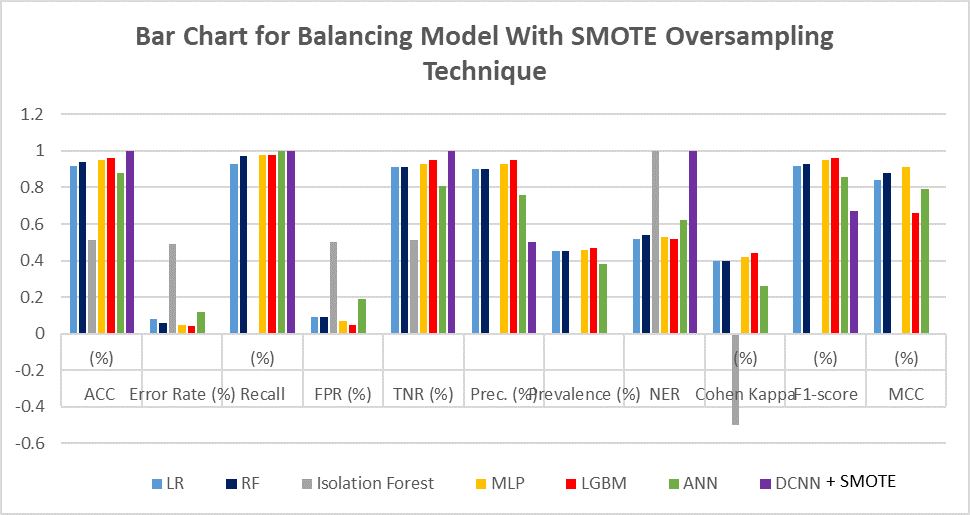
Fraudulent credit card transactions are committed by unauthorized individuals and organizations employing methods such as phishing and social engineering fraud tactics. Researchers propose several Machine Learning (ML) techniques to deter the challenges of credit card fraud. However, the ML approaches are endorsed with some challenges, which makes the detection of credit card fraud extremely difficult. This study proposes a Deep Convolutional Neural Network (DCNN) with Synthetic Minority Oversampling Techniques (SMOTE) as an ideal solution. Kaggle datasets with 284,807 records and 31 features were exploited. Implementation was performed on the Google Colab cloud-based platform, embedding a Jupyter notebook setting with Graphical Processing Units (GPUs). Two experiments were conducted; the first was probed to determine suitable models among baseline models: Logistic Regression (LR), Random Forest (RF), Isolation Forest, and a single Deep Learning (DL) model of Multiple Layer Perceptron (MLP). The baseline models yielded an overfitting accuracy score, with recall, specificity, precision, and F1-score all presenting 1.00% respectively. This outcome is not sufficient in establishing findings on imbalanced data distribution as it's biased. This led to the construction of a new ML model incorporating Light Gradient Boosting Machine (LGBM), with Artificial Neural Network (ANN) and the proposed DCNN+SMOTE for the second experimental phase alongside baseline models. Experimental results via simulation show the proposed DCNN+SMOTE yielded awesome superclass performance across the board, displaying 1.00% results respectively. Its Error Rate (ER) and Null Error Rate (NER) are 0.00% distinctly. Meanwhile, the False Positive Rate (FPR) yields a 0.001% result, lesser and better than the baseline models.
Published
How to Cite
Issue
Section
Copyright (c) 2024 L. G. Salaudeen, D. GABI, M. Garba, H. U. Suru

This work is licensed under a Creative Commons Attribution 4.0 International License.
How to Cite
Similar Articles
- Sunday Samuel Bako, Norhaslinda Ali, Jayanthi Arasan, Assessing model selection techniques for distributions use in hydrological extremes in the presence of trimming and subsampling , Journal of the Nigerian Society of Physical Sciences: Volume 6, Issue 4, November 2024
- Isah Charles Saidu, Musa Yusuf, Florence Chukwuemeka Nemariyi, Ayenopwa Comfort George, Indexing techniques and structured queries for relational databases management systems , Journal of the Nigerian Society of Physical Sciences: Volume 6, Issue 4, November 2024
- Majid Khan Bin Majahar Ali, Shahida Shahnawaz, An inverse physics-informed neural network (I-PINN) framework for parameter estimation in mixed convection and melting effects , Journal of the Nigerian Society of Physical Sciences: Volume 8, Issue 2, May 2026
- Ibrahim Adamu Mohammed, Majid Khan Majahar Ali, Sani Rabiu, Raja Aqib Shamim, Shahida Shahnawaz, Development and validation of hybrid drying kinetics models with finite element method integration for black paper in a v-groove solar dryer , Journal of the Nigerian Society of Physical Sciences: Volume 7, Issue 4, November 2025
- Emmanuel Gbenga Dada, Aishatu Ibrahim Birma, Abdulkarim Abbas Gora, Ensemble machine learning algorithm for cost-effective and timely detection of diabetes in Maiduguri, Borno State , Journal of the Nigerian Society of Physical Sciences: Volume 6, Issue 4, November 2024
- Charles Otobrise, Godwin Eferurhobo, Prediction of the acentric factor of some halogenated hydrocarbons via group contribution techniques , Journal of the Nigerian Society of Physical Sciences: Volume 6, Issue 4, November 2024
- Lek Ming Lim, Yang Lu, Ahmad Sufril Azlan Mohamed, Majid Khan Majahar Ali, Data safety prediction using YOLOv7+G3HN for traffic roads , Journal of the Nigerian Society of Physical Sciences: Volume 6, Issue 3, August 2024
- Daud Olaoluwa, Abdulhadi E. Abdulmalik, Taoreed A. Muraina, Sadisu Girigisu, Ayo F. Balogun, Dissolution of a Nigerian sourced Muscovite ore for use as an ingredient in paint production , Journal of the Nigerian Society of Physical Sciences: Volume 2, Issue 3, August 2020
- Olalekan Taofeek Wahab, Salaudeen Alaro Musa, AbdulAzeez Kayode Jimoh, Kazeem Adesina Dauda, Constructive approach and randomization of a two-parameter chaos system for securing data , Journal of the Nigerian Society of Physical Sciences: Volume 6, Issue 2, May 2024
- Santosh Kumar Upadhyay, Rajesh Prasad, Efficient-ViT B0Net: A high-performance light weight transformer for rice leaf disease recognition and classification , Journal of the Nigerian Society of Physical Sciences: Volume 7, Issue 4, November 2025
You may also start an advanced similarity search for this article.