Non-monochromatic laser assist scattering in thermal environment
Keywords:
Non-monochromatic laser fields, Differential cross section, Thermal environment, Electron-atom interactions, Quantum controlAbstract
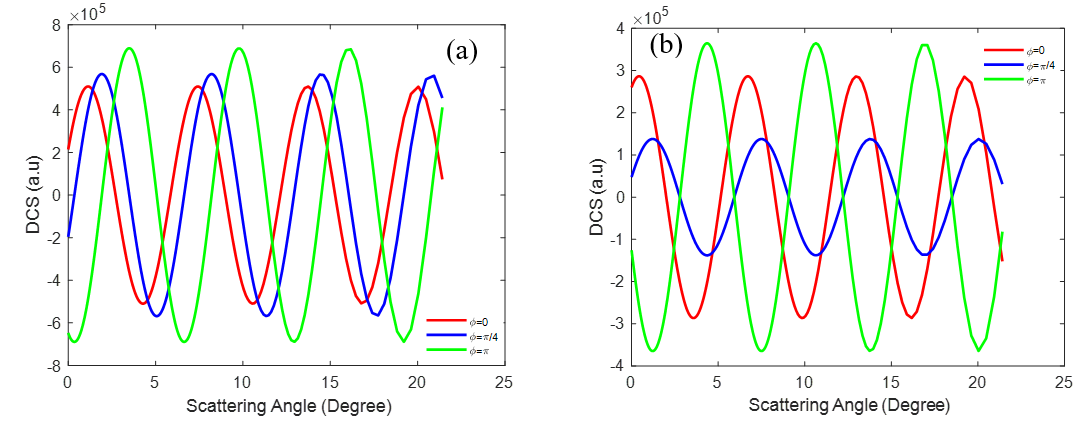
This study aims to investigate the differential cross-section (DCS) in a non-monochromatic laser-assisted thermal environment. Building on existing research, which primarily explores electron dynamics and ionization processes without considering thermal effects, this work seeks to bridge this research gap by examining the DCS under non-monochromatic laser fields in a thermal environment. The methodology involves utilizing a vector potential derived by Milosvic to represent non-monochromatic laser fields and applying a semi-classical approximation with the help of Volkov solutions. The S-matrix is then obtained to study the DCS. The developed model was computed to analyze the nature of the DCS. The results indicate that the DCS for photon absorption is higher than for emission due to atomic oscillation/excitation. This causes atom expansion upon absorption and a decrease in field strength during emission. Furthermore, the DCS behavior varies with the phase of the non-monochromatic wave and polarization, with distinct patterns observed for absorption and emission scenarios. The DCS with energy at different rates of absorption and emission exhibits a damping nature. Additionally, the DCS shows oscillatory behavior with separation distance, displaying higher values for absorption and varying with laser phase. The findings provide valuable insights into electron-atom interactions under laser fields in thermal conditions, with implications for quantum thermal machines, photochemistry, proton exchange membrane fuel cells (PEMFC), and more.
Published
How to Cite
Issue
Section
Copyright (c) 2024 Saddam Husain Dhobi, Kishori Yadav, ]{Suresh Prasad Gupta, Jeevan Joyti Nakarmi, Ajay Kumar Jha

This work is licensed under a Creative Commons Attribution 4.0 International License.
How to Cite
Similar Articles
- K. M. Omatolaa, A. D. Onojah, A. N. Amah, I. Ahemen, Synthesis and characterization of silica xerogel and aerogel from rice husk ash and pulverized beach sand via sol-gel route , Journal of the Nigerian Society of Physical Sciences: Volume 5, Issue 4, November 2023
- D. Eli, M. Y. Onimisi, S. Garba, R. U. Ugbe, J. A. Owolabi, O. O. Ige, G. J. Ibeh, A. O. Muhammed, Simulation and Optimization of Lead-Based Perovskite Solar Cells with Cuprous Oxide as a P-type Inorganic Layer , Journal of the Nigerian Society of Physical Sciences: Volume 1, Issue 2, May 2019
- Arezu Jahanshir, Jalil Naji, Relativistic correction on bottomia within the gaussian basis function method , Journal of the Nigerian Society of Physical Sciences: Volume 7, Issue 4, November 2025
- Opeyemi O. Enoch, Catherine O. Alakofa , Lukman O. Salaudeen , Odd Order Integrator with Two Complex Functions Control Parameters for Solving Systems of Initial Value Problems , Journal of the Nigerian Society of Physical Sciences: Volume 5, Issue 1, February 2023
- Dalal Khalid Almutairi, Mohamed A. Abdoon, Salih Yousuf Mohamed Salih, Shahinaz A.Elsamani, Fathelrhman EL Guma, Mohammed Berir, Modeling and Analysis of a Fractional Visceral Leishmaniosis with Caputo and Caputo–Fabrizio derivatives , Journal of the Nigerian Society of Physical Sciences: Volume 5, Issue 3, August 2023
- E. A. Nwaibeh, M. K. M. Ali, M. O. Adewole, The dynamics of hybrid-immune and immunodeficient susceptible individuals and the three stages of COVID-19 vaccination , Journal of the Nigerian Society of Physical Sciences: Volume 6, Issue 3, August 2024
- Lamees K. Alzaki, Hassan Kamil Jassim, Time-Fractional Differential Equations with an Approximate Solution , Journal of the Nigerian Society of Physical Sciences: Volume 4, Issue 3, August 2022
- G. R. Venkatakrishnan, R. Rengaraj, K. K. Sathish, R. K. Dinesh, T. Nishanth, Implementation of Modified Differential Evolution Algorithm for Hybrid Renewable Energy System , Journal of the Nigerian Society of Physical Sciences: Volume 3, Issue 3, August 2021
- G. Sudhaamsh Mohan Reddy, Existence and Ulam–Hyers stability of nonlinear fractional differential equations via enriched (g, alpha, beta, k)-functional contractions , Journal of the Nigerian Society of Physical Sciences: Volume 8, Issue 4, November 2026 (in progress)
- Bolarinwa Bolaji, B. I. Omede, U. B. Odionyenma, P. B. Ojih, Abdullahi A. Ibrahim, Modelling the transmission dynamics of Omicron variant of COVID-19 in densely populated city of Lagos in Nigeria , Journal of the Nigerian Society of Physical Sciences: Volume 5, Issue 2, May 2023
You may also start an advanced similarity search for this article.